The weirdness flows between us

32. Freak Scene – Dinosaur Jr.

We showed off to each other back then. Goofing around, throwing ridiculous shapes on the dance floor, conjuring ludicrous puns that, over time, became impenetrable in-jokes, and just enjoying each other. Not, you know, in that way. Okay, sometimes in that way, but mostly it was entirely rated PG stuff; occasional moments of mild peril and sexual references. As Supergrass would later put it: we were young, we were free, we kept our teeth nice and clean. It’s unsurprising that my self penned follow up – I am middle aged, I have responsibilities, I have ground my teeth down to such an extent that I displaced my jaw – has never troubled the charts.

We were 16, going on 17, and weren’t skipping around a summer house in Austria on the brink of war trying to impress a young Nazi boy. But we were interested in the sound of music (boom, and indeed, tish). Specifically we were all starting to share a love of what you might generally term indie music; some gravitating from an earlier goth phase, others from heavy metal (an odd mix of US hair metal and New Wave Of British Heavy Metal), and some feeling the benefit of older siblings passing down people like The Smiths. Irrespective of how we got there we all arrived at a place where a shared love of Nirvana, Pixies, Muses, Dinosaur Jr, Mudhoney, Sonic Youth, Teenage Fanclub, and a host of others became something that both defined us and soundtracked our late teens and early 20s.

We, of course, was me and my friends. A small but perfectly formed gang; smart, funny, at ease with each other, if not always with ourselves. I’m probably romanticising it across the years. I’m sure there were times we had terribly dull conversations and just sat around fretting about our A levels but that’s not how I remember it. In my head now it was all either hilarious, wise cracking bon mots or very earnest, deep discussion about matters of great import. We knew we weren’t the cool kids but convinced ourselves that, because we knew that, it actually made us the cool kids anyway. We were cool because we weren’t cool but we knew it. Make sense ? Not really but it did at the time. Looking back I think we were pretty cool. If I was 16 again I would want to be friends with us.

And I would want to spend my nights at the Kandi Klub. I imagine that every major city in the UK, around the late 80s and early 90s, had its own version of the Kandi Klub: what might loosely be described as an indie rock nightclub. Somewhere for the people who felt a bit out of place everywhere else to go and feel slightly less out of place together. Later in my life I frequented Rock City in Nottingham and Sector 5 in Leicester but the Kandi Klub in Bristol was the place I called home. It was our weekly stage (literally so if it was being held in the Thekla) and where we played out our friendship.

History hasn’t recorded what anyone else thought of those kids that turned up every week and spent their time alternating between dancing very seriously – shuffling feet, head down nodding, fringes falling over eyes – and then appearing to take the piss out of it all – the star jumps, the hands on hips head shaking, the watusi. If it had I’d like to think it would mention how much fun they were having. Was it fun in that slightly self absorbed way that only teenagers can really pull off ? Yeah it was but we were slightly self absorbed teenagers so…

There’s a long, long list of songs that I associate with those regular trips to the Kandi, whether it was ensconced at The Studio or The Bierkeller or The Thekla, but the one that was guaranteed to get me on to the slightly sticky dancefloor was “Freak Scene”. It was probably one of those songs that used to get slipped in fairly early in the night, before DJ George got into the bigger “hits” from people like Nirvana and The Wonderstuff. There were a bunch of songs that occupied that part of the night that I latched on to and still love: stuff like the Violent Femmes’ “Add It Up”, Buffalo Tom’s “Velvet Roof”, Sonic Youth’s “Kool Thing”, Pulp’s “Babies”, and probably a couple of Mudhoney tracks. As it was still early the dancefloor might be empty, or virtually empty, but we’d bounce out there regardless and throw ourselves into that aforementioned head down shuffle of a dance.

For the three and a half minutes of “Freak Scene” everything would fall away. There was the song, the sensation of moving, and that was it. Or almost it. I was self conscious enough, I expect, to be aware of the fact that I was dancing and always enjoyed the odd mixture of doing something that felt quite private in a public place* – it was effectively an outward expression of my internal relationship with the song. If you’d seen it you might, mistakenly, have seen it as a tall, spotty kid wearing a black tee shirt dotted with pieces of washing powder visibly picked out, shining, under the blue neon lights rather ponderously swishing his hair around. It wasn’t that. It was an outward expression of my internal relationship with the song. I admit some of that outward expression required that I slowly step from side to side and possibly clasp my hands behind my back. Don’t judge me.

You need places that feel like they’re yours when you’re that age, hovering uncertainly between being a child and an adult. Places and people. Territory that’s yours, where you’re free to work out who you might be. The Kandi Klub was part of my territory and if I had the chance to do it all again I’d be back there in a heartbeat with exactly the same people: my friends.


*this will be the only thing I did that “felt quite private in a public place” that I ‘fess up to here…

Take the long way, ‘cos I like the view

31. Take The Long Way – Po’ Girl

There’s a dull ache where my prostate should be and I’m sat in a car I don’t own, in the car park of an anonymous industrial estate on the outskirts of Milton Keynes, a town that seems to be comprised almost entirely of outskirts. I’m waiting for an all day meeting that I’d rather not attend; my expectations are for a painful few hours of corporate jockeying, career eyeing obfuscation and the uncomfortable small talk that only a group of people that really don’t know each other, despite spending every day together for the past three years, can muster. Look up inauspicious in the dictionary. There will be a picture of me in a Vauxhall Astra, eating a double bacon and egg McMuffin, on that industrial estate.

I had spent a good few minutes trying to manoeuvre the car between the white lines that had been marked out for parking. They’re set at an odd angle – perhaps 70 degrees – and are just marginally too narrow. As I’m first to arrive I can’t line up next to an already parked vehicle and, for reasons that now escape me, I had decided to reverse in. Trying to fit between the lines. As I repeatedly try to position the car this feels a lot like one of those free metaphors that life has been throwing at me of late.

I had not been looking forward to this day. Its purpose was for a small group of us to discuss team objectives, in the absence of a head of function, away from the office which, in the grand scheme of things, shouldn’t be cause for concern. Except I’ve been in this play before. Almost exactly twelve months ago: same meeting room in the same industrial shed with the same task to be performed under the same circumstances – no head of team, let’s sort things out. Only twelve months ago the casting was different and, specifically, I had been shunted from understudy to something approaching the lead role. Now I wasn’t even sure if I qualified as understudy.

That day a year ago had, briefly, felt like a fresh beginning. I’ve dealt with my redundancy elsewhere but this had been the point at which I felt like I’d found my way back to some kind of approximation of my previous job; my previous status I guess. I was sharing the responsibility for the running of the day, the running of the team, with someone else but it was close enough. I was back doing what I knew I could do, building a happy and productive insights team.

I was sufficiently emboldened that day to take a risk. The team were dealing with the departure of their “head of” – in retrospect maybe I was dealing with it more than they were, I’m not sure. It was someone I had a lot of respect for and was bitterly disappointed to see him depart and, again in retrospect, it surfaced a lot of memories about how I had left my previous job. So I decided to risk opening up to my colleagues, sharing what was supposed to be my own personal story of dealing with change. I stopped short of a full confessional, complete disclosure of my struggle with mental illness, but there was enough there for people to fill in the blanks. I guess it was intended to be a rallying cry, an illustration of how people can come through traumatic events and stay strong. There’s some irony. It was definitely intended as a show of strength: a sense of resolve and fortitude from what might, ostensibly, appear a place of weakness. It was about empathy and understanding and letting people know that there was someone there for them – my far less eloquent version of this “down in a hole” clip from The West Wing. If you believe the corporate text books it was intended as an overt piece of “authentic leadership”. It was definitely authentic.

And then it all went wrong. Not literally then (people didn’t start throwing things and booing – they may have wanted to…) but over the next couple of months. A series of ordinarily manageable events piling up to a point where they became unmanageable; like dropping enough pebbles onto a hillside until, eventually, it dislodged a boulder, and then the whole thing came tumbling down. Then we’re into panic attacks and adrenaline and cortisol and pills and counseling and all of that stuff.

So back in the car park, a year on, I have all of that in my head. Returning to work after my sabbatical has not been without its challenges, my subconscious seems keen to cling to the fact that I’m back in an environment where I melted down. It’s well intentioned with its occasional prompting – “hey, this is a bad place for you, I remember what happened, I’m going to stimulate some chemicals for you to encourage you to get the fuck out” – but not terribly helpful. I understand the theory of it all but unpicking it in practice – rewiring it – is hard. And this particular car park, outside of the particular meeting room I’m about to go into, is a major crime scene to revisit. If I wasn’t back on beta blockers I imagine I’d be accelerating hard back down the A5 right about now.

I have a playlist that I use for my commute to work. It is, imaginatively, called “car”. Admittedly that isn’t as strong as my Motown playlist – “Good Lordy, It’s Berry Gordy” – but on a par with most of my naming conventions (for example: “new” for, er, new stuff). It was on whilst I sat in the car thinking about the upcoming meeting, set as it usually was to play on shuffle. Sometimes life chucks you a rubbish metaphor about trying to park between the lines whilst you’re wondering where you fit in and sometimes it throws you a bone. Po’ Girl’s glorious reflection on enjoying life’s journey – because that’s the only point to it all – “Take The Long Way” shuffled its way on to the car stereo.

This song was always on the list for inclusion in the 42. I didn’t necessarily expect that this odd tale of mid life crisis would be my route into it but there it is. In some respects it might have been more obvious to pick a moment in my life that was so perfect that it stopped me in my tracks; a moment in which it’s almost easy to understand that this is a moment and that’s probably all that life is, a succession of moments. The sun setting over the ocean in Lanzarote. My wife appearing at the end of the aisle on our wedding day. Sitting holding my new born daughter in the hospital. First kiss. Playing live music. Sex. Any of those would be easy to isolate as moments in which it feels like you can express what life is about. But you don’t get that many of those. What you get are a few of those and, in between, long, long stretches of sitting in car parks – metaphorically, not literally. Unless, of course, you’re a car park attendant.

So it has to be on the list because I utterly adore it, I adore the melody, I adore the vaguely incongruous mix of country and folk and hip hop, but most of all I adore the sentiment. That reminder to be mindful, to savour experience – the journey and not the destination – and that life is not something you’re working towards, it’s something you’re doing. Right now. To steal wholesale from Annie Dillard: how we spend our days is how we spend our lives. All of that time sat in a car park, sat in a meeting room, is life.

It would be too neat and tidy if I told you that in that moment I understood everything I wanted to do with my life. If it was a film I’d have probably driven off, or better still, walked off, casually chucking the keys to a car that wasn’t mine over my shoulder. Maybe deliberately leaving the car parked across the lines first: you see what I did there ? But I don’t (sadly) live in an Aaron Sorkin drama and whilst walking off into a Milton Keynes sunrise might have been glorious for a while it would have been swiftly followed by a dawning realisation that I got responsibilities now.

It was enough, for now, that it reminded me to be present. It was enough that it got me back into that meeting room and got me through that meeting without gasping for air. Right now there are days when that is enough: that is a good day. That won’t always be enough because, how we spend our days and all that, but right now it is.

I would like to write about…

Anything that doesn’t contain the word “customer” or “segmentation” or “retail” or any of those myriad of corporate non-words that I regurgitate every day. That language that is never taught but which everyone in an office learns to speak. Going forwards. On the same page. Outside the box. Out of our comfort zone. All utter nonsense.

Going forwards, to really get out of my comfort zone, to fully step change my thinking out of the box, I’d like to actually write about:

  • A story of grief and escape, Emily’s story as she comes to terms with the loss of her father and finds expression through their shared love of country music. A wise, sad, funny coming of age story I’d like them to say. I’d settle for less.
  • A knockabout comedy loosely based on The Wizard of Oz; a girl named Dorothy moves to London from Australia, landing in an upstairs flat as the woman in the flat beneath dies. She would meet, and date, three men lacking in brain and heart and courage before setting her faith in someone else; he, of course, would prove to be a fraud. There probably wouldn’t be winged monkeys.
  • Six stories, interlocking, set in and around Marylebone station. The conceit being that each story would start as a train arrived at each of Marylebone’s six platforms. The centre piece involves a chance meeting of a man and woman who, through a plot device yet to be established, end up killing a substantial amount of time together exploring the streets in that part of town. I guess it would be about falling in love, an exploration of those first moments as strangers realise a deep set connection. There’s a risk that this doesn’t so much tread as trample on Richard Linklater’s toes – if you haven’t seen “Before Sunrise” then don’t watch it, you will never need know my inspiration.
  • Me. Perhaps in a way that comes off as slightly less narcissistic than just “me”. I would like to tell my story, how I made some bad choices and ended up with a career I didn’t really want. How my body parts ganged up on me over a period of a few years and decided to fail, one by one. How my mind, previously relied upon as a trusted ally, joined the rebellion. How my so called career careered out of control (puns are non negotiable) and I spent a glorious six months out, re-evaluating, reconnecting, not thinking too much. How, during that time, I saw llamas in Amersham and, in that oddly incongrous moment, saw my life as mildly absurd but potentially wonderful. How the appearance of something out of the ordinary could help me see that everything might be seen fresh as out of the ordinary: family, friends, the school run, cleaning the bathroom even. I would write that as the happy ending, as the lesson learned, and then I would write the epilogue; that life’s not as neat as that, that sometimes when you return to where you saw the llamas it’s now just sheep and no matter how much you tell yourself that just sheep can be out of the ordinary too, it’s hard. It’s ordinary. It’s just sheep. Undoubtedly I would write using other metaphors and other analogies. Hopefully some of them would be better than that one….

……

My writing classes began again last week and, as promised, I’ve scrapped the old labelling of those posts in the title – I’ve even given these posts their very own category. The piece above was actually the homework for next week – write for 5 minutes or so from “I would like to write about…” as a trigger.

The bulk of the class was spent on an exercise in “show, don’t tell” (none of which I appear to have used above) which was surprisingly hard; finding means to reveal character or what someone is feeling through their actions. None of it was remotely in a shape to be shared here… so I won’t.

At some point I should possibly assert some kind of copyright on this blog in the unlikely event that I write something a) good b) that is read, and c) gets stolen. Whilst I investigate how I do that then take this sentence as an assertion that the work herein (herein sounds suitably legal) is mine and please don’t duplicate it or share it without appropriate acknowledgement of the source (i.e. me).

One sentence at a time

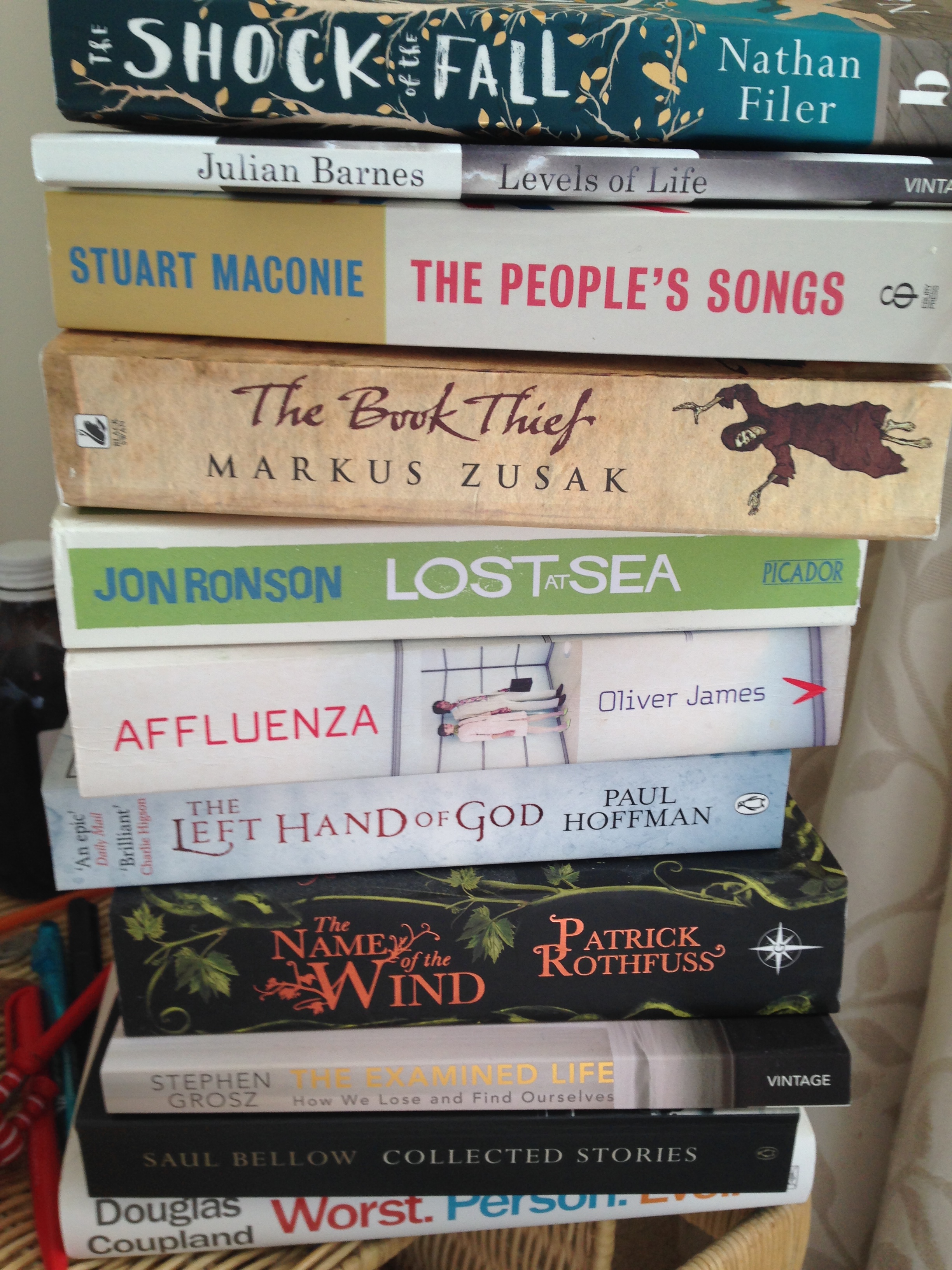
bookstack

Ever read something that makes you want to put down your pen, close the lid on your laptop, and never dare write another word ?

There’s sometimes a moment, a gut reaction, to something so perfectly crafted that makes me despair of ever getting close, when the gap between here and there yawns to a chasm. I had that reaction on reading John Williams’ “Stoner” last year, specifically during one transcendent scene in which the eponymous lead sits alone in his study, lost in the warmth of the room, gazing at the drifting snow outside. A few paragraphs in which nothing happens but written with such poise, such grace, that you inhabit that room and that character utterly. I had it again watching the opening scene of Aaron Sorkin’s “The Newsroom” last month, a deliberate piece of grandstanding, like the film that blows its entire special effects budget on the first scene or a band that opens their set with their biggest hit. Bold, funny, biting, true, ambitious, fiercely intelligent, and slightly sentimental: typical Sorkin then in many respects. I adore his writing and can only watch in slightly befuddled awe at where it comes from. Does he have that stuff on tap ?

I had it again this morning finishing up Nathan Filer’s “The Shock Of The Fall” which is astonishingly good; blackly funny and deeply sad. There it was, that first thought: I could never do that. He writes the bulk of the novel in a single voice and it is note perfect, a real person come to life across the pages of the book in your hands telling their story of death, and grief, and mental illness. Did I mention that it is also blackly funny ?

I have an idea for a story that deals in death and grief. Right now I feel exactly how I used to feel playing in bands at University, those terrible moments when various guitarists were all together in the same place, casually showing off to each other in their rehearsing: me pretending I was still tuning up so I didn’t have to play anything. I didn’t persist with the guitar, I still play (in so much as knowing a few chords is playing) but I never tried to really improve. I gave up. It didn’t matter to me as much as writing matters to me; it was something I wanted to do but not something that always felt like my best expression of myself. So what if you sometimes feel like the best expression of yourself, stacked up against other work, just isn’t that good ?

As that moment passes – that shit I might as well pack up and go home moment – I allow some different thoughts to take hold. Sometimes, I remember, a sentence comes out that isn’t half bad. That wasn’t one of them by the way. Sometimes I write something that makes me smile, or feels close to capturing what was in my head, or articulates an idea well, or tiptoes its way round being trite or hackneyed or clichéd. Sometimes I don’t serially abuse punctuation. Again, pretty much this whole paragraph doesn’t fall into that category…

Maybe the gap between here and there, between an idea and a book, is in having enough of those fragments – the ones that seem to come unforced, like someone else steals into your mind and places them there – and patching them together coherently, consistently ? You can’t play guitar like that, a single pure note amidst a blizzard of noise (although J Mascis may beg to differ), but perhaps you can write like that. No one ever need hear the noise.

The writing group I joined earlier this year reconvenes next week. I expect I will produce a lot of noise but perhaps, too, some pure notes. Looking forward to it. One sentence at a time.


Hard times come and hard times go

30. Wrecking Ball – Bruce Springsteen

“You’ll probably look back and think this was the best thing that ever happened to you”. If you ever find yourself talking to someone that has just lost their job, just been made redundant (what an appalling turn of phrase that is), then take it from me, don’t fall back on telling them that it might turn out to be a great thing. However well intentioned. Give them some time. Give them some empathy, some sympathy even, but don’t dismiss the awfulness of it in that sentence. Let them work through just how shit it is before you start up with the platitudes. And believe me it’s shit.

Just over three years ago I was about to leave the office late on a Friday afternoon. I knew my company was struggling – it would have been difficult not to know as I was responsible for understanding UK consumers, the market, and how we performed in that context. UK consumers were on the floor, the market had finally run out of technology innovation that had propped us up and kept customers spending, and even the weather had turned against us – the preceding Christmas wiped out in a flurry of snow. I also knew that something was going on. It was nearly the end of the financial year, which is often when these things happen, and I just had a sense that my time might be up. I’d been in the organisation for 13 years, part of the furniture, and was pretty well plugged in to all of the usual rumour, conjecture, and gossip that flies around a business. I wasn’t the only one that had suspicions.

I was due to be in Leeds the following Monday evening, invited to speak at a market research event, and so I stopped by my boss’ office to float the idea that I might just go directly up North rather than come in to the office. On reflection I think by this point that I already knew. I was just trying to fish for some kind of confirmation. He clearly didn’t want to give anything away. Presumably there had been some kind of agreement internally to “not spoil everyone’s weekend” and he was cagey. Eventually I somewhat bluntly asked him if I needed to be in the office on Monday morning. Yes, was the response. He knew what he’d just told me. I knew too.

Knowing is one thing but being directly confronted with it is another. It seems vaguely laughable now but there was a ridiculous mistake made over the weekend – the one that presumably was not to be spoiled. Meeting invites went out to various members of the Marketing team, ordered in a particular way (if you were near the end it was good, near the start was bad), on the Sunday, evidently with the intention that they’d be seen as everyone came in on Monday morning. Under normal circumstances we weren’t the type of employees that left our Blackberries alone all weekend, let alone in a time of heightened tension about our future prospects. So various of us saw the invites on the Sunday, saw the run of people summoned to the same room on the first floor, and drew our own conclusions.

I held it together until the Monday morning. I was in early as usual and one of the first people I saw was the new HR head, a woman that seemed to have expressly been brought in to do unpleasant work. She was well suited to it. There are lots of things, looking back, that I’d do differently if it all happened again. One of those things is that I wouldn’t have pleaded with her quite so desperately to tell me what was going on, only to be stone walled. I get why. I understand the professional obligation, the need to treat everyone the same, the requirement to protect the company’s interests and not say anything that might compromise the process. I get it but it’s utterly dehumanising. I wish I’d not said a single word to her. That stone walling, along with many other parts of what became “the process”, reduces you to the status of a line on a spreadsheet somewhere. You don’t really exist as a person anymore in the eyes of the organisation. You finally get to understand that age old Finance gag that directly rebuts HR’s “people are our greatest asset” line: people, on any balance sheet, will always be listed as a liability.

I didn’t have to wait very long for my meeting. It transpired that I wasn’t the only casualty in my team and so they needed to remove me first. To this day I deeply regret that the fate of the rest of my team was taken out of my hands, particularly as one of them was away on maternity leave at the time – but redundancy is no respecter of that. The ones that survived this cull all left within three months anyway; the writing was on the wall and I’m glad at least that I recruited and worked with people (great people) that had enough nous to bail out when they could. I don’t remember all of the details of the meeting; I just remember being very, very angry. In a bizarre way it almost helped that I didn’t particularly get on with my boss, it gave me a focal point for my rage and scorn. He didn’t necessarily deserve it, we were just different people, but that was where I directed all of my negative feelings.

The official line was that I was in a period of consultation – a month – as my role had been deemed redundant. That’s always the distinction: it’s the role, not you personally, that is redundant. The business doesn’t need that role anymore. It’s not a reflection on you. It’s not personal. Except, of course, it couldn’t be more fucking personal. The role doesn’t pay your mortgage. The role doesn’t give up its time and energy and emotionally invest in a place, in the people that work there, in the work that it does. The role doesn’t have to go out and find a new role: it’s redundant. You, of course, do. And you, of course, are inseparable from the role and are the one that is really now deemed redundant. Don’t ever let them tell you it’s not personal.

“Don’t go to Leeds”. I remember he said that. Told me – not unreasonably I guess – that I probably wasn’t in the right frame of mind to drive for three hours and deliver a presentation on engaging businesses with customer insight. At my very best I’m not good at being told to not do something. Sheer bloody minded stubbornness is not necessarily my most appealing character trait but there it is. I wasn’t anywhere near my best. “Don’t go to Leeds” was like a red rag being stuffed in my face and, in that moment, I would have crawled on my hands and knees through broken glass to sodding Leeds and delivered that presentation just to spite him, spite the company I’d given 13 years to, and to try and retain some sense of myself as a professional, employed, person.

I went to Leeds. Delivered a great presentation to the good folks of the Northern branch of the Market Research Society. Didn’t breathe a word of what had happened until afterwards when I couldn’t keep a lid on it anymore. I think they were a little surprised. I was exhausted. It had been a pretty draining day.

I was one of the lucky ones. That’s what I tend to tell myself now. The business I left folded a couple of years later, collapsing after a private equity buy out that, whilst difficult to prove, looks a lot like it was designed to close the business and walk away with a profit. Some people made money on a business that failed: none of those people were the ones that worked there. So I was lucky because I got paid off. I more or less walked straight into another job too. But I don’t remember feeling particularly lucky sobbing in the toilets at the office when it all got too much during that month of “consultation” or when I pretended to be working from home because I couldn’t tell our child carer what was going on or when colleagues I’d known for years – had worked directly for in some cases – couldn’t bring themselves to have any words for me. You find out who your friends are I guess. For every person that suddenly seemed unable to even look at me there was another who would take me out for lunch. For every process and policy demon in HR there was others who, in simple terms, put the human back into human resources (they know who they are). I was particularly touched by the generous spirit of my research agency network who, without exception, were wonderful at a time when there was genuinely nothing in it for them beyond being decent people – I couldn’t commission any work for them anymore.

About a year after I went through the redundancy Springsteen released “Wrecking Ball”, an angry riposte to the banking crisis induced recession and consequent human cost. Inevitably it’s the record I have co-opted as articulating my powerless anger about what happened to me and about the subsequent collapse of the business I worked so long for. It’s a big fuck-you of a record, especially the title track (the video at the start of this post); a giant musical middle finger extended to an abstract set of bankers who dealt in abstract trades that had anything but abstract repercussions. For me it’s more straightforward: you got rid of me, I’m not going to let it beat me.

I walked away – or more accurately was made to walk away – from my job with a decent chunk of money and didn’t need it to tide me over until I found another one. But there was a cost. My redundancy wasn’t the only thing that tipped me into depression 18 months later but it was undoubtedly one of the things. It was almost like a bereavement and I don’t think I’d worked it all through until I took my 6 month sabbatical some 30 odd months after the event. Some of it is still probably working its way through now. And, as I say, I was one of the lucky ones; I didn’t have to bear the financial cost as well as the emotional one. I have nothing but empathy and respect for all my former colleagues who had to deal with both.

So, no, even in retrospect I wouldn’t say that it turned out to be “the best thing that ever happened” although in a roundabout way it was one of the triggers that made me write again so perhaps, eventually, I’ll look back on it differently. For now it’s still a big old wrecking ball that clattered through my life and the dust from the damage that it caused is still settling.

I’m not like them but I can pretend

You will have your own opinion, no doubt, of Kurt Cobain. I’ve heard most of them before – the range running from “spokesman (or person as he would surely have preferred) for his generation” through to “junkie loser”. Now he seems to just be a face on a tee shirt, like Che Guevara is a face on a tee shirt, an icon or emblem of something (rock and roll ? suicide ? disaffected alienation ?) that’s disconnected from the person.

Twenty years ago today was probably the day he died, his body found three days later on April 8th, 1994. I was in my final year at University and heard the news as I lay in bed listening to the radio. I’m still not entirely sure why but it definitely affected me at the time; it was troubling and shocking and sad. In retrospect my “tribute”, which involved daubing his name on the back of a white football shirt for a 5-a-side tournament I was about to play in, doesn’t seem desperately respectful. But then, it was playful I guess, and perhaps he would have liked that.

I was first aware of Nirvana from my frequent visits to the Kandi Klub in Bristol in the late 80s and early 90s. I don’t remember it exactly but I imagine “Sliver” was probably my introductory point. They made a bigger impression at the Reading Festival in ’91 – about a month before “Teen Spirit” was released – playing a set in the middle of the afternoon that had the site buzzing for the rest of the weekend. Not, mind you, that any of us thought they were about to have a no.1 album in the States – they were just one of “our” bands that had played a great set. Mudhoney played an equally enjoyable set that day and some of the smart money was on them breaking through if anyone was going to.

After success happened Cobain never seemed to satisfactorily reconcile art and commerce for himself; desperate not to “sell out” on the one hand but making choices that left himself open to the charge on the other (major label, the production on “Nevermind”, the video for “Teen Spirit”). It’s frightening how much changed for the band in the space of a year. They were back at Reading in ’92 but this time as headliners amid wild speculation about the state of Cobain’s health (which he lampooned by being pushed out on stage in a wheelchair dressed in a surgical gown). Their performance was good – I don’t have many “I was there” stories but Nirvana at Reading ’91 and ’92 is one of them – but there’s more cynicism. It’s worth listening to and comparing the frenetic run through of “Teen Spirit” from the ’91 set (at about 9 mins in here) to the deliberately mangled take from ’92 (here) when Cobain, at least, was evidently pretty sick of playing that song. The nod to the Boston “More Than A Feeling” steal at the start is still pretty funny though.

It had felt like a victory when “Nevermind” broke, a validation if you felt like you were on the margins of mainstream culture. It’s okay, that victory said, it’s okay to feel a little lost and a little alone and a little like you don’t know what your life is going to be. It’s okay to be vulnerable. He was never a “spokesperson” for me or for anyone I knew but he was someone I could identify with, from the goofing around with his friends to the pain you heard every time he opened out that cracked and ragged voice to sing. And make no mistake, Cobain was a brilliant, brilliant singer if the point of singing is to articulate and express aspects of the human condition. Catharsis is usually the word that gets bandied around when people talk about his vocals; cathartic for us maybe but evidently in the end not for him.

So inevitably it felt like a defeat when he died. Not just died but took his own life (I don’t buy any of the conspiracy theories). He was living in a lot of pain by all accounts and trying to numb it with whatever he could; heroin and, ultimately, a shot gun. Here was one of the guys that had made you feel a little better about being on the outside and he’d not been able to cope. Maybe everything wasn’t going to be okay ?

I don’t, and won’t, glorify his death nor his drug taking but neither will I judge him by those acts alone. I admired his sense of humour, how he took his work seriously but not the stuff around it, his sense of melody married to noise, and the way that he could produce sounds with his voice that spoke to how I felt, even (especially) when I felt pretty dark. I wish he’d been free of pain, free of his mental demons, free to find a way to continue to make music, and free to be with his daughter. I will raise a cup of lemsip (I am currently sick – it seems fitting) in his honour today.

The way I will always remember him is splayed out amongst Dave Grohl’s drums at the end of that ’91 Reading set having launched himself into it as a finale. Kinda cool. Kinda stupid. But happy and alive. Not just a face on a tee shirt. He got up, gave us a grin and a wave, and was gone.

May you one day carry me home

29. Oh My Sweet Carolina – Ryan Adams

There was an incongruity to it, the contrast between the man shuffling on stage, unkempt hair, scruffy, and the surroundings. He almost looked lost, a tiny figure sat with his guitar, a piano to one side, accompanied by a cellist, dwarfed by the Royal Festival Hall with its capacity to house an orchestra; a vast open space purpose designed (not entirely successfully) to accommodate sound and music.

With scarcely a word or barely so much as a glance at us, the audience, he began to play, picking out the opening notes to “Oh My Sweet Carolina”. The expectant chatter that had broken into appreciative applause as he’d made his way on to the stage died instantly. There was a collective holding of breath as he began:

Well I went down to Houston and I stopped in San Antone
I passed up the station for the bus

Was trying to find me something but I wasn’t sure just what
Man I ended up with pockets full of dust

The words exhaled softly, quietly into the microphone, fingers methodically working the neck of his guitar. He seemed lost in it, oblivious to us, absorbed in some personal meditation on homesickness and another of those tales of a lost soul looking for a way back that country music does so well. We were lost in it too, the audience given over in a kind of reverie, astonishingly still and silent and rapt.

So I went on to Cleveland and I ended up insane
Bought a borrowed suit and learned to dance

I was spending money like the way it likes to rain
Man I ended up with pockets full of ‘caine

Just voice and guitar was holding us, the entire room transfixed. I’d seen him do this before, first time I saw him play was at the Lyric in Hammersmith, a pokey old theatre with maybe a hundred of us there. He’d been a little difficult that night, almost affectedly pulling open note books, propping them up on his music stand, puffing on endless cigarettes, ignoring the crowd despite the intimacy of the venue for the first half of the set. It was either someone extremely insecure, stumbling through stage fright, or someone desperate to project their cast iron credentials as an artist. Perhaps it was both. The set was largely made up of the songs from “Heartbreaker” which is such a bruisingly honest and raw record that I guess it might not be easy to lay yourself that bare on stage, particularly on such a small stage with nowhere to hide. Whatever it was something magical happened that night when he played “Come Pick Me Up” and he and us in the audience softly seemed to find some catharsis in its bitter lament to betrayal. It was the first- but not last – time that I thought he was absolutely the real deal.

Oh my sweet Carolina
What compels me to go ?

Oh my sweet disposition
May you one day carry me home

I’d seen the other Ryan Adams too, the rock n roll version. In those early stages post Whiskeytown, solo, it was as if he wanted to be Gram Parsons and The Rolling Stones at the same time; a one person embodiment of the Exile sessions both in terms of music and lifestyle. Just before “Gold” broke in the UK I saw him at Shepherd’s Bush Empire backed by a full band – a full band purpose built to replicate that early 70s Stones sound, or even a country leaning E Street Band. It wasn’t quite Dylan going electric but there was definitely a mixed reaction in the crowd – in particular the saxophonist divided opinion, filling in the harmonica parts from both “Heartbreaker” and “Gold” with horn. I loved it but then he was riffing on two reference points – in Springsteen and the Stones – that I adore so it was easy for me to hear it all as a straight extension of his country (or Americana if you insist) roots into R&B and rock and roll. For others it was apparently some kind of betrayal or sell out – the purity lost in chasing some notion of being a star. To me it just looked like he was going where his muse took him and having a ton of fun. By the close he had everyone pretty much back on side, closing with what became his famous cover of Wonderwall, which eventually even the song’s writer, Noel Gallagher, acknowledged was improved in Adams‘ reading of it. Again, I left, convinced of his genuine greatness.

I ain’t never been to Vegas but I gambled all my life
Building news print votes I raced in sewer mains
I was trying to find me something but I wasn’t sure just what
Funny how they say that some things never change

“Gold” and “Heartbreaker” were huge records for me in the early 00s as was, latterly, the two parts of “Love Is Hell” (another painfully beautiful record, so raw it’s practically an open wound). In particular “Gold”‘s lead track “New York New York” will always place me driving home, picking my way into West London from Hertfordshire, skirting Heathrow, on September 11th, 2001, anxiously and acutely aware of the eerily empty skies above me. It was chance, of course, that Adams had recorded an open love letter to the city that had become his adopted home, chance that repeated as the video for the track was recorded four days before 911: the entire film features Adams playing the song with the Manhattan skyline as his backdrop, the Twin Towers dominating every frame. It became a song of defiance and will always be lodged in my memory in association with that day alongside Springsteen’s “My City Of Ruins”.

Oh my sweet Carolina
What compels me to go
Oh my sweet disposition
May you one day carry me home

Back in the Festival Hall I am experiencing something akin to a religious awakening. I don’t think I’ve taken a breath since the song began, haven’t moved a muscle, as if changing anything – the slightest disruption – could shatter this fragile, delicate piece of music. It sounds like a direct expression of the deepest, saddest longing I’ve ever heard and he’s creating it right in front of me.

For me Adams never quite touched those early heights (or possibly depths) again but, in a way, I’m glad. His early work speaks of such overwhelming pain and unhappiness that I suspect the alternative path his life might have taken – alternative to continuing as a respected singer songwriter, settling down, cleaning up – would have been for his life to end. If there was a likely candidate to join “that stupid club” along with Kurt and Jeff and Jimi and Janis and Jim then he was it. I’m glad he didn’t and I still greatly enjoy his music. Perhaps it’s not quite as personal to me now as it was but he still has the capacity to floor me – witness the more recent performance of “Oh My Sweet Carolina” with Laura Marling filling in admirably for Emmylou Harris that you can find here. It is a fabulous thing indeed.

Up here in the city it feels like things are closing in
The sunset’s just my light bulb burning out
I miss Kentucky and I miss my family
All the sweetest winds they blow across the South

Memory is imperfect. Funnily enough one of the themes in writing this particular series of posts is that I believe that specific songs are strong anchors of a certain time and place, strong signifiers of what I was experiencing and feeling at the time. It’s possible to hear a recording of “Oh My Sweet Carolina” from that night in November 2002 at the Royal Festival Hall – you can stream it here if you’re so inclined or you can read closer-to-the-moment reviews of the gig here and here. It’s interesting how many details were wrong in my memory. In my first draft of this post he didn’t acknowledge the audience at all before playing – he actually directly spoke to us. I’d forgotten the cello completely. The song does play out to silence but it’s not quite as instant as the version in my mind (it’s still pretty impressive for a London audience who, often times as not, seem to love their own conversation as much as what is happening on stage).

The spirit of it is right though. The intensity of a moment in which he conjured something breathtakingly, heart achingly beautiful; a tender yearning for the safety of home. All delivered by the unassuming, slightly dishevelled man playing, stripped back and exposed, in that grand and imposing space.

Oh my sweet Carolina
What compels me to go
Oh my sweet disposition
May you one day carry me home


Everything is broken… phew, for a minute there I lost myself…

28. The Bends / OK Computer – Radiohead

Me and Radiohead go way back. We first met when they were supporting, believe it or not, The Cranberries at Leicester University who were touring off the back of “Linger”. I’d like to believe that I had my finger so firmly on the pulse that I was only there because I’d been tipped off about Radiohead but I suspect it was more that I went to pretty much every gig at the University that year. Sometimes this unearthed a gem (Maria McKee) and sometimes it didn’t (T’pau). In this case it did both. For avoidance of doubt The Cranberries were not the gem.

So the first time I heard “Creep” was at that gig. It’s impossible to recreate now as the song is too entrenched in memory but that first time that Jonny Greenwood’s guitar went into spasm, that stab of distortion into the chorus, was a real jaw dropper. It was visually arresting too, him hunched over his telecaster, slung low, face covered by his hair as it fell forwards, and then this twitching, violent slash over the strings and a burst of white noise erupting. The wannabe rock star in me took copious notes. The only thing I actually pulled off was the telecaster. Maybe the hair.

I also distinctly remember the first time I heard “Paranoid Android” I was stuck in traffic on the outskirts of Liverpool, making my way there for something related to my job at the time working for Boots – back in the days when radio got first play of a song. It’s still vivid for me because the song was astonishing on first listen: those snaking, sinewy verses, tense chorus that hints at some terrible future peril (in so much as it is a chorus) before the build into the off kilter solo and gorgeous break down into the defeated, resigned “rain down” section. It’s still astonishing now. Whisper it but it’s kind of a prog record although I don’t recall much of the cooler-than-thou indie press reporting it as such at the time.

Shortly after that I eagerly purchased “OK Computer” on its day of release – a Monday lunch time mooch around either HMV or Virgin (as was) or Selectadisc in the centre of Nottingham was very much my routine then. That evening I lay on my bed, put my headphones on, closed my eyes and listened to it straight through. It was an event. I sort of miss the days when a record release was an event for me. There was something almost ritualistic to it. The album didn’t disappoint and its over arching themes of a vague pre millennial anxiety and sense of displaced unease resonated strongly with me at the time; echoes of that sense still resonate strongly with me now.

The record sandwiched in the middle of all of this – post “Creep”, pre “OK Computer” – was “The Bends”. Released in 1995 it caught me post graduation, recently moved to Nottingham, trying to figure out what to do with myself. It also largely sound tracked the disintegration of two relationships that were important to me; both of which I can look back on now with fondness but these songs are forever attached to their messy ends. In many respects both records are associated with a time of unhappiness, or at least, a time of uncertainty. In that period I had no idea what I wanted to do (plus ca change…), was clinging on to the idea that old relationships might still work, and gradually became separated from most of my friends who were largely living (and living large) in London. I was scraping by in a job I didn’t really want, sharing a house with people I didn’t really know, and spending any money I did have on train fares to the big smoke. It’s not really a surprise that two albums, more or less book marking the beginning and end of this time in my life, that major in themes of alienation, listlessness, torpor, and a twitchy anxiety should have been so important to me. I probably should have spent three years sitting in a back corner of The Salutation reading Camus. I didn’t. I think I spent it sitting in one of the five homes I had during that time watching Star Trek: Deep Space Nine. It’s angst, Jim, but not as we know it.

In 1997 they headlined Glastonbury. I was, by that point, a regular festival goer and had enjoyed the previous few years in blazing sunshine at Reading, Glastonbury, and the short lived Phoenix festival near Stratford. Had enjoyed the sun so much that for Glasto ’97 a small group of us decided to arrive at the festival site on the Wednesday (it usually ran Friday to Sunday) to soak up the atmosphere, chill out, have a little mini holiday. It basically threw it down for five days, the site turned into a swamp, and we spent our time turning bin liners into makeshift rain coats: it was miserable. Somewhere in amongst the mud though Radiohead closed the Saturday night and it was possibly the finest live performance I’ve ever seen, certainly in the top three. There was an intensity to it, and in the reaction of the audience, that happens rarely and very rarely for me at an outdoor gig. There was a real buzz around the festival ahead of their performance as “OK Computer” was pretty well cemented as album of the year and it turned into one of those very special events, almost a shared communion, between audience and band. Quite a bit of it is on YouTube: here. Inevitably it doesn’t convey the atmosphere – the palpable electricity in the air – but there’s a sense of the intensity.

There’s a bit at 18.30 on that BBC clip which I remember clear as day when Thom Yorke asks for the stage lights to be turned on the crowd: somewhere in that heaving throng was a 25 year old me. I watched that headline set on my own. Surrounded by thousands of people, obviously, but alone. I was at Glastonbury with a bunch of friends but I deliberately took myself off to watch that performance by myself. I had a strong sense that it would be a deeply personal experience for me and, in some respects, an intensely sad experience. Sad might be the wrong word. It would be  – and was – a deeply emotional experience, a space where those songs would connect directly to feelings that were tucked away, hidden, and give them expression. It was a year or two characterized by loneliness and I knew that the songs that would make up their set would speak to that. I remember I wanted it to be a private experience – laughable as that seems in the churning throng – but I wonder now why I wanted it to be private. I wonder now whether I might not have been better off watching it with my friends, telling them I wasn’t happy, and sharing it all.

Within the next six months the relationship I was in was over, which was better for both us, I left my job in Nottingham, and started again in London.

……

That bit about “maybe” pulling off Jonny Greenwood’s look / hair. I didn’t. I was that skinny then though. Thems were the days…

Just Write: Week 8, 17th March – part 2

door

I opened the door and stepped inside. Shut it tight behind me. Shut all of it out.

The room was empty. Four grey, stone walls, with matching floor and ceiling. A single blue door facing me in the opposing wall, identical to the one I’d just shut behind me. I crossed the floor towards it.

I opened the door and stepped inside. Shut it tight behind me. Shut all of it out. Went further inside.

This room was also empty. Four grey, stone walls, with matching floor and ceiling. It was a little darker than the previous one, the only light pervading from the cracks around the door behind me, less light leaking through to this room than the one before. Otherwise it was a replica. A single blue door facing me in the opposing wall, identical to the one I’d just shut behind me. I crossed the floor towards it.

I opened the door and stepped inside. Shut it tight behind me. Shut all of it out. Went further inside. Further beyond reach.

The third room was empty. Four grey, stone walls, with matching floor and ceiling. The light was faint now, a pale glow describing a rectangle behind me, thin tendrils reaching into the room ahead. Enough to see that there was nothing to see except the familiar single blue door facing me in the opposing wall, identical to the one I’d just shut behind me. I crossed the floor towards it.

I opened the door and stepped inside. Shut it tight behind me. Shut all of it out. Went further inside. Further beyond reach and reason.

The fourth room – was it the fourth room – was empty. Four grey, stone walls, with matching floor and ceiling. It was quite dark now, the brief illumination as the door opened quickly fading. It didn’t matter as there was nothing to see, nothing here. Reflexively I crossed the floor towards where I know will be a single blue door in the opposing wall, identical to the one I’d just shut behind me.

I opened the door and stepped inside. Shut it tight behind me. Shut all of it out. Went further inside. Further beyond reach and reason. Was this far enough to be safe ? Or was this too far to come back ?

The next room, number five or six or seven, was also empty. Pitch dark and silent and empty. I had no reason to believe there was anything other than four grey, stone walls, with matching floor and ceiling. A single blue door in the opposing wall, identical to the one I’d just shut behind me, would be there if I was compelled to go further. This far in it was easy to lose orientation: was this further in or the way out ? If I wanted to get out could I find the way ? It is easy to find a way in here, there’s enough light to find a way in to the darkness, but so much harder to come out when the darkness has stolen the light. I hadn’t intended to come this far. A blue door in the opposing wall or is it the blue door in the original wall ?

I opened the door and stepped inside.

……

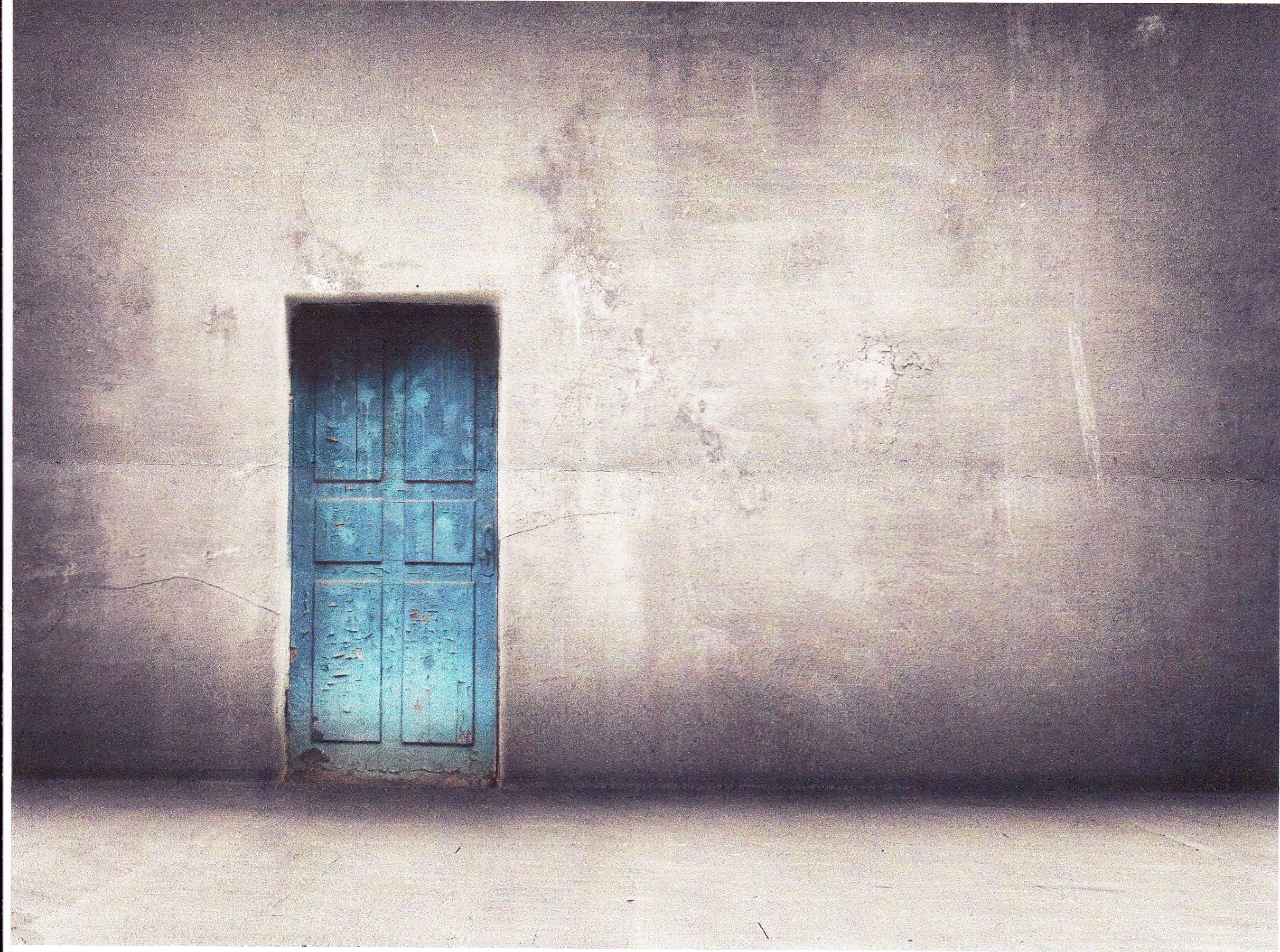
I have cheated a little here. This isn’t the piece that I wrote in Monday’s writing class but it is the piece that I wanted to write. I’ve posted it without rereading or editing so I may well look back at it and hate it but this was broadly what I wanted to write. The class revolved (pun possibly intended) around a set of pictures of doors – we had to pick one, make some initial notes of ideas it suggested to us, and then write a short piece.

I had a number of ideas but zeroed in on this door pretty much immediately and also knew pretty much immediately that what it suggested to me was a series of rooms that were all identical, repeating, with someone (me) disappearing further and further into them. It was a fairly straightforward metaphor for depression.

However, I wasn’t entirely sure I wanted to commit to that in the general bonhomie of the last-lesson-of-term and we only had about ten minutes… So instead I wrote a cheery piece on the idea of being tortured in some far flung prison, loosely inspired by Abu Ghraib. It’s not the sort of thing I’d usually write and I don’t think it’s that good to be honest but, I guess, that’s in part because my heart wasn’t really in it. Anyway, for posterity here it is (I would definitely lose the last line looking at it again):

Just before they shoved me inside the blindfold was ripped from my face. Harsh sunlight pierced my skull and I reflexively shut my eyes, the light playing across the inside of my lids even after they were closed.

A foot in the back of my knee forced me to kneel before I was urged back to my feet. I reached out my arm for purchase and grabbed at the door; a cool blue in a blank stone wall of grey. The door opened and I staggered in, managing two steps before sinking to my knees again. Adjusting to the relative gloom I blinked and glanced around, tried to take in where I was. It was a dark, square space, illuminated from behind me by the light streaming in through the door and ahead by a solitary bulb suspended from the ceiling. It hung above a simple metal chair in the middle of the stone floor. There was no other furniture save a large, deep sink on one wall, the tap dripping and with water pooling beneath from some rusted, leaking pipe. My eyes followed the shape of the pool as it edged into the room, finally reaching a carelessly tossed towel. The towel was stained red with something.

I was dragged back to my feet, weakly protesting, struggling in vain as they pulled me to the chair. Through the terror I realised the towel was stained with blood.

Just Write: Week 8, 17th March – part 1

I’m splitting week 8 (final week of this term, *sobs quietly and wonders what to do on a Monday night*) into two parts as per last week. Not in any way because I think it is going to drive a sudden explosion in page views – it didn’t last week – but because I think the posts are a little more digestible.

Homework from week 7 was to visit a place that you regularly walked past (or knew of) but never went into and then try to capture how that made you feel. I thought this one worked out quite well but I am rarely best placed to judge my own work… so let me know what you think:

I expected it to feel like the 1980s; a place out of time. Not the 1980s of gaudy excess, streamers on Top Of The Pops, city boys with braces, but the 80s that was still shaking off the dowdiness of the late 70s.

Wimpy. Didn’t they all close ? Weren’t they seen off by McDonalds and Burger King and the caffeinated tidal wave of coffee chains that have flooded UK high streets for the last ten years ? Yet here it is in Amersham. It’s not the most likely place I’d expected to see it – not that I expect to see them anywhere anymore. Wimpy is frozen in memory for me as an unspecified place along the A1 – one of those unassuming service stops at a place like Newark or Grantham before we got the quasi-theme parks every twenty miles along the motorway that we have now. It used to be a straight choice between stopping now or holding out until Doncaster where there might be a Little Chef. This was Little Chef before Heston tried to infuse it with a certain culinary scientific sophistication; Little Chef when the choice of pineapple ring or fried egg on top of your gammon was sophistication enough. Heston hasn’t come a-knocking for Wimpy. Nor Gordon. Not even Jamie it seems.

It does feel a little like the 80s. Pushing open the door and stepping inside is a bit like stepping back into childhood. This used to be a treat, before we were convinced that getting a burger in a poly urethane box was more of a treat than getting one on a plate. The décor evidently hasn’t changed for thirty years, fake formica topped tables and wooden chairs. The chairs have taken on an aged, distressed look that, ironically, would now see them right at home in the fashionable coffee come lifestyle emporium Harris & Hoole a few doors up. The back lit menu above the counter looks much as I remember it as a kid, excepting the “mozzarella melts”. I’m pretty sure we didn’t know what mozzarella was back then, back when Chicken Kiev was the height of exotica. 

Behind the counter a beautiful, vintage Conti coffee machine rises proudly, all reds and polished steel. It faces off against a similarly old Carpigiani ice cream maker – you’d ask for a Mr Whippy, not a Carpigiani. They’re both immaculate, spotless, and have clearly been well tended these last few decades. It’s hard to shake the nagging, slightly sad, feeling that they will remain immaculate now as much from lack of use as from care. Where does Wimpy belong in a world of Baskin Robbins and Costa and the we-all-live-in-a-Manhattan-loft boho chic of Harris & Hoole ? My daughter has never once asked to go into the Wimpy on Amersham high street. Why would she ? There are no “happy meals” – registered trademark – here although I remember many happy meals in them when I was young. And me ? I’ve lived here seven years and this is my first time in. I’m only here to do my homework – the very act of which is itself a nudge towards the nostalgia of childhood that the entire experience evokes – and to be honest the coffee’s not great and I’m getting too old to eat bacon and egg rolls that often in the morning. I certainly can’t blame anyone for preferring the pretense of a Manhattan loft lifestyle to an 80s British bedsit either – I prefer it, this is absolutely not a rose tinted look back at some glorious forgotten past. Would we all rather hang out in Central Perk with Rachel and Joey than in Sid’s Café with Del Boy and Rodney ? The evidence up and down the high streets of the land suggests that we would.

There is something wonderfully incongruous though about Amersham’s Wimpy. It makes no sense – the brand is essentially dead, the town’s demographics are all wrong and there’s tons of competition – but it’s still there clinging on. I doubt I’ll go in again but I like that it’s there, a mental shortcut to days when burgers on plates was a treat. To childhood.