Everything is broken… phew, for a minute there I lost myself…

28. The Bends / OK Computer – Radiohead

Me and Radiohead go way back. We first met when they were supporting, believe it or not, The Cranberries at Leicester University who were touring off the back of “Linger”. I’d like to believe that I had my finger so firmly on the pulse that I was only there because I’d been tipped off about Radiohead but I suspect it was more that I went to pretty much every gig at the University that year. Sometimes this unearthed a gem (Maria McKee) and sometimes it didn’t (T’pau). In this case it did both. For avoidance of doubt The Cranberries were not the gem.

So the first time I heard “Creep” was at that gig. It’s impossible to recreate now as the song is too entrenched in memory but that first time that Jonny Greenwood’s guitar went into spasm, that stab of distortion into the chorus, was a real jaw dropper. It was visually arresting too, him hunched over his telecaster, slung low, face covered by his hair as it fell forwards, and then this twitching, violent slash over the strings and a burst of white noise erupting. The wannabe rock star in me took copious notes. The only thing I actually pulled off was the telecaster. Maybe the hair.

I also distinctly remember the first time I heard “Paranoid Android” I was stuck in traffic on the outskirts of Liverpool, making my way there for something related to my job at the time working for Boots – back in the days when radio got first play of a song. It’s still vivid for me because the song was astonishing on first listen: those snaking, sinewy verses, tense chorus that hints at some terrible future peril (in so much as it is a chorus) before the build into the off kilter solo and gorgeous break down into the defeated, resigned “rain down” section. It’s still astonishing now. Whisper it but it’s kind of a prog record although I don’t recall much of the cooler-than-thou indie press reporting it as such at the time.

Shortly after that I eagerly purchased “OK Computer” on its day of release – a Monday lunch time mooch around either HMV or Virgin (as was) or Selectadisc in the centre of Nottingham was very much my routine then. That evening I lay on my bed, put my headphones on, closed my eyes and listened to it straight through. It was an event. I sort of miss the days when a record release was an event for me. There was something almost ritualistic to it. The album didn’t disappoint and its over arching themes of a vague pre millennial anxiety and sense of displaced unease resonated strongly with me at the time; echoes of that sense still resonate strongly with me now.

The record sandwiched in the middle of all of this – post “Creep”, pre “OK Computer” – was “The Bends”. Released in 1995 it caught me post graduation, recently moved to Nottingham, trying to figure out what to do with myself. It also largely sound tracked the disintegration of two relationships that were important to me; both of which I can look back on now with fondness but these songs are forever attached to their messy ends. In many respects both records are associated with a time of unhappiness, or at least, a time of uncertainty. In that period I had no idea what I wanted to do (plus ca change…), was clinging on to the idea that old relationships might still work, and gradually became separated from most of my friends who were largely living (and living large) in London. I was scraping by in a job I didn’t really want, sharing a house with people I didn’t really know, and spending any money I did have on train fares to the big smoke. It’s not really a surprise that two albums, more or less book marking the beginning and end of this time in my life, that major in themes of alienation, listlessness, torpor, and a twitchy anxiety should have been so important to me. I probably should have spent three years sitting in a back corner of The Salutation reading Camus. I didn’t. I think I spent it sitting in one of the five homes I had during that time watching Star Trek: Deep Space Nine. It’s angst, Jim, but not as we know it.

In 1997 they headlined Glastonbury. I was, by that point, a regular festival goer and had enjoyed the previous few years in blazing sunshine at Reading, Glastonbury, and the short lived Phoenix festival near Stratford. Had enjoyed the sun so much that for Glasto ’97 a small group of us decided to arrive at the festival site on the Wednesday (it usually ran Friday to Sunday) to soak up the atmosphere, chill out, have a little mini holiday. It basically threw it down for five days, the site turned into a swamp, and we spent our time turning bin liners into makeshift rain coats: it was miserable. Somewhere in amongst the mud though Radiohead closed the Saturday night and it was possibly the finest live performance I’ve ever seen, certainly in the top three. There was an intensity to it, and in the reaction of the audience, that happens rarely and very rarely for me at an outdoor gig. There was a real buzz around the festival ahead of their performance as “OK Computer” was pretty well cemented as album of the year and it turned into one of those very special events, almost a shared communion, between audience and band. Quite a bit of it is on YouTube: here. Inevitably it doesn’t convey the atmosphere – the palpable electricity in the air – but there’s a sense of the intensity.

There’s a bit at 18.30 on that BBC clip which I remember clear as day when Thom Yorke asks for the stage lights to be turned on the crowd: somewhere in that heaving throng was a 25 year old me. I watched that headline set on my own. Surrounded by thousands of people, obviously, but alone. I was at Glastonbury with a bunch of friends but I deliberately took myself off to watch that performance by myself. I had a strong sense that it would be a deeply personal experience for me and, in some respects, an intensely sad experience. Sad might be the wrong word. It would be  – and was – a deeply emotional experience, a space where those songs would connect directly to feelings that were tucked away, hidden, and give them expression. It was a year or two characterized by loneliness and I knew that the songs that would make up their set would speak to that. I remember I wanted it to be a private experience – laughable as that seems in the churning throng – but I wonder now why I wanted it to be private. I wonder now whether I might not have been better off watching it with my friends, telling them I wasn’t happy, and sharing it all.

Within the next six months the relationship I was in was over, which was better for both us, I left my job in Nottingham, and started again in London.

……

That bit about “maybe” pulling off Jonny Greenwood’s look / hair. I didn’t. I was that skinny then though. Thems were the days…
Just Write: Week 8, 17th March – part 2

door

I opened the door and stepped inside. Shut it tight behind me. Shut all of it out.

The room was empty. Four grey, stone walls, with matching floor and ceiling. A single blue door facing me in the opposing wall, identical to the one I’d just shut behind me. I crossed the floor towards it.

I opened the door and stepped inside. Shut it tight behind me. Shut all of it out. Went further inside.

This room was also empty. Four grey, stone walls, with matching floor and ceiling. It was a little darker than the previous one, the only light pervading from the cracks around the door behind me, less light leaking through to this room than the one before. Otherwise it was a replica. A single blue door facing me in the opposing wall, identical to the one I’d just shut behind me. I crossed the floor towards it.

I opened the door and stepped inside. Shut it tight behind me. Shut all of it out. Went further inside. Further beyond reach.

The third room was empty. Four grey, stone walls, with matching floor and ceiling. The light was faint now, a pale glow describing a rectangle behind me, thin tendrils reaching into the room ahead. Enough to see that there was nothing to see except the familiar single blue door facing me in the opposing wall, identical to the one I’d just shut behind me. I crossed the floor towards it.

I opened the door and stepped inside. Shut it tight behind me. Shut all of it out. Went further inside. Further beyond reach and reason.

The fourth room – was it the fourth room – was empty. Four grey, stone walls, with matching floor and ceiling. It was quite dark now, the brief illumination as the door opened quickly fading. It didn’t matter as there was nothing to see, nothing here. Reflexively I crossed the floor towards where I know will be a single blue door in the opposing wall, identical to the one I’d just shut behind me.

I opened the door and stepped inside. Shut it tight behind me. Shut all of it out. Went further inside. Further beyond reach and reason. Was this far enough to be safe ? Or was this too far to come back ?

The next room, number five or six or seven, was also empty. Pitch dark and silent and empty. I had no reason to believe there was anything other than four grey, stone walls, with matching floor and ceiling. A single blue door in the opposing wall, identical to the one I’d just shut behind me, would be there if I was compelled to go further. This far in it was easy to lose orientation: was this further in or the way out ? If I wanted to get out could I find the way ? It is easy to find a way in here, there’s enough light to find a way in to the darkness, but so much harder to come out when the darkness has stolen the light. I hadn’t intended to come this far. A blue door in the opposing wall or is it the blue door in the original wall ?

I opened the door and stepped inside.

……

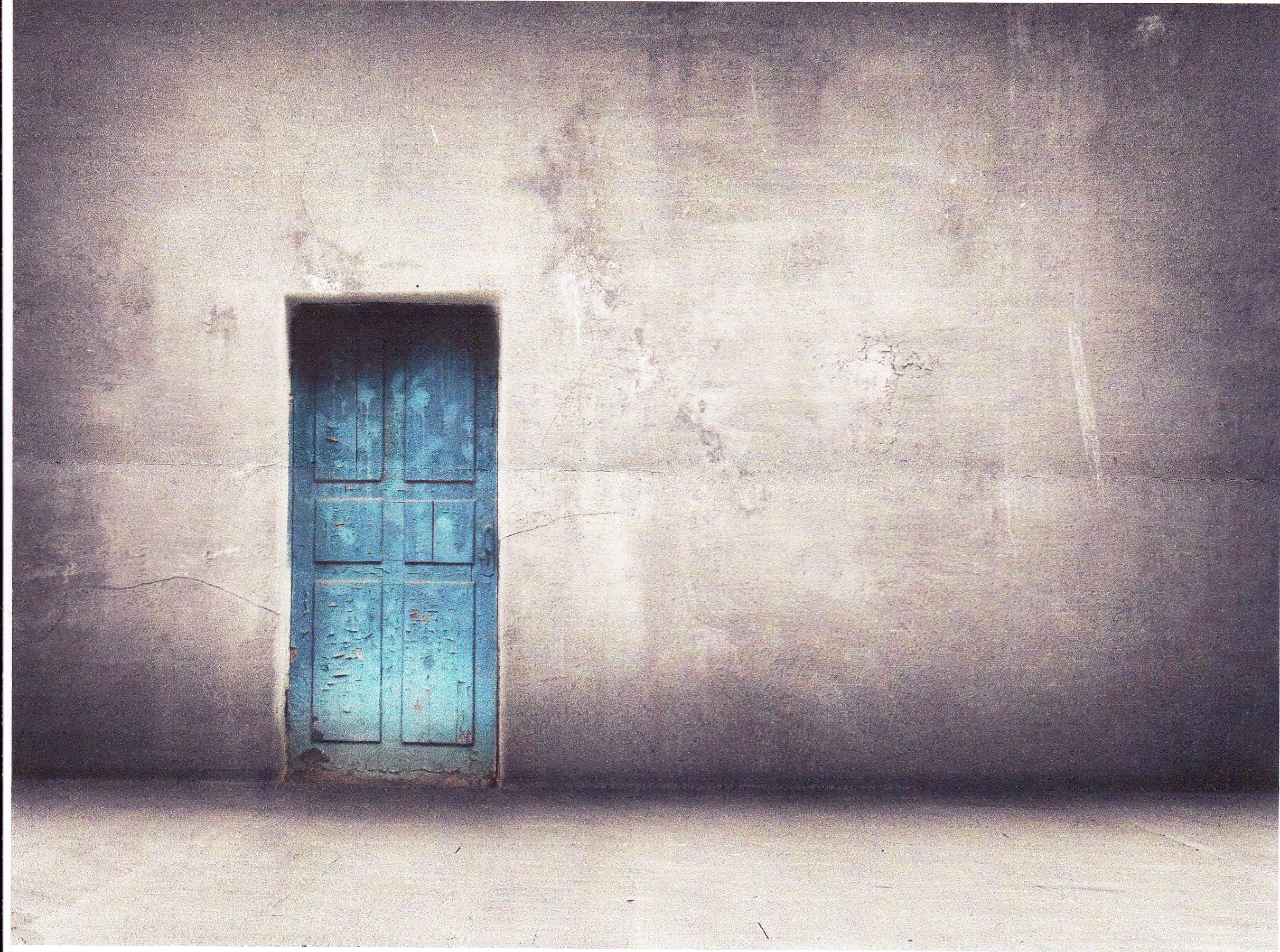
I have cheated a little here. This isn’t the piece that I wrote in Monday’s writing class but it is the piece that I wanted to write. I’ve posted it without rereading or editing so I may well look back at it and hate it but this was broadly what I wanted to write. The class revolved (pun possibly intended) around a set of pictures of doors – we had to pick one, make some initial notes of ideas it suggested to us, and then write a short piece.

I had a number of ideas but zeroed in on this door pretty much immediately and also knew pretty much immediately that what it suggested to me was a series of rooms that were all identical, repeating, with someone (me) disappearing further and further into them. It was a fairly straightforward metaphor for depression.

However, I wasn’t entirely sure I wanted to commit to that in the general bonhomie of the last-lesson-of-term and we only had about ten minutes… So instead I wrote a cheery piece on the idea of being tortured in some far flung prison, loosely inspired by Abu Ghraib. It’s not the sort of thing I’d usually write and I don’t think it’s that good to be honest but, I guess, that’s in part because my heart wasn’t really in it. Anyway, for posterity here it is (I would definitely lose the last line looking at it again):

Just before they shoved me inside the blindfold was ripped from my face. Harsh sunlight pierced my skull and I reflexively shut my eyes, the light playing across the inside of my lids even after they were closed.

A foot in the back of my knee forced me to kneel before I was urged back to my feet. I reached out my arm for purchase and grabbed at the door; a cool blue in a blank stone wall of grey. The door opened and I staggered in, managing two steps before sinking to my knees again. Adjusting to the relative gloom I blinked and glanced around, tried to take in where I was. It was a dark, square space, illuminated from behind me by the light streaming in through the door and ahead by a solitary bulb suspended from the ceiling. It hung above a simple metal chair in the middle of the stone floor. There was no other furniture save a large, deep sink on one wall, the tap dripping and with water pooling beneath from some rusted, leaking pipe. My eyes followed the shape of the pool as it edged into the room, finally reaching a carelessly tossed towel. The towel was stained red with something.

I was dragged back to my feet, weakly protesting, struggling in vain as they pulled me to the chair. Through the terror I realised the towel was stained with blood.

Just Write: Week 8, 17th March – part 1

I’m splitting week 8 (final week of this term, *sobs quietly and wonders what to do on a Monday night*) into two parts as per last week. Not in any way because I think it is going to drive a sudden explosion in page views – it didn’t last week – but because I think the posts are a little more digestible.

Homework from week 7 was to visit a place that you regularly walked past (or knew of) but never went into and then try to capture how that made you feel. I thought this one worked out quite well but I am rarely best placed to judge my own work… so let me know what you think:

I expected it to feel like the 1980s; a place out of time. Not the 1980s of gaudy excess, streamers on Top Of The Pops, city boys with braces, but the 80s that was still shaking off the dowdiness of the late 70s.

Wimpy. Didn’t they all close ? Weren’t they seen off by McDonalds and Burger King and the caffeinated tidal wave of coffee chains that have flooded UK high streets for the last ten years ? Yet here it is in Amersham. It’s not the most likely place I’d expected to see it – not that I expect to see them anywhere anymore. Wimpy is frozen in memory for me as an unspecified place along the A1 – one of those unassuming service stops at a place like Newark or Grantham before we got the quasi-theme parks every twenty miles along the motorway that we have now. It used to be a straight choice between stopping now or holding out until Doncaster where there might be a Little Chef. This was Little Chef before Heston tried to infuse it with a certain culinary scientific sophistication; Little Chef when the choice of pineapple ring or fried egg on top of your gammon was sophistication enough. Heston hasn’t come a-knocking for Wimpy. Nor Gordon. Not even Jamie it seems.

It does feel a little like the 80s. Pushing open the door and stepping inside is a bit like stepping back into childhood. This used to be a treat, before we were convinced that getting a burger in a poly urethane box was more of a treat than getting one on a plate. The décor evidently hasn’t changed for thirty years, fake formica topped tables and wooden chairs. The chairs have taken on an aged, distressed look that, ironically, would now see them right at home in the fashionable coffee come lifestyle emporium Harris & Hoole a few doors up. The back lit menu above the counter looks much as I remember it as a kid, excepting the “mozzarella melts”. I’m pretty sure we didn’t know what mozzarella was back then, back when Chicken Kiev was the height of exotica. 

Behind the counter a beautiful, vintage Conti coffee machine rises proudly, all reds and polished steel. It faces off against a similarly old Carpigiani ice cream maker – you’d ask for a Mr Whippy, not a Carpigiani. They’re both immaculate, spotless, and have clearly been well tended these last few decades. It’s hard to shake the nagging, slightly sad, feeling that they will remain immaculate now as much from lack of use as from care. Where does Wimpy belong in a world of Baskin Robbins and Costa and the we-all-live-in-a-Manhattan-loft boho chic of Harris & Hoole ? My daughter has never once asked to go into the Wimpy on Amersham high street. Why would she ? There are no “happy meals” – registered trademark – here although I remember many happy meals in them when I was young. And me ? I’ve lived here seven years and this is my first time in. I’m only here to do my homework – the very act of which is itself a nudge towards the nostalgia of childhood that the entire experience evokes – and to be honest the coffee’s not great and I’m getting too old to eat bacon and egg rolls that often in the morning. I certainly can’t blame anyone for preferring the pretense of a Manhattan loft lifestyle to an 80s British bedsit either – I prefer it, this is absolutely not a rose tinted look back at some glorious forgotten past. Would we all rather hang out in Central Perk with Rachel and Joey than in Sid’s Café with Del Boy and Rodney ? The evidence up and down the high streets of the land suggests that we would.

There is something wonderfully incongruous though about Amersham’s Wimpy. It makes no sense – the brand is essentially dead, the town’s demographics are all wrong and there’s tons of competition – but it’s still there clinging on. I doubt I’ll go in again but I like that it’s there, a mental shortcut to days when burgers on plates was a treat. To childhood.

Just Write: Week 7, 10th March – part 2

Week 7 of this term’s writing class pulled together a few of the themes from the last three or four weeks and focussed on one slightly larger exercise than usual. We all, without a huge amount of thought, came up with four potential characters – just name, age, and profession – which gave us a selection of about 30 to choose from. We picked two and then had to write three scenes – or, effectively, two scenes and a brief ending – with some direction.

First up was a scene in which the two characters are at either a wedding or funeral, second was the start of the overall story, and finally a few lines that suggested the ending of the story. We didn’t know about parts 2 and 3 before writing part 1 and, ultimately, we read back the work in chronological order (i.e. part 2 before part 1) rather than as written. I’ve reproduced here in the order it was written, however.

So I picked Joy, a 34 year old book shop owner, and Grace, a 21 year old student. This is what they got up to:

It was on occasions like this that Joy was given to rue her name. There was something toe curlingly embarrassing about introducing herself at a funeral:

“Hi, I’m Joy”.

There was no getting past it, no matter how sad she made her face, how remorseful her follow up words, there it was. “Joy”. On the least joyous occasion.

She was loitering near to the edge of the room, trying not to make eye contact with anyone, desperate to avoid an introduction. It was worse here – she’d barely known the guy, he just used to come into the shop pretty regularly. An avid comic reader she remembered. Thought it was graphic novels now she’d asked him once, you know “all grown up” she’d added with a smile. Apparently not. Comics, he’d declared, boldly reclaiming the word from her projections of childhood and the Beano and all that stuff. She’d barely known him but his wife had come to the shop, said it was his favourite place and asked her to come.

Just then she was startled away from her thoughts by a young woman entering the room just next to her. She’d somehow caught her foot on the small step on the way in and tumbled forwards, landing at Joy’s feet.

“God, are you alright ?” said Joy extending her hand, pulling the woman up.

“Yeah, yeah. How embarrassing !” said the woman.

“I’m…” Joy hesitated. “I’m Joy”. An apologetic smile.

“Thanks Joy, hi” said the woman, extending a hand. “I’m Grace.”

……

“No, no, no !” Grace exclaimed. “It just couldn’t happen.”

“It would !” retorted her uncle, turning back to the pile of comics on the table. “There’s precedent Grace.”

“Precedent ?” she snorted.

“Yeah ! There was that arc where the Marvel guys came in to the DC universe…”

“That was just money” she cut him off. “DC did it chasing sad old fan boys like you !” Her uncle cheerily winked at her. “Just money.”

“So you really don’t think Bruce Banner would team up with Bruce Wayne ?”

She rolled her eyes. She knew he was just teasing but they both loved these conversations, she wasn’t sure when they’d stumbled on a shared love of superheroes and the fantastic but it had kept them close now for a long time.

“Wayne’s a loner. Banner’s a loner. They work alone.” It was her final word. Almost her final word. “Besides, one argument and you’ve got the Hulk smashing up the Bat Cave and trashing all that hi tech gadgetry. Never gonna happen.”

Her uncle raised his hands in supplication, accepting defeat, and delighting in the act they’d created, each of them playing their part so well. Sometimes he thought it was all he had.

……

She found it tucked in his oldest pile of comics; she’d been leafing through, inhaling the dusty pages, remembering him. The pink piece of A4 fell out, a single name written in the middle under her birth date: Grace Jenkins.

The room flipped as she caught sight of her father’s name.

……

I enjoyed this exercise albeit I felt the results were a little mixed. I was pretty pleased with my first piece – okay the play on the character’s names is arguably a little trite but I thought it worked quite nicely. However, having made my characters meet in the funeral scene and, consequently, making it feel like the beginning of the story, I was then a little thrown by the instruction to make the second piece the actual start of the story. The outcome was that I pretty much jettisoned Joy altogether and it turned into Grace’s story and her, as it transpires, father (uncle). I didn’t intend that at the outset – it was making itself up as it went along.

Second scene works less well for me. I don’t know where the comic thing came from in the first scene and I kind of ran with it in the second. I’m not sure I’d stick with it if I was revisiting the piece overall. It was interesting though (to me) that I ended up with what was essentially a close father / daughter relationship that hints at some deep sadness to come – well, not really hints, he ends up dead. Fairly big hint. This is at the heart of the bigger story idea I have with the character of Emily from the last couple of weeks.

So, not an unmitigated disaster… but still not quite right in terms of the tone I’m looking for. Last week of term next week. Not long to get it right (fortunately there are more terms to come…).

Just Write: Week 7, 10th March – part 1

Another snappy title… but I haven’t thought of anything pithy to replace it yet. Next term, next term. It’s hardly as if this site is optimised for search anyway…

Have divided week 7 of the writing class into two as there was a fair amount of writing. Part one then covers the homework from last time; writing trigger was simply “No”, he said. Again we were supposed to write early in the week and edit later. Again there was a reasonable amount of the former and relatively little of the latter. I did, however, find that what I’d written fitted together with something else that I had from a few months ago and both pieces spend some more time with Emily, whom we met a couple of posts ago. She’s in there somewhere although I’m still not sure she’s coming out quite the way she is in my head. Anyway, feedback and comments very welcome as this may – may – be part of a bigger piece eventually. Here ’tis:

“No”, he said. He always said no and she’d almost given up asking.

“Come on Wil, why can’t we just try it ? It’s only one song.”

“We don’t play country music Em. I don’t know how many times we have to go through this. It’s not what we’re about.”

“It’s not country Wil” she half heartedly protested. “I’d say it’s more Americana.”

“Americana ?” he sneered back. “That’s what you have at Starbucks isn’t it ?”. He grinned smugly at his own joke and, not for the first time in recent months, Emily wanted to slap him.

“So what are we about then ?” she said instead, pretending to ignore his ridiculous pun.

The smile vanished from Wil’s face immediately; there was nothing he took more seriously than the band. Emily couldn’t decide if he was more annoying when he was trying to be funny or when he was deadly serious.

“Suburban alienation” he declared solemnly.

Emily strongly suspected that the most suburban alienation he’d ever experienced had been when the guy in Tesco Express had taken one look at his fake ID and refused to sell him a bottle of Strongbow but she played along.

“Alienation ?”

“Yeah, alienation. In the suburbs.”

“The suburban bit is important ?” she enquired, tilting her head, bemused. He mistook it for a doe eyed expression of puzzlement and genuine interest.

“Oh god yeah. It’s like everyone in this town is sleeping, not really alive. I don’t belong here Em, I belong in the city but I’m trapped. That’s why I had to start the band, to try to wake everyone up from their sad and cosy lives.”

In ten minutes he would actually belong in double chemistry but Emily resisted the temptation to remind him.

“I’m not destined for Leighton Buzzard” he finished, moodily staring into the middle distance.

“That’s what I’m talking about.” Emily decided to try one last time. “Let’s do a Whiskeytown song. It’s about escape. They’re all about escape those songs…”

“Did The Clash sing country ?” he asked

“I guess not” she sighed. “But they did embrace a lot of styles…”

“We’re not doing it Em. MK Ultra will never be some hillbilly country hick band”.

…… 

“Play something !”

The shout came from someone at the bar, a regular maybe. The crowd were impatient now, sensing that the band perhaps weren’t about to usher in “a rock and roll liberation from comfortable suburban mediocrity” as the posters outside the pub proclaimed. Emily looked out at the audience and wasn’t convinced that they wanted liberating anyway; there were only five people there and she had a sense that the only mediocrity on offer was currently being served up by the band.

“Play something !” hissed a voice to her left. It was Wil, singer and guitarist in MK Ultra. The name had been his idea (“MK Ultra, like the FBI mind control experiments, like extreme Milton Keynes”) but he’d even got that wrong, she thought, it was the CIA not the FBI. The posters had been his idea too – emblazoned with “wake up Milton Keynes” across the top above a picture of Che Guevera, that suburban mediocrity quote running across the bottom. Emily remembered him picking them up from a local printers (“they need to look professional”) and then helping him add the band’s name by hand; he’d forgotten to include it.

Wil was crouched on his haunches trying to untangle a broken string from his guitar. They’d been half way through a cover of the Manics’ “If You Tolerate This Then Your Children Will Be Next” which Wil had sarcastically dedicated to the educational establishment of the Greater Bucks area, before his top E string had snapped, bringing the song lurching to a halt.

“We can’t play anything” Emily hissed back. “What are we going to do with just bass and drums ?” She was the band’s reluctant bassist as Wil had insisted that she couldn’t play guitar and she had gone along with it, content to stay out of the spotlight. The five members of the audience had turned their attention back to the bar, a couple of them talking amongst themselves. One of them finished up his pint and began to pull on a coat.

“Come on Em, do something” muttered Wil, briefly looking up from his unsuccessful attempts to re-string. He looked desperate. Playing in Milton Keynes had been a big deal for him. Besides none of the pubs in Leighton Buzzard would let them play anymore.

“I only know country songs, remember ?”

Wil frowned but recognised that the tangle of guitar string that had now managed to wrap itself around his wrist was going to take a while to sort out.

“About escape, yeah ?”

“Yes”, she said, her heart suddenly accelerating. He gestured with his head towards his acoustic guitar propped up beside his amp.

“Just don’t introduce it, okay ?” he said. Then added, “or, if you do, then say it’s Americana.”

Walk tall… or baby don’t walk at all

27. Incident On 57th Street / Rosalita / New York City Serenade – Bruce Springsteen

I was recently tipped off by a friend that Springsteen was making most of his current run of shows available as official bootlegs for the princely sum of £6. Given that most of his current shows are running to three hours or more that’s a pretty fair deal. At a point in his career when he could be forgiven for slowing down, or even stopping following the deaths of Danny Federici and Clarence Clemons, Springsteen seems as alive, more alive maybe, than he has in the last twenty years. The loss of Federici and Clemons has prompted a shuffling of the E Street Band’s line up, its ranks swelling with the addition of a full horn complement, string section on many dates, and Tom Morello from Rage Against The Machine on guitar – as if Nils Lofgren, Steve Van Zandt, and Springsteen himself isn’t a stellar enough line up already. The current band is phenomenal. Of course, it always was.

The Brisbane show on the current tour features a complete run through of “The Wild, The Innocent & The E-Street Shuffle”, Springsteen’s second record, and the one that prefaced his eventual break through with “Born To Run”. I am a massive fan of that album and it contains my favourite run of three songs straight on any record: the whole of side two covering “Incident On 57th Street”, through “Rosalita” and finishing with “New York City Serenade”. None of the songs clocking in beneath seven minutes but none of them outstaying their welcome. Springsteen was never this – excuse the obvious lift – wild again, rushing headlong into a myriad of musical ideas, embracing styles, trying anything and everything (virtually all of it working). All he learned gigging the Jersey shore is here. All his influences sucked in – Dylan, Van Morrison, jazz, latin, R&B, gospel, straight up rock and roll – and spat back out across three songs that are almost heroic in their ambition and scope. There is more invention here than most artists achieve in their lives; Springsteen crammed it into twenty four minutes.

I adore “Wild, Innocent…” for its sheer hubris. It’s a young man’s record, before age and experience reins in some of its excess. Ten minute jazz rock work out ? Yeah, why shouldn’t I do that ? “West Side Story” ? I could reimagine that. If I’m going to serenade New York then why not nod back to Gershwin with a dramatic, classical piano intro ? All of this, eventually, was tightened up, compressed and finessed, onto the record that became “Born To Run”, every note worked and worked until it was perfect, but I don’t think he could have gotten there without stretching out on the sprawling “Wild, Innocent…” first.

So, for me, the Brisbane show is telling. A much older man revisiting a young man’s record and, arguably, his most diverse record musically. For the most part it’s a pretty straight run, not quite a direct recreation of the album but not far off (which, don’t get me wrong, takes some serious chops to pull off). Then, towards the end of “Incident On 57th Street”, Springsteen launches into the climactic solo and something magical happens. It begins in very similar style to the record but then he finds a gorgeous new sequence, a series of intricate, melodic runs that aren’t there in 1973. It’s a really small moment but it lifts the whole run through of the album for me, beautiful evidence that his creative spark is still firing forty years later. Not for the first time he moved me to tears – happy tears – when I heard it. It’s like a thirty second salvo against fading away into old age, not just because technically and physically it’s a pretty astonishing piece to play, but because he’s still finding new things and creating new moments.

It’s a measure of my love and admiration for Springsteen that I believe I could run a list of songs, in parallel to this one, filled entirely with 42 of his records. Perhaps that’s an idea for another time. He deals in songs of joy, songs of pain, songs that demand you get up and dance, songs that ask you to sit down and reflect. There’s shade and light and tears and smiles. Fear, hope, truth, anger, remorse. And redemption. Almost always redemption.

In short all human experience and life is here. All of my life is here. It’s no accident that last year Springsteen inspired a documentary film – “Springsteen & I” – which specifically deals with people’s – his fans’ – relationship to his music. If his music touches you (and I accept that he’s an artist that doesn’t resonate for everyone) then he connects in a way unlike anyone else currently working, arguably ever working, in rock music. I use “rock” music as lazy shorthand for the eclectic stew of rock, pop, jazz, latin, soul, folk, country, blues, hell-pretty-much-whatever, that characterises his songs over the past forty or so years. I’d originally written some of this post immediately after the Dylan one (here) as there’s common ground between the two and Dylan was a hugely important influence on Springsteen. I buy the argument that without Dylan there would be no Springsteen, certainly not as we know him, but I don’t buy the argument that Dylan is the greater artist (in so much as I buy that any artist is “greater” than another, it’s not really a competition). The fundamental difference between them I think is that Dylan has no interest in being understood whereas everything Springsteen does is about making a connection, about finding a way for the themes in his songs to be recognised.

So here’s what I take from those three songs now: the willful naivety of youth and its capacity to get stuff done, just for the sheer pleasure of doing it, and the fact that age and experience needn’t deaden that capacity. Play them and walk tall.

……

This post ended up being a little light on Rosalita – officially the most fun you can have listening to a song ever – and New York City Serenade. I doubt I’d do them justice so here’s some links to just go listen to them:

Roaslita from 1978 (I think it’s ’78 anyway)

New York City Serenade from 2013

Just Write: Week 6, 3rd March

It has just struck me, on week 6 of reporting back on my Monday night writing adventures, that perhaps the title of each of these posts is possibly not the most exciting hook…. Bit late now. Will look to rectify when I get to term 2.

This week’s class was broadly a build on the previous two in that it looked at characters, through the lens of archetypes, and dialogue. However, before we get into that here’s my homework from the previous week. With just “Yes”, she said as a trigger we were supposed to write a short piece early in the week and then return to it later in the week and edit. I found the former far easier than the latter – to the extent that I ended up writing two pieces. Voila:

The “fun” one (names changed to protect the innocent):

“Yes”, she said. 

“Ah… god, sorry. I didn’t realise”. So it did only open one way.

We looked at each other, me attempting an expression that wrapped up innocent ignorance, profuse apology, and a cautious smile to suggest that we-might-as-well-see-the-funny-side-eh ? I caught the look on her face, not so thinly veiled rage and exasperation, and rapidly dialed down my cautious smile. Aimed for even more apology. It was difficult to rein it in though and it was threatening to escalate from a cheerful smile into a mischievous smirk. All the more so as the torrential rain was now literally dripping off her face. Abruptly I realised I was standing there under an umbrella. This seemed somewhat un gallant in the circumstances, almost as if I was rubbing it in, and I half heartedly offered up its protective canopy to a now sodden Laura.

“Fucking hell”, she half sighed, half seethed. “I’ll have to go all the way round now”. I decided against asking her to mind the language in front of my daughter. Seemed churlish.

“Sorry Laura, I didn’t realise this gate only opened from the inside. I’m so sorry”.

“Well now you do” she said. “Of course it does, it’s a school gate. They generally don’t want people getting in”.

“I saw you running over…” I started before it occurred to me that this wasn’t likely to make things better. I paused but it was too late. She looked at me, an eyebrow raised in question. Quite a wet eyebrow.

“You saw me running ?”

“Er, yeah. I saw you running towards us, waving, but I couldn’t make out what you were calling…” It was the best I could manage.

“I think it was ‘hold the gate’” she said.

“Yes I suppose it probably was” I replied. “But I didn’t quite catch it and so I pulled the gate shut behind me.” Another unhelpful thought popped into my mind and before I could resist it I added, “It’s a school gate. You don’t want people getting in”.

With that, and perhaps now accepting that the back gate wasn’t going to open any time soon, she let out a final, exasperated noise – if the girls had been studying it phonetically it would probably have been “uurgghh” – and ran off back towards the front of the school.

“Katy’s mummy didn’t seem very happy daddy” said a small voice below me.

“No Nevie, she didn’t, did she ?”

“Was it because you shut the gate ?”

“I think so Nevie”

“And she got really wet ?”

“Yes Neve”

“She was absolutely soaking” she declared and after thinking for a moment she added, “And it was your fault really wasn’t it daddy ?”

I didn’t answer but instead turned my attention to getting us across the road to the car park and out of the downpour. As quickly as I could I strapped Neve into her seat, jumped into the front and pulled the car out onto the street. As we sat at the junction back on to the main road, waiting for a gap in the traffic so that we could make our way home, we both caught sight of Laura, now with Katy in tow, making their way back to to the car park. Katy, coat hood up, cheerfully waved at Neve. Laura, without coat, hood, or umbrella, did not.

“Daddy ? Would it be okay if Katy came round for a playdate soon ?”

“Let’s see Neve. Let’s see….”

……

The “sad” one (entirely fictional):

“Yes”, she said.

Later she realised she hadn’t really understood what she was saying yes to but everything had seemed to happen so quickly. Mum had asked her over and over:

“Are you sure you want to come ?”

She’d asked it gently at first but increasingly she’d pushed the question.

“Everyone will understand if you don’t. Are you sure Em ? Are you sure you’ll deal with it okay ?”

Later she realised that Mum had been looking for her own way out. Maybe she was trying to protect her or maybe she was trying to protect herself. Anything but face up to the reality.

“Of course I’ll be there Mum”. Quietly but firmly.

“It’s such a lot to deal with….” Her Mum held her gaze for a moment before looking back at the floor. In half a murmur adding: “You shouldn’t have to…”

Emily watched her mother, neither of them speaking for a few minutes. She noticed how tired she looked, eyes drawn, bags swelling beneath her lids. It struck her that her mum had looked like this for a while, not just since it had happened but before that as well. She just hadn’t noticed it before. It struck her that she hadn’t noticed anything. Tears rose in her eyes and fell silently down her cheeks at the realisation.

“Em ?”

Emily shook her head and closed her eyes, drawing her knees up to her chest and pulling herself into a ball. She shook her head to deny the tears but they fell anyway. The tighter she pulled on her legs, the smaller she tried to make herself, the more they fell; as if they were being squeezed forcibly from her.

“Em… Em….”

Her mother reached for her, wrapping her arms around her coiled frame. It was awkward at first, all there was to embrace were elbows and knees, sharp points of protection for the softly convulsing person within. Slowly though jagged bone gave way and her daughter allowed her to get close, returning the embrace, laying her sobbing head across her chest.

They sat like that until they both stopped crying. Emily’s mother gently took her daughter’s face between her hands and lifted her head up towards her own. Their foreheads nodded, touched and they rested there face to face.

“Your Dad…”

“Don’t Mum… Don’t…”

“Your Dad would have wanted you there Em, you know that ?”

Emily bit her lip and mutely nodded her assent.

“But it will be hard. It will be really hard. No one will blame you if you don’t think you can go. I won’t blame you.”

“I can’t believe… I can’t believe he’s gone”

Her Mum didn’t respond.

“I just can’t believe he’s gone Mum”

Later, when she’d learned all of it, she realised quite how difficult that moment must have been for her mother but understanding it didn’t make it any easier to forgive her. In that darkest moment she hadn’t realised that she wasn’t offered the truth and that the truth was darker still.

“Are you sure you want to come to the funeral, Em ?”

“Yes”, she said.

……

As mentioned earlier I found the editing (in so much as I did any) quite difficult. I have a load of notes for the second piece in particular which largely say things like “this bit needs work” or “change this bit”. I’m not entirely sure but I suspect that isn’t all that a decent editor does, is it ? Overall I was reasonably happy with both pieces. The tone in the first one is more natural for me and may form part of a series of (mis) adventures based around my six months off work whereas the second one was tougher. However, the second one is broadly a scene – or the beginnings of a scene – from a much longer idea for a story that I’ve had for a while. I hesitate to bandy the word novel around but it would be a story of that sort of length…

In that spirit the piece I ended up writing in the class, following some discussion about archetypes, was based on the same character as the homework – Emily, a teenager struggling to find herself following the death of her father, eventually finding expression through their shared love of country music (which, in itself, makes her something of an outsider in the UK). As luck would have it the archetype I picked out of a hat in the class was “troubled teenager” and the similarly randomly plucked situation for that archetype was “unexpectedly meeting someone whom they thought had died”. The result:

She turned the key in the lock and pushed open the door, reflexively looking at the matt for that day’s post. She barely had time to register that there was a neat pile of letters stacked on the table in the hall, not carelessly scattered across the floor, before she heard the sound.

Three chords softly strummed on an acoustic guitar, echoing up the hallway. Echoing out from the study: from Dad’s study. The same three chords rang in her ears as she walked cautiously towards the study door. It was that Tom Petty song he’d tried to teach her. F. F minor. C. Was that it ? Free falling. He’d loved it, said it was about him – something she’d never really understood until afterwards. Her friends had always teased her about it: “Got your cowboy hat Em ?”. She’d gone with it after a while and told herself that they were right. No one her age listened to that stuff; it was music for old men. Sad old men that left.

She pushed the door and stood in its frame and the playing stopped. A figure she knew, a face that she knew burned in her brain, looked up and smiled.

“Em…” he started.

“Dad ?” was all she managed before the room swam and she fell to the floor, that ghost was the last thing she saw before she fainted.

……

This was odd in the sense that, in the bigger story I have in my head, this scene doesn’t exist – he is definitely dead and definitely doesn’t come back. However, I was quite happy with it, particularly the internal dialogue bits towards the end which start to reveal a bit of Emily and what she’s been through. I may stay with her for a while, kinda irrespective of whether I think the scene is in my story or not, and see what she does…

The eagle eyed and musical amongst you will note that Tom Petty’s Free Fallin’ does not go F, F minor, C but I couldn’t remember what the chord instead of F minor was… and nor could Emily so it was okay ! That song was never really in my head in relation to this story either but popped in during the class. It’s not a perfect fit for the story I have in mind but works well enough if you squint a bit (dial up the i’m gonna leave this world for a while section)… As I’m good to you here it is in all its glory:

Just Write: Week 5, 24th February

Writing classes resumed after a week’s absence for half term with a focus on dialogue. If nothing else in the past few days it has made me appreciate that the placement of the “” speech-mark on a Mac is one of the few things that’s less intuitive than the standard keyboard position above the 2 found on most laptops. I digress.

Homework had been something of a spying mission; to eavesdrop on some real life dialogue, transcribe it, and note down what struck you in terms of its flow and tone. In a triumph for technology over ethics I achieved this by using the voice recorder on my phone and picked apart a brief piece of conversation that I recorded and, I should add, subsequently deleted. I won’t transcribe it here: it’s not something that I’ve actually written and was done only for the purposes of listening to how people really talk.

A number of (I guess, obvious) things were striking to me. Firstly, the extent to which conversation just doesn’t follow any readily accepted written convention – it really isn’t a series of “turns” by its participants. People interject and interrupt, brief sub conversations start up and die, people get off track, come back to the point, lose it again. Secondly, quite a bit of it is pretty dull. Some of this might be as straightforward as people playing through a set of social conventions (“hello, how are you ?” etc.) and some of it might be just, you know, that all of us have our fair share of moments being dull. Every single sentence that comes out isn’t a pithy one liner worthy of Dorothy Parker or Clive James or <insert your own favourite wit here>. Finally, pace was quite interesting to me as the cadences of people’s speech change dependant on a variety of things, from what they’re talking about to how likely it is they think they’re about to be interrupted, to the emotion they’re trying to convey. That’s a tricky thing to capture within written dialogue itself – without clues that might come off as clunky (she said slowly…).

The exercise didn’t entirely disabuse me of the notion that I like quite stylised speech in books and films; I don’t necessarily want fictional people to talk like real people, I want real people to aspire to talk like fictional ones. I guess the important thing is to try to write dialogue that reveals character. This struck me more as I took on some additional, self administered homework and picked out some random pieces of dialogue from work that I admire – specifically Ken Kesey’s “One Flew Over The Cuckoo’s Nest” (if pushed, my favourite book), Armistead Maupin’s “Tales Of The City”, and Douglas Coupland’s “Generation X”. I’ve included the snippets as an appendix at the bottom of this piece – no copyright infringement intended and all that.

Whilst stylistically very different it was telling in all of them that, even taken out of context, you got some sense of the character that was speaking – it gave you something to go on whether it’s Michael’s faux melodrama, McMurphy’s glee and mischief, or the Gen X’ers self involvement (pot, kettle, black – I know but technically I am a Gen Xer). The voices are distinct.

The main exercise in the class wasn’t so far removed from my extra curricular work. We were given a randomly assigned line of dialogue from a book and had to work it in to our own free written (i.e. ten to fifteen minutes, whatever comes) piece, ideally with a focus on a conversation. It turned out that I knew the book that my line was from – still not sure whether this was a good or bad thing – and once that was in my head it was difficult not to reference it in some way. So, here it is, with apologies to a couple of old school friends whose names I shamelessly plundered in this piece:

“Three pints ? said Arthur”

“At lunchtime ?”

John sat bolt upright in the bed as he called back the line.

“Let’s not do that”.

“Why not hoopy froods ?” asked Dan.

“We did it last week, remember ?”

“Did we ?”

“Yeah, Willsy was passing that paper round in the back of Latin. Hobbo never suspected a thing.”

“How far’d it get ?” asked a now interested Dan.

“Vogon poetry I think. Definitely past the towels but then Jenkins cam in about that Maths thing for half term and I think he knew we were up to something.”

“God, Jenkins… There’s a guy that doesn’t know where his towel is.”

“What do you want to do then ?”

“Is this a cheese shop ?”

“No ! Not again” all of them said in unison.

“What have the Romans ever done for us ?”

“No, seriously, no Python.”

“Ever wonder why girls never talk to any of us ?”

“It’s a mystery my friend, a mystery….”

Looking at it now it didn’t quite do what I wanted – I had a fairly specific memory of some sort of school trip and a group of lads working their way through a Python recital. It’s in that spirit and some of that comes through but it needs a little more flesh to strictly qualify as prose I think. It’s pretty bare boned at the moment. I also appear to have misremembered the cheese shop sketch as I don’t think the words “is this a cheese shop” are actually in it. The fifteen year old me would have known that. The jump off quote (which I cheated a little by breaking into two lines) is from Douglas Adams’ The Hitchhiker’s Guide To The Galaxy; a book which my friends and I did indeed used to quote at each other.

We also did a quick fire exercise with just the line “yes”, she said as a start point which we had to follow with one line to try to express a girl/woman in a variety of emotional states. This yielded the following (none of which I was particularly taken with):

“Yes” she said. “I wasn’t sure how we’d recognise each other, that’s why I mailed about the carnation.” (shy) 

“Yes” she said. “You’re the little brother, I’m the mummy and you have to pretend that you’ve been really really naughty” (bossy)

“Yes” she said. “It’s what he asked. Turn it off” (sad)

“Yes” she said. “I have had enough, we’re going home” (moody)

“Yes” she said. “He does do that but I won’t leave him” (stupid)

That exercise was a five minute thing at the end and I struggled with it. Of the five the bossy little girl was the only one that really came easily and that’s largely because I have a six year old daughter who, on occasion, does say things like that.

However, all in all, another enjoyable week and much to ponder.

……

It would be remiss of me to not mention that one of my fellow classmates has just co-authored a book that has just been published. It is a non fiction piece on the subject of assisted dying and, amongst other things, compiles some heart breaking personal testimonies on the subject.

It’s an emotive topic but, to my mind, the law in the UK as it stands is wrong on this and we should seek to help people choose the manner of their dying with compassion and dignity. I wish Lesley well with her book and ongoing campaign work.

There are more details here at Dignity In Dying and, for the book, at Assisted Dying: Who makes the final decision ?.

……

That promised appendix (and once again – this is not my work (I wish !) and it’s reproduced solely for reference)

Random snippet from Tales Of The City (Armistead Maupin):

She managed a grin. “That might be nice.”

“Try to control your ecstasy, will you ?”

“I might not be here, Michael.”

“Huh ?”

“I think I’m going home to Cleveland.”

Michael whistled. “That’s not close to death. That is death.”

“It’s the only thing that makes sense right now.”

“You mean” – he threw his napkin down – “I just wasted a whole chicken making friends with a transient ?” He stood up from the table, walked to the sofa, sat down and folded his arms. “Come over here. It’s time for a little girl talk!”

Random snippet from One Flew Over The Cuckoo’s Nest (Ken Kesey):

“It’s your roll, Cheswick.”

“Hold it a minute before he rolls. What’s a man need to buy them hotels?”

“You need four houses on every lot of the same colour, Martini. Now let’s go, for Christsakes.”

“Hold it a minute.”

There’s a flurry of money from that side of the table, red and green and yellow bills blowing in every direction.

“You buying a hotel or you playing happy new year, for Christsakes ?”

“It’s your dirty roll, Cheswick.”

“Snake eyes! Hooeeee, Cheswicker, where does that put you ? That don’t put you on my Marvin Gardens by any chance ? that don’t mean you have to pay me, let’s see, three hundred and fifty dollars ?”

“Boogered.”

“What’s thum other things ? Hold it a minute. What’s thum other things all over the board ?”

“Martini, you been seeing them other things all over the board for two days. No wonder I’m losing my ass. McMurphy, I don’t see how you can concentrate with Martini sitting there hallucinating a mile a minute.”

“Cheswick, you never mind about Martini. He’s doing real good. You come on with that three fifty, and Martini will take care of himself; don’t we get rent from him every time one of his “things” lands on our property ?”

Random snippet from Generation X (Douglas Coupland):

The first chink of sun rises over the lavender mountain of Joshua, but the three of us are just a bit too cool for our own good; we can’t just let the moment happen. Dag must greet this flare with a question for us, a gloomy aubade: “What do you think of when you see the sun ? Quick. Before you think about it too much and kill your response. Be honest. Be gruesome. Claire, you go first.”

Claire understands the drift: “Well, Dag. I see a famer in Russia, and he’s driving a tractor in a wheat field, but the sunlight’s gone bad on him – like the fadedness of a black-and-white picture in an old Life magazine. And another strange phenomenon has happened, too: rather than sunbeams, the sun has begun to project the odour of old Life magazines instead, and the odour is killing his crops. The wheat is thinning as we speak. He’s slumped over the wheel of his tractor and he’s crying. His wheat is dying of history poisoning.”

“Good, Claire. Very weird. And Andy ? How about you ?”

“Let me think for a second.”

“Okay, I’ll go instead. When I think of the sun, I think of an Australian surf bunny, eighteen years old, maybe, somewhere on Bondi Beach, and discovering her first keratosis lesion on her shin. She’s screaming inside her brain and already plotting how she’s going to steal valiums from her mother. Now you tell me, Andy, what do you think of when you see the sun ?”

I refuse to participate in this awfulness. I refuse to put people in my vision. “I think of this place in Antarctica called Lake Vanda, where the rain hasn’t fallen in more than two million years.”

“Fair enough. That’s all ?”

“Yes, that’s all.”

Here is a sunrise… ain’t that enough ?

26. Ain’t That Enough ? – Teenage Fanclub

“What will you do ?”. That was the most common question and, no doubt, “what did you do ?” will be its echo when I return. I took six months out from work, six months sabbatical, and the question was always the same: what ? Sometimes people would cautiously venture into      “why ?”, wary that they were poking at something evidently personal, but it was much less common. Generally the safe question was “what ?”.

My answer was almost always the same, a vague “spend some more time with the family”, and something about getting to know my daughter’s school better. Those things were true but, six months ago, I don’t think I genuinely knew exactly what I was going to do. My answer always seemed to engender a very slight sense of disappointment in whomever had asked the question. Only very slight but just discernible. As if the answer everyone wanted to hear was something that, on the face of it, seemed more exciting: I’m going to travel the world, I’m going to base jump off the Sears Tower, I’m going to swim with wild dolphins, I’m going to write a book. And whilst those things sound great (apart from the base jumping thing, never a good look with vertigo) and I would genuinely love to do at least one of them that was never what six months out was about for me.

Some people knew I wasn’t in a great place when I decided to take the time out: this will give you some time to think they would offer gently. That wasn’t what the time became about either. Time to think has never been something I’ve been short of: it’s how I’m wired. I take Descartes to heart. I think, therefore… What had steadily crept up on me though was the old cliché about the mind being a wonderful servant but a terrible master (some more eloquent thoughts on which can be found here from David Foster Wallace via the wonderful Brain Pickings). Six months off didn’t give me a chance to think – it gave me a chance not to.

So the answer to “what…” ended up being this:

Four days a week I walked my daughter to school. Every single time it was the best twenty minutes of my day. We walk exactly the same route but she finds something new every time we walk it: a patch of snowdrops, a skip in someone’s front garden, the moon visible in the morning sky. She talks, babbling excitedly, and I listen to all the small things that are important to her – who is friends with who, why Scooby and Shaggy always have to be the bait, what she is going to play at school that day. We pretend a lot. I spend a fair amount of time being Max, her imaginary little brother, or the owner of Biscuit, an imaginary cat (obviously she is Biscuit), or someone from Star Wars. We practice spelling and she indulges my game of weaving that week’s words into the conversation seemingly by accident – “look at those flowers, what a beautiful purple…. Oh, purple – that’s one of your words, how would you spell that…. ?”. She indulges it with a roll of the eyes but indulges it nonetheless. She asks me questions that veer from the simple to the profound – what happens when people die ? why does Anakin turn to the dark side ? – and I answer as best I can. That Anakin one is pretty tricky, there’s certainly not enough in Attack Of The Clones or Revenge Of The Sith that convinces as motivation. Then we arrive at school and I watch her skip happily into the playground with scarcely a backward glance.

I cooked for my wife every week. I’m no one’s idea of a cook but every Thursday I tried to create something from scratch (my definition of scratch is quite loose). Tray baked fish is my specialty which has everything to do with the fact that it involves throwing everything into one dish and putting it in the oven. Presented rustically is what it would probably say in the review. Dolloped might appear in the same sentence. The point of my culinary misadventures wasn’t really about being any good, it was about investing time and effort and thought into the person I value above all others, the person whose empathy and support effectively gave me the gift of six months off: my wife.

I cleaned the house. I did the ironing. Went to the supermarket. Did all of the mundane, ordinary things that needed doing. I enjoyed them, enjoyed the routine, found value in the tasks in contrast to the lack of value I had been finding in my paid work. I don’t doubt that some of it was novelty, that some of it would become dull in time, but I didn’t reach that point. I actually remember thinking as I was cleaning the toilet that it felt like a better use of my time than the previous few months at work had been and if that isn’t a sign that you need some time off then I don’t know what is.

I took my daughter to swimming every week, sitting in the over heated local baths and watching her plough up and down the pool. I took her to ballet, dropping her off and then retiring to a local café with my notebook whilst she and her peers stomped around and occasionally stood in first position (presumably to distinguish what they were doing as ballet rather than just running about and randomly leaping). I chatted with the mums (and dads – but it was mostly mums) and the nannies and felt like I became part of a new community of people.

I bought a bike and started cycling. I won’t be troubling Bradley Wiggins any time soon but it did enable me to discover, on one of my meandering rides, that there’s a llama farm in the town where I live. If I’d been minded to write a diary of my sabbatical months then “Llama Farmers Of Suburbia” would have been in the running for its title. “Zen And The Art of Llama Farming” perhaps. I also took up a pilates class and discovered another new community of people. Mostly a community of middle aged ladies who routinely put me to shame in the strength and flexibility stakes. Still, not only can I now see my toes but I can also touch them without displacing something in my spine. All that stuff about exercise being good for depression ? It’s all true.

And I wrote. I didn’t write a book but I did find a way to start. I wrote 40,000 words. Some of them were quite good words and sometimes they were either preceded or succeeded by other quite good words. Rarely, a sentence would emerge that wasn’t half bad and a couple of times I think I nailed a paragraph. I discovered a lot about writing in the last six months but chiefly I discovered that the important thing – for me – to do is just to do it. Irrespective of any aspirations I might have to write a novel or make a living from writing the most important thing is to do it. Turns out it’s a part of me, an outlet for expression that is as critical for my emotional health as getting enough fruit and veg is for my physical health. Initially I grappled with writing in a public space (like this blog) given that I wanted to deal with some issues personal to me but it turns out that’s important to me too. Comments, words of encouragement, some recognition, however small, have all been hugely important to me. And deeply appreciated. If you’ve ever taken the time out to read any of this then thank you: it’s a slightly astonishing thing to me and means a great deal.

One of my stock responses when asked about my sabbatical was to say something like: “I can’t afford a Porsche and a ponytail really wouldn’t suit me so I thought I’d better have some time off instead”. A jokey acknowledgement that all of this might look a bit like a mid life crisis manifest. It didn’t answer the question as to what I was going to do nor, indeed, why I was taking the time. It was a light hearted deflection. I didn’t have a plan for the six months and, now at the end of it, I don’t regret that; I have no sense of having “wasted” time. Quite the opposite in fact. What I did and why I did it ended up having the same answer and it turned out that my vague “spend some time with the family” that I reflexively settled on before the sabbatical was right.

Experience some time might be better phrased. Experience some time, be present in those moments and not lost inside myself, and appreciate the truly important things in my life. Of course there’s been a certain amount of taking stock and a regaining of perspective as well; I’ve had time to not think but me being me there’s inevitably been some thinking. I had lost sight of what mattered to me and some time has helped bring that back to focus; my family have helped guide me home, guide me back to myself.

This morning, on the walk to school, my daughter was beside herself with happiness at the first signs of Spring, birds singing, flowers budding, and the sun in the sky. It wasn’t the first time in recent months that I’ve found the irony in life chucking me another free metaphor (watching Disney’s Frozen at the cinema and having way too much empathy with the lead character’s emotional repression and resultant disaster was my personal favourite) and I’m sure there will be ups and downs to come – there are as many winters as there are springs after all. But those moments are enough. They might be all there is. You probably all knew that anyway, I’ve been a bit slow on the uptake. Teenage Fanclub had it right all along.

Just Write: Week 4, 10th February

Session 4 of what is steadily becoming the highlight of my week was largely dedicated to idea generation, particularly with respect to potentially funny ideas. The homework from the previous week had been to write about something that had made you laugh and the class followed on from that.

I had actually found the homework pretty difficult. I just didn’t have a particularly funny week and, in turn, this made me reflect on all sorts of vaguely depressing things about how, actually, things just were less funny now than they used to be. Only I could turn homework that was designed to put a smile on your face and find a way for it to make me miserable. Lol. As I believe the young folk might say.

Anyway, I didn’t actually do the homework in time for the class as the piece I was going to write just wasn’t funny or didn’t strike me as in the spirit of what was asked for. I probably should have written it regardless. However, I have now found – hopefully – a happy balance between light and shade in something that did happen to me last week. I won’t outright claim that it’s “funny” as only you will be able to judge that for me. I quite like it though:

“You’re not going to make me look permanently surprised are you ?”

The hairdresser stared at me in the mirror quizzically. It had been a joke. She hadn’t got it. Maybe, to be fair to her, it wasn’t really a joke. 

I hadn’t given much thought to my eyebrows before but now, apparently, they were the main event. Cause for discussion. Cause for judicious pruning. It had started about six months ago on another visit to the hairdresser; finishing off my hair the woman that ran the place had casually asked if I wanted my eyebrows doing. Caught unawares I’d stammered some sort of refusal and left. Surely that had been some kind of mistake ?

Then it happened again the next time I was in and this time with a different hairdresser. Again I was caught off guard and refused but now I was concerned. Twice can’t be a mistake. Not with two different people. I inspected my eyebrows in the mirror at home with new found curiosity. What would constitute out of control eyebrows anyway ? I mean, they’re pretty big and bushy but not running amok across my forehead. Small children aren’t pointing and laughing in the streets. No one has given me a pair of tweezers as a subtle gift.

So this time I was ready for the question, was ready to engage in the world of eyebrow depilation. The sheet draped over my clothes, tucked in to my jumper like a giant napkin, was slowly covered with dustings of my hair. I was struck again by the changing proportions of dark to grey, black to white, like some elaborate game of chess played out on my head. The grey and white pieces are starting to win and black’s position looks lost without chemical assistance. The face staring back at me doesn’t look like one of those “Just For Men” faces. Not yet at least. For a start my eyebrows are evidently too big.

Daydreaming about the disconnect between the age I feel in my heart and the reality presented to me follicly I am thus, once again, caught out by the question:

“Do you want me to do your eyebrows ?”

I just catch myself before I blurt my standard demurral.

“What needs doing to them ?”

I ask it in the least defensive way I can. It still sounds pretty defensive.

“Just tidy them up – take off the long hairs”

She clearly thinks I’m mad. Which men of your age don’t have their eyebrows trimmed her reflected stare is screaming ? I mean, look at those furry monstrosities. So I surrender to it. I make a mental note to draw the line at getting one of those nose trimmers but accept that it’s only a matter of time before my ears need some attention.

“Okay… You’re not going to make me look permanently surprised are you ?”

She didn’t. Besides I spent most of the remaining day with my newly shorn brows furrowed in a frown anyway. Time – and facial hair it seems – waits for no man.

The idea generation in the class involved making two separate lists of nouns or proper nouns alongside each other – first things that came to mind – and then looking to combine any two of the randomly selected words and running with it. We had everything from the mundane – iron, table, paint – to the unusual – ventriloquist, taxidermist, leggy blonde (a running gag in the group) – and a variety of people and places – Gordon Brown, Mick Jagger, Tring. A whole host of others. From this it was surprising how easily you could end up with some potential jump off points for, at the least, vignettes. We had the ventriloquist in a steam room and there are some good possibilities there in voice throwing, face hidden. It got a bit out of hand when we put a bishop, the leggy blonde and Gordon Brown in with them…

After that we were given (in a similar vein) a character and a specific trait and had 10 minutes to write something. So here’s my obsessive compulsive driving instructor:

“Hands at ten to two please”

I adjusted my grip.

“No Mr Robson. Not 14.12. Ten to two please.”

Cautiously I moved my hands a fraction on the wheel and glanced across for approval. I was met with the sensation of my seatbelt catching me as the car ground to a halt. Hands reached over, moved mine a further half centimetre on the wheel. A pocket watch appeared in front of my eyes.

“See Mr Robson ?”

I looked at the watch face.

“Ten to two ?” I ventured.

“Ten to two”.

I checked my mirror and let out the clutch, ready to move on with the lesson.

“Why don’t we try the three point turn Mr Robson ?” asked the voice to my left. “Please turn the car around and line up with the kerb facing in the opposite direction.”

The road was narrow and, for fear of hitting the pavement, I clumsily turned the car around.

“A three point turn Mr Robson” sighed the voice. “Again please”.

I tried again.

“Three Mr Robson. Not multiples of three.”

“It’s too narrow… I don’t think the Highway Code is clear that it has to be three” I muttered.

“The code is not precise enough for me. Very well. At least align the vehicle with the kerb”.

I looked down out of the window. The car appeared straight.

“I don’t understand…”

“Align. Line up. Parallel. Please Mr Robson.”

Half heartedly I moved the car forwards, turning the wheel slightly, before stopping again. My instructive nemesis unsnapped his seatbelt and wordlessly left the car. I watched him in the offside mirror – he was pulling a tape measure from his suit pocket. He disappeared from view.

“Rear… 3.27 centimetres from kerb” he announced. I daren’t look as he moved up the side of the car. “Front… 3.39 centimetres”.

There was a deep sigh from somewhere down to my right and he then appeared at my window.

“Is that aligned Mr Robson ?”

“It’s very close…” I offered.

“The road is no respecter of very close Mr Robson”

And that was where I ran out of time and inspiration. In the class I didn’t really like it and I’d decided I didn’t really like it about half way in – I thought it was a one note idea and it ran out of steam pretty quickly. Also I couldn’t think of how to finish it. However, looking at it now – and reflecting on feedback in the class – there are elements that work okay. The perspective is quite interesting and there is something there of the atmosphere when you’re learning to drive so it’s not an unmitigated disaster. If I was going to finish it then I’d probably manufacture some accident that befalls the instructor, arising directly from his fastidiousness. Comedy gold.

Break for half term next week but, in the meantime, as ever, any thoughts or comments very welcome.