Tag Archives: music

This is the sea

Once upon a time I learned to sail. Time steals the memories of that learning and now that I can navigate the river I can’t remember those days of running aground, of fighting the slow, easy current, or even of the repeated soakings as I was tipped into the water. Nor do I remember those early journeys, all way back upstream now, through the hurried rapids, down the narrow streams of my childhood. Perhaps at the time it all seemed bigger but looking back, up and across to the mountains we made our way down, I can barely make out the path of the water; like tracing my face for the lines left by tears that dried up long ago. As the river widened and relaxed into the valley some memories stick. I do remember that initial sense of freedom, striking out from the bank alone for the first time but secure in knowing that the river was slow, shallow, and not so broad that I couldn’t swim back to something solid. The river guides. That was the teaching: trust in its easy, forgiving flow and use it to learn for the sea. The unspoken truth though was that the river is poor learning for the sea but it is all we have.

The sea looked like hope from the river as I glimpsed it occasionally back then, wide eyed, staring downstream into the future. Just as looking back changed perspective, shrinking things that had seemed vast, looking forwards played the same trick but in reverse. The sea looked contained, bound by shore and horizon; it looked manageable. Navigable. The distance flattened the ceaseless rise and fall of the tides and ironed out the distant surges and storms. It looked like a gently creased, blue grey sheet stretched out between the land and sky and I miss that idea of it. I miss the time when I headed for uncharted waters with excitement and confidence, when apprehension felt like the precursor to discovery – something new and wonderful – instead of the prelude to fear. Even when the discovery was just someone else’s map of those uncharted waters, the discovery that they weren’t uncharted at all, that someone had sailed this course before and left you their notes.

And for a while, as I stuck to the charted waters or uncovered the notes from those that had sailed before me, the sea delivered on the promises whispered in its waves. Close to the mouth of the river it was as easy to sail as the river itself had been. The boat I’d built and sailed as a child rode the benign tides close to shore just as it had coped with the nudging currents that had eventually pushed it out into open water. The coastal squalls were exhilarating rather than frightening, the rush of adrenaline feeding the strength to trim the sails or tack back into the wind. And when they abated the sea was calm for long enough, and I was strong enough, open enough, to improve the boat, to make modifications and adjustments. To face each successive squall stronger than I’d faced the last. Perhaps the sea guides too. That’s what I thought in those days skimming the surface spray hugging the shoreline. I don’t think that anymore.

I don’t remember losing track of the shore. It must have happened slowly, over years, a progressive pull from the ebb of the tides winning out over the flow. Out here the sea doesn’t look contained or manageable and the notes left by fellow sailors are fewer and further between. Is it even navigable ? Out here there’s just the sea. Vast and endless and unforgiving: it can swallow you up and leave you cold, lost and adrift. When the storms hit my boat splintered and sank. I fought them until my bones ached and my fingers blistered from straining against salt lashed ropes in the desperate struggle to stay afloat. If I’d had a solid place to stand then perhaps I’d have saved the boat but the drenched deck gave no purchase for my feet. If I’d battled a single, violent tempest then perhaps I’d have saved the boat but the bad weather resolved itself into a change in the climate, storms piled on storms. If I’d learned to rest, to trust the sails to others, to admit to the weariness of near defeat, then perhaps I’d have saved the boat but even back in the days on the river I’d always sailed alone. There was no solid place to stand, there were many storms, and there was nobody to relieve me as captain: my boat splintered and sank.

The sea’s depths seemed to offer solace, they were untouched by whatever raged above. At first there was a relief in the isolation as I dropped beneath the roiling, rolling waves, pieces of my former vessel, fractured and sinking beside me. As I lingered there longer though it became colder and a kind of numbness set in; it became harder to strike out again for the surface. There was nothing up there but storms and the relentless toss and twist of the swelling waters. Nothing there but more sorrow. There was nothing here either but it was a constant nothing. It was predictable. Navigable. I was lost but if I stayed where I was I’d never be more lost and I’d never risk the hope of clutching at a way back to shore. I’d never feel the touch of the sun on skin but I’d never have to feel the rain either.

The sea doesn’t guide, it just is. The sea doesn’t guide but perhaps those that sail it still can and still do. The notes from fellow sailors are fewer and further between out here – down here – in the sea. But some remain. Even here some remain.  I found one of those stray, rare notes and it said this: even out here it’s not truly uncharted. There’s a universal map written in the stars for those able to raise their eyes and read it. Perhaps it leads back to your shore but you can’t read that map ensconced and ensnared under water. You might see the lights, foggy and distorted, but the water refracts and changes the true positions of the fixed reference points you must follow. You must brave the surface to see the way. The only way back to the shore is to risk the storms. How do you learn to be still on the waves ? Or how do you learn to lean in to the teeth of the gale and laugh ? When does knowing you’re not in control of the boat stop being terrifying and fill your heart with exhilaration ? How do you leave notes as you chart your waters that others might find and learn from in future ? These are the questions I asked and still ask as I seek the playful exploration of the shores close to the river that I learned to navigate when I was young. I read the note and draw strength to seek the surface.

This is the sea. Terrible and terrifying and relentless. Open and hopeful and limitless. Build the best boat you can and learn to make it dance on the river but accept that when you reach the sea it can crush the strongest vessel or the skilled sailor without thought or malice. All you can do is learn to sail again. Seek out the constants in the sky, learn to sail and as you chart your course leave notes that others might follow and might know that they are not alone, adrift in their storms. The river need not be our only learning. We are each other’s guides.

Once upon a time I learned to sail. Happily ever after remains my destination, out there on the horizon, across the sea.


……

This is story 42 in a series of 42 to raise money and awareness for the mental health charity Mind. My fundraising page is here and all donations, however small, are really welcome: http://www.justgiving.com/42shorts

So that’s it. Took longer than anticipated but all 42 are done and, to date, I’ve raised £700 for Mind. This one’s about everything the other 41 were about but also, in spirit, was about the value in sharing stories.

It owes a huge debt to Mike Scott and The Waterboys who said in six glorious minutes and two chords what I’ve struggled to say here.
We are home now

It resumed, as befits a great love affair, on a hot summer’s night. Not quite the Valentine’s anniversary that would have knitted together the last twenty three years perfectly but after so long what’s a few months between old lovers ? It resumed in London. Leicester was a hazy memory of long fringes, short sleeved tee-shirts over long sleeved tee-shirts, and long afternoons in bars stretching into longer nights in clubs and watching bands.

She brought her mates again. They’d not been together for a while but the easy camaraderie and friendship was still there: a little gang against the world, like all the best bands. I turned up alone. She was still cool, confident, talented and sassy. And now she was wise and warm too. I was no longer growing out a haircut turned bad. After several missteps from our first encounter I’d settled on something suitably respectable: greying, sensible, unremarkable. I probably should have had a better sense of who I was by now. Maybe I did. Some days I’m not so sure. She was from Boston, Mass. I was from Amersham, Bucks. Twenty three years ago it probably wasn’t meant to be and I guess now that will never change.

Earlier on this blog I wrote about seeing Belly in Leicester back in ’93. You can read that here: https://42at42.wordpress.com/2013/10/18/you-cant-change-the-unchangeably-untogether/. Last night they returned to the UK for a series of reunion dates and, spoiler alert, it was glorious.

As I wrote then there are some bands that you just get. They’re playing at relatively small venues – this isn’t a cash in tour by any means – but they’re all packed out with devotees who probably never thought they’d see them again. I’ve rarely seen an audience so on side with the people on stage. Everyone who was there gets them. There’s just something in those circular, dreamlike, chiming riffs and something in those vocal ticks and trills and something in those lyrics – man, those dark and twisted and beautiful lyrics – and something in those shout along melodies and choruses. They were woven into the fabric of my 20s and I can trace the stitches back across the last twenty years. There are parts of me that those songs spoke to, still speak to, and always will.

We got the singles. “Feed The Tree”, “Gepetto”, “Now They’ll Sleep”, “Super Connected” (a riotous version: they pack more of a punch than I remember). There are a few sound problems but dynamically they were always a tough band for an engineer to pin down: from the quietest whisper in the ear to a roar and back again inside of a verse and chorus. But you know what ? It didn’t matter. We got some lesser known gems, brilliant versions of “Spaceman” and “Thief” (this post’s “we are home now” borrowing its refrain). We got most of “Star” and we got most of “King”. The songs from the latter, in particular, came across really well – a wonderful “Judas My Heart”,  a delicate “The Bees”, a joyous stomp through “Red”. We got two new songs and they offered huge promise although given Tanya Donelly’s solo and recent collaborative songwriting that really wasn’t a surprise.

There were several on stage references – mainly from bassist Gail on usual hilarious form – to reliving the 90s but the thing that struck me over and above everything was just how well the songs had weathered. They don’t sound especially like a stuck-in-the-90s band; that just happened to be when these songs first surfaced. I’m hoping they decide to surface some more now that they’re back playing together again.

Finally, we got “Stay”. Writing about the performance in ’93 I described it as a soaring, spine-tingling, heart-bursting-out-of-your-chest kind of song. I wasn’t wrong then and time has not dimmed its power. Emotionally it was a curious evening in many ways – a revisitation of people we used to be, catching up with ourselves and remembering some former, formative versions of ourselves. Mostly it was a straightforward expression of joy. “Stay” stopped me in my tracks just like it did all those years ago. There’s all sorts of personal reasons why hearing T sing “it’s not time for me to go” cut me to the core and that was the moment, right there at the end, that Belly had me in tears. I’ve a long and distinguished record of crying at concerts but this was the strangest mix of happy tears for what had been and sad ones for some things to come.

Then they were gone. If falling in love, all those years ago, was about possibilities and being at peace, then rekindling that love was about all of the things that love is really about: constance and comfort and fun and feeling like you’re home. Oh, and singing fragile ballads but also rocking like bastards.

We are home now.

Purple

It came in a rush that you couldn’t stop.
An outpouring from every fibre, leeching out of your skin.
An out-poring.
A creative rainbow burst of words and sounds and shapes and rhythms…
…and they called you a genius. And you shrugged.
Is a genius just someone who comes to the world unfiltered, raw, unaltered, and pure ?
…and they called you a virtuoso. And you shrugged.
Is it virtuosity to breathe ? It came as naturally – as easily – as breath.
…and you stopped calling yourself anything at all. And I guess you shrugged.
Why wear a name when you’re in the business of transcendence. Right ?
When you live in the rush that you can’t stop.
When it’s pouring and pouring and pouring from every pore.
When there is no gap between the art and the life and the life and the art.
When you’re bursting with words and sounds and shapes and rhythms.
They’ll remember your name. Whatever it wasn’t. Whatever it was.

Then came the morning

It’s too early for record-of-the-year proclomations but what the hell.

I spent the best part of a year writing about 42 records and concluded nothing more dramatic than the fact that savouring and appreciating moments was kind of important. A realisation that, for me, music has quite often been a short cut to that: a life hack to suspend thought, banish anxiety, and mainline emotion. It seemed like a hard won lesson, worked out over 40 odd thousand words, and one that I’m guessing wiser folk than me have had sussed for some time. A hard won lesson but one that bears refreshing.

Saw The Lone Bellow at the 100 Club last night. I love the album they put out this year – also called “Then Came The Morning” – and also love their self-titled debut. They’re both exceptionally well crafted slices of whatever we’re calling folk-country-Americana these days: you know, music involving lots of variously numbered stringed instruments. Music that, in the past few years, has moved from being a niche concern to something of a serious mainstream proposition as a genre. So much so that, inevitably, there’s a fair amount of by-the-numbers records being released – country even seems to have spawned its own Dallas-esque TV soap in “Nashville”.

The Lone Bellow make their way through the audience at the 100 Club – got to love those venues where the only route to the stage is through your crowd – and launch straight into “Then Came The Morning”. It is obvious within the first four bars that it is going to be a special night and that they are a special band. You can’t fake heart or soul or guts and from first note to last the band are, for want of a better word, real. There’s no artifice. Whether they’re ripping the place up through “Heaven Don’t Call Me Home” or breaking everyone’s heart on “Marietta” or inspiring a hushed audience singalong at the close of “You Never Need Nobody” all of it is anchored in something true.

They’ve got technical chops to die for. I was literally laughing at how absurdly good a singer Zach Williams was last night. First song, utterly slayed it. And then the three part harmonies kicked in and progressively his bandmates, Brian Elmquist and Kanene Pipkin, get their chance to lead a song and laughter dissolves to mild hysteria as it transpires that all three of them are equally good. Individually sensational and together stunning. But it’s not the technical prowess that elevates them beyond the mass of acoustic country-tinged bands working now: it’s the heart and the energy and the passion. Something ineffable.

It is, I guess, slightly hackneyed to talk about music in spiritual terms but on the other hand perhaps there’s good reason why the two often slot together. Spiritual in the broadest sense. In the horizon expanding, inspiring, uplifting, purging, foot stomping, chest beating, heart stopping, life affirming sense. On those terms something spiritual happened in a famous, pokey little club on Oxford Street last night. In very simple terms it was a moment that made me glad to be alive.

Brilliant, brilliant band. Go see them if you can. Buy the records if you can’t. And shortcut yourself to some of those moments worth savouring. That’s all there is.

Day After Tomorrow

It’s end of year round up time which has tempted me out of writing-about-music-semi-retirement. In no particular order my three favourite records of 2014 (without checking whether they actually came out in 2014) are: The Delines “Colfax”, The War On Drugs “Lost In The Dream”, and Emily Barker & The Red Clay Halo with “Dear River”. I am obviously getting older as they all have more of a late night sit at home with a glass of wine vibe about them than throwing frantic shapes on the dance floor feel.  The spirit remains willing but the flesh is a little weak and all that.

The Delines record is a Willy Vlautin (of Richmond Fontaine fame) project with Amy Boone singing and it’s a brilliant set of bruised, weary sketches. Vlautin’s usual sharp words and eye for character detail richly conveyed through Boone’s aching, resigned vocals. It’s a pretty determinedly melancholy album but beautiful at the same time. I’ve been scratching around for the right word that sums up its mood and the closest I can get is a Portuguese term with no direct equivalent in English: saudade. A deep, nostalgic melancholic longing. It’s not quite that but that’s pretty close (and a fine word). Wonderful record anyway.

The War On Drugs record has featured a lot in end of year lists and is another heartbreaker – let’s be honest, this is me, Meghan Trainor’s “All About That Bass” was never likely to feature. I was obsessed with this in the early part of the year; a strange mashing together of 80s rock (bit of Springsteen, bit of Rod Stewart, bit of Dire Straits even) and 90s indie. “Burning”, in particular, owes more than a passing debt to “Dancing In The Dark” and “Young Turks” but manages to more than stand on its own merits: if anyone makes their way backwards from it to those records then that feels like a good thing to me.

Last, and by no means least, there’s the Emily Barker album. “Dear River” is a fantastic set of lovingly crafted folk/americana songs spinning out stories of place, identity and travel. Sadly it (for now) appears to be the last album that they will make together and so I feel a little like I arrived at this particular party just as everyone was leaving. I’m really not sure how they slipped under my radar for so long as I’ve been back through the earlier albums from “Dear River” and it’s all brilliant. Barker must be the best kept secret in the UK (and, country of origin, Australia). Possibly it was just me that not having my finger anywhere near the pulse again.

The video at the top of this post is a song that’s not actually on “Dear River”. I was fortunate enough to see the band play in London a few weeks ago, in St James’s church in Piccadilly, and this was my fondest musical memory of the year. On the night itself I was feeling a bit under the weather, was pretty tired, and it was one of those evenings when crawling into bed with a lemsip was looking like an attractive option. We met some friends for dinner before the gig and that pepped me up but, consequently, we were a bit late to the venue and ended up, initially, with a fairly limited view of the stage from behind a pillar. Glorious building, don’t get me wrong. Luckily we were allowed to move up on to a balcony for the main set and sight lines improved hugely but given how glorious the music was I’m not sure it would have entirely mattered.

I’ve tried to write before about the real magic of music to create moments: to bring you precisely into the present, for everything else to fall away. There were lots of those moments in the performance that night but, specifically, when the group played “Day After Tomorrow” (a Tom Waits cover) I was utterly transfixed. It is one of my absolute favourite things to hear something for the first time live that I’ve never heard before and instantly fall in love with it. I sat through this in a church in London, barely breathed for four or five minutes, let tears fall down my face, and marvelled afresh at the bewildering spell craft of music to strip back life to its essentials. Its capacity to really make you feel, to surface and experience emotion. In Emily Barker & The Red Clay Halo’s take on the song there’s an a cappella section in the middle where all the instruments drop out save four voices in harmony. It was the most exquisite, breath taking thing I heard all year. Any sense of being tired, or off colour, or griping about pillars just disappeared.

I don’t think I’ll ever really understand it and perhaps that’s the point. It’s magic I tell you.

It’s not going to stop ’til you wise up

38. Wise Up – Aimee Mann

If there was ever a movie version of this blog – just suspend belief for a moment – then it’s becoming apparent that the director would need to change the ending. There are five records left to cover, including this one, and in the movie you might reasonably expect those final musical musings to build to some sort of rousing conclusion. A happy ending.

However – *spoilers* – we are probably not headed for a neat and tidy finale in which our hero (again, suspend some of that belief for me) unravels the question to the life, the universe, and everything, unpicks whether the answer really is Deep Thought’s 42, and achieves a deep and abiding sense of contentment. It’s going to be more like the end of Empire Strikes Back than Return Of The Jedi, put it that way.

All of which is a slightly convoluted way of ‘fessing up that the road back from anxiety and depression – assuming optimistically that there is a “back” – seems to be a difficult one. In the neat and tidy version of this blog I returned to work after my sabbatical with a renewed and refreshed perspective on how I wanted to live and floated through productive days in a state of Zen like calm. In the real version I’m still artificially moderating my adrenaline levels with pills, still struck with irrational panic in seemingly innocuous scenarios, and still sometimes hating myself for what has happened to me. Or what I seem to be doing to myself, albeit subconsciously. I’m not even really sure which it is. I guess it’s what I’m doing to myself.

I’ve never really been very good at expressing how I feel. Turns out I may not even be very good at feeling how I feel. I seem to have something of an aversion to fully experiencing how I’m feeling and being okay with it, in all its glorious, uncontrollable, maddening cadences. Just for clarity, I’m not a psychopath, I haven’t lost the capacity to feel, it’s just that I seem to have stopped allowing myself full range of expression without even realizing it. It’s almost as if I have become distrustful of giving free reign to experiencing emotion and have tried to lock it away, either to project some notion of strength or to protect against something painful. It is a very difficult thing for me to admit to vulnerability. I realise that sentence looks somewhat incongruous written on a publically viewable blog, somewhat contradictory, but there’s a distance here – between me writing and someone reading, even if it’s someone that knows me – that feels okay in a way that telling someone the same wouldn’t. Put another way, possibly more simply, it is not too difficult to write here that I cried on my way home from work this week because I felt so defeated by my illness (if that’s what it is – I guess that’s what it is) but I would almost certainly never let you see those tears.

For a long time I have tried to keep a lid on it. Keep it under control. Inevitably it’s all still there, bubbling away under the surface – constant maintenance of which requires no little effort (the Manic’s “No Surface, All Feeling” was on my long list of songs for this blog). That’s not to say that I think that everything would be okay if I magically transformed into a creature driven entirely by its emotional impulses, that would seem to me to just be a different kind of hysterical mess. There’s a balance somewhere and I haven’t found it, don’t seem to know quite how to find it, and the consequence of that is that stuff (eat your heart out Jung) builds up inside me, isn’t given expression, and ends up popping out in other ways: lately in anxiety, previously in depression. In that context anxiety really is a fucker (eat your heart out Freud) as it becomes like a loop – repressed emotion feeding an anxiety response which in turn provokes a repression of emotion for fear of an anxiety response. Rinse and repeat.

Even this post is telling about my essential modus operandi. It’s a pretty rational, balanced assessment of something that is happening to me – or something that currently is me – rather than a splurge of feeling. It’s fairly dispassionate and detached. And that might well be part of my issue. The point of it, I guess, is a recognition and acknowledgement of that fact. The process of actually giving up the barriers I duck behind emotionally may take rather longer.

All of which 6th form psychology brings us to Aimee Mann. I’ve alluded to the fact before that there were a number of artists whose place on the list of my 42 records was never in question and she was absolutely one of them. I first heard her properly via the film “Magnolia” (and this song is part of the soundtrack) and the album she released around the same time, “Bachelor No. 2”. She is consistently smart, sharp, wise, funny, melancholic, warm, and melodic. There are very few wry observers of the human condition via the medium of three minute pop songs that I admire more.

“Wise Up” is a pretty simple song – a beautiful song but pretty simple. In the context of “Magnolia” it works to tie together the stories of the various lost characters in the film, asking each of them to recognise that things won’t improve for them unless they acknowledge some things about themselves and change. It’s about as straightforward as it gets in terms of wrapping a record in to my own personal narrative. The last line of the song might be heard as ambiguous – it’s not going to stop so just… give up – but I have always heard that line as “giving up” modes of behaviour or habits that are damaging rather than the more blunt sense of just giving up entirely. It’s a hopeful giving up rather than a fatal one.

So I suspect, in four record’s time, that not all of this will be resolved; there will be room for a sequel (although I’m not committing to writing about another 42 records). It may even turn into a saga – perhaps I could franchise it and sell tee shirts or something (“keep calm and take propranolol hydrochloride” or something equally snappy). I will try at the very least to ensure it remains a story of wising up and giving up.

Sanvean

36. Sanvean (I Am Your Shadow) – Lisa Gerrard

There’s a moment in The Rolling Stones’ “Gimme Shelter”, about three minutes in, when Merry Clayton, in duet with Jagger, gives herself over to her performance so completely that Jagger is spontaneously moved to acknowledge what he’s hearing. Her voice threatens to break open, cracks on the line “murder yeah”, and he lets out a gleeful, slightly awed “woo” in response; completely natural, unforced and without artifice. Clayton had been called up in the middle of the night to see if she would come down to the studio to record a vocal. She hadn’t heard of the Stones but, encouraged by her husband, she duly turned up, hair still in curlers, and talked through the lyrics before delivering her peerless performance in two or three takes. She was pregnant at the time and sang sitting on a stool. Tragically she miscarried later that night, possibly a result of the stress and strain in the performance.

Even stripped of the surrounding context it’s an astonishing recorded moment, you don’t need Clayton’s back story to recognise the brilliance and intensity of her performance. Knowing it makes the song even more chilling. It’s telling that trying to replicate Jagger’s response comes across as a little flat on the page: “woo”. That is broadly, phonetically, the sound he makes but it’s nigh on impossible to impart the complex range of feeling, from encouragement to admiration to delight to astonishment, that he lets slip in one sound without actually hearing it. Similarly noting that Clayton’s delivery “cracked” in the verse scarcely does justice to the ragged, impassioned, desperate pleading in her voice unless you hear the tones and textures as well as listen to or read the words. You can hear the song here (link) introduced by Clayton’s vocal separated out as an individual track: it is magnificent, terrifying, and simultaneously one of the most inspirational and heart breaking things I’ve ever heard.

Music can tap emotion directly. I think, when you strip away everything else I’ve written in the 42 so far, that’s what it fundamentally does for me. In hearing the direct expression of feelings in a performance I can experience more fully my own. It might be too simplistic to say, to paraphrase Nick Hornby, that I particularly listen to sad songs because I feel sad but there’s some truth in that. I do genuinely think there’s solace there too, I think that in experiencing that sadness it makes me feel better – this isn’t just a form of emotional masochism. Or at least I don’t think it is.

There’s a host of singers who express aspects of the human condition through sound – rather than just through their lyrics – for me. It’s why I’m generally not particularly fussed by overly technical singers; someone hitting a note beyond the seventh octave leaves me cold if it’s done just for the sake of showboating and doesn’t serve the song. There has to be, as Bruce Lee might put it, emotional content: don’t miss all that heavenly glory and all that. So I hear it as plainly in Jeff Buckley’s pitch perfect cry at the end of “Grace” just as I hear it in Kurt Cobain’s somewhat more ragged screams throughout Nirvana’s songs. It’s there in Future Island’s Sam Herring’s last-chance-saloon performance on Letterman – grunts and growls and vocal tics – and it’s there in Sinead O’Connor’s take on Prince’s “Nothing Compares 2 U” (it’s there with or without the tear rolling down her cheek in the video). Dusty Springfield had it in spades (listen to the majestic Goffin / King song “Goin’ Back”) and so did Amy Winehouse – away from all the attendant bullshit that surrounded her life just listen to “Back To Black” and it is an extraordinary record.

At the extreme end of that spectrum of singers that really connect with their song is Lisa Gerrard. Former singer with Dead Can Dance, and latterly probably most famous as the vocalist on much of Hans Zimmer’s Gladiator soundtrack, Gerrard often sings in her own fabricated language. There is no room for words to either help or hinder the delivery of her message: if they mean anything at all then only she knows. As a listener you’re free to purely experience the sound of her voice and allow it to provoke or evoke.

I have very little idea as to what “Sanvean (I Am Your Shadow)” is officially about. By officially I mean what the artist may have said it’s about. There’s relatively little about it to be found online beyond some odd speculation (“is it sung in Algerian ?” – no it isn’t) and Gerrard only gives away that it was written at a time when she was missing her children who were in a different country. For me there’s certainly a deep sense of melancholy in the song, a bottomless, beautiful sadness conjured in her haunting vocal. On some level I had always taken death as one of the themes of the song, it always feels like there’s a sense of mourning in her voice here – a keening quality that conveys both the release and sorrow in that final parting. On that read I guess the “shadow” could be referenced almost directly as some sort of spectral, ghostly presence watching over those left behind – whereas if it’s a more straightforward lament to missing her children then the shadow is just a reminder that she’s always with them even when far away. It’s possible that my read has been influenced by the song’s appearance in West Wing episode “7A WF 83429” – although explicitly used to reference the mobilisation of troops to recover President Bartlet’s daughter the prospect of death hangs pretty heavily over the entire scene.

Almost irrespective of the specifics the song is quite simply utterly mesmerising, almost transcendentally beautiful. I tinker with writing and I can find my way around a guitar so, often, I can at the very least begin to understand the mechanics of a song. Whilst I couldn’t create any of the songs in this series of posts in most cases I have some comprehension for how they work, how they’re built. “Sanvean” exists way beyond my comprehension and I can understand why some people have been moved to write (in various places on the web) that they detect something spiritual here, the presence of God. That’s not to say that I entirely agree – the song hasn’t caused an epiphanous turnaround in my atheism – but it gives me pause. There is something spiritual here and something deeply, profoundly moving.

When my daughter is older and wants to talk about what I believe constitutes a human soul I think I will play her this by way of a start.

Blue Sky Falls

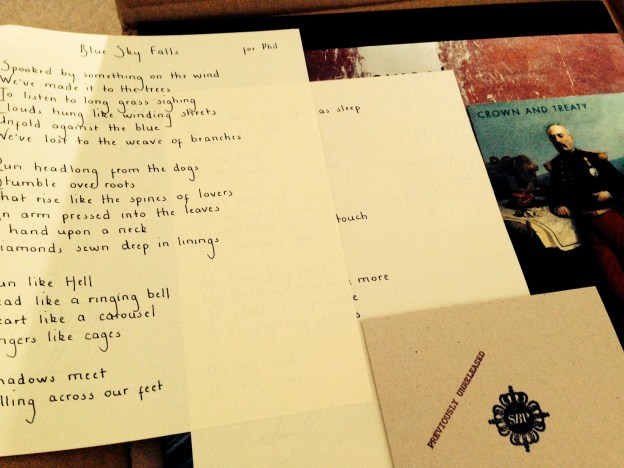
A quick post to show off some rather fine musical swag that arrived over the weekend. I recently signed up to become a “patron” for the new Sweet Billy Pilgrim record which is all pretty exciting as I’ve never patronised anything before; you may insert your own gag about how patronising I am here.

So the deal is that, for the princely sum of £85, you get a signed vinyl copy of their last album (the Mercury nominated, bloody marvellous “Crown & Treaty”), a CD of unreleased music, a hand written set of lyrics to a song of your choice, a pair of tickets to an upcoming gig, and a copy of the new album when it’s finished. There’s a £500 version where you get a private gig in your house which I would love to have stumped up for but the subsequent divorce would have cost even more. More details on all of that here at their website.

SBP loosely hail from Aylesbury (what is with Aylesbury bands and crowd sourcing – has Mark Kelly been running workshops ?) which, in a bizarre way, has always made me feel a certain affinity with them beyond the fact that I love their music. So my £85 was for anyone trying to create something in the Chilterns; be it them, Marillion, or Bill Drummond plotting his latest art experiment. Of the three I figure SBP will probably use the money in the wisest way – Marillion don’t need it so much and Bill might burn it.

I guess the cost, pitched some way above the usual price of a new album, might raise a few of your eyebrows. But what’s a song worth ? If you asked me to put a price on Jeff Buckley’s “Lover, You Should Have Come Over” or Merry Clayton’s vocal on “Gimme Shelter” or John Squire’s solo at the end of “I Am The Resurrection” or the drums at the start of The National’s “Bloodbuzz Ohio” then I would struggle. I have paid money for all of those records so I can tell you the cost to me in buying them but the £10.99 (or whatever it was) doesn’t come close to expressing their value to me.

It’s a question that I asked myself again last year when SBP offered up “Crown and Treaty”, for free. It seemed – still seems – mildly ridiculous to me that something so lovingly crafted and brilliantly executed could be mine for nothing. In particular the closing track, “Blue Sky Falls”, a gorgeous, fragile slow burner, is worth more than that surely ? For each and every time it has lifted my spirits as I picked my way across the countryside separating Amersham from Milton Keynes, driving to work, for each and every moment it has spoken to me of escape, every time that layered, building, intertwining “oh my god” harmony at the song’s climax has raised the hair on my neck and pulled a smile to my face, for all of those times it’s worth rather a lot more than nothing.

Here it is in all its glory:

So £85 seems like fair redress to me. Besides: behold the glorious swag !

May you one day carry me home

29. Oh My Sweet Carolina – Ryan Adams

There was an incongruity to it, the contrast between the man shuffling on stage, unkempt hair, scruffy, and the surroundings. He almost looked lost, a tiny figure sat with his guitar, a piano to one side, accompanied by a cellist, dwarfed by the Royal Festival Hall with its capacity to house an orchestra; a vast open space purpose designed (not entirely successfully) to accommodate sound and music.

With scarcely a word or barely so much as a glance at us, the audience, he began to play, picking out the opening notes to “Oh My Sweet Carolina”. The expectant chatter that had broken into appreciative applause as he’d made his way on to the stage died instantly. There was a collective holding of breath as he began:

Well I went down to Houston and I stopped in San Antone
I passed up the station for the bus

Was trying to find me something but I wasn’t sure just what
Man I ended up with pockets full of dust

The words exhaled softly, quietly into the microphone, fingers methodically working the neck of his guitar. He seemed lost in it, oblivious to us, absorbed in some personal meditation on homesickness and another of those tales of a lost soul looking for a way back that country music does so well. We were lost in it too, the audience given over in a kind of reverie, astonishingly still and silent and rapt.

So I went on to Cleveland and I ended up insane
Bought a borrowed suit and learned to dance

I was spending money like the way it likes to rain
Man I ended up with pockets full of ‘caine

Just voice and guitar was holding us, the entire room transfixed. I’d seen him do this before, first time I saw him play was at the Lyric in Hammersmith, a pokey old theatre with maybe a hundred of us there. He’d been a little difficult that night, almost affectedly pulling open note books, propping them up on his music stand, puffing on endless cigarettes, ignoring the crowd despite the intimacy of the venue for the first half of the set. It was either someone extremely insecure, stumbling through stage fright, or someone desperate to project their cast iron credentials as an artist. Perhaps it was both. The set was largely made up of the songs from “Heartbreaker” which is such a bruisingly honest and raw record that I guess it might not be easy to lay yourself that bare on stage, particularly on such a small stage with nowhere to hide. Whatever it was something magical happened that night when he played “Come Pick Me Up” and he and us in the audience softly seemed to find some catharsis in its bitter lament to betrayal. It was the first- but not last – time that I thought he was absolutely the real deal.

Oh my sweet Carolina
What compels me to go ?

Oh my sweet disposition
May you one day carry me home

I’d seen the other Ryan Adams too, the rock n roll version. In those early stages post Whiskeytown, solo, it was as if he wanted to be Gram Parsons and The Rolling Stones at the same time; a one person embodiment of the Exile sessions both in terms of music and lifestyle. Just before “Gold” broke in the UK I saw him at Shepherd’s Bush Empire backed by a full band – a full band purpose built to replicate that early 70s Stones sound, or even a country leaning E Street Band. It wasn’t quite Dylan going electric but there was definitely a mixed reaction in the crowd – in particular the saxophonist divided opinion, filling in the harmonica parts from both “Heartbreaker” and “Gold” with horn. I loved it but then he was riffing on two reference points – in Springsteen and the Stones – that I adore so it was easy for me to hear it all as a straight extension of his country (or Americana if you insist) roots into R&B and rock and roll. For others it was apparently some kind of betrayal or sell out – the purity lost in chasing some notion of being a star. To me it just looked like he was going where his muse took him and having a ton of fun. By the close he had everyone pretty much back on side, closing with what became his famous cover of Wonderwall, which eventually even the song’s writer, Noel Gallagher, acknowledged was improved in Adams‘ reading of it. Again, I left, convinced of his genuine greatness.

I ain’t never been to Vegas but I gambled all my life
Building news print votes I raced in sewer mains
I was trying to find me something but I wasn’t sure just what
Funny how they say that some things never change

“Gold” and “Heartbreaker” were huge records for me in the early 00s as was, latterly, the two parts of “Love Is Hell” (another painfully beautiful record, so raw it’s practically an open wound). In particular “Gold”‘s lead track “New York New York” will always place me driving home, picking my way into West London from Hertfordshire, skirting Heathrow, on September 11th, 2001, anxiously and acutely aware of the eerily empty skies above me. It was chance, of course, that Adams had recorded an open love letter to the city that had become his adopted home, chance that repeated as the video for the track was recorded four days before 911: the entire film features Adams playing the song with the Manhattan skyline as his backdrop, the Twin Towers dominating every frame. It became a song of defiance and will always be lodged in my memory in association with that day alongside Springsteen’s “My City Of Ruins”.

Oh my sweet Carolina
What compels me to go
Oh my sweet disposition
May you one day carry me home

Back in the Festival Hall I am experiencing something akin to a religious awakening. I don’t think I’ve taken a breath since the song began, haven’t moved a muscle, as if changing anything – the slightest disruption – could shatter this fragile, delicate piece of music. It sounds like a direct expression of the deepest, saddest longing I’ve ever heard and he’s creating it right in front of me.

For me Adams never quite touched those early heights (or possibly depths) again but, in a way, I’m glad. His early work speaks of such overwhelming pain and unhappiness that I suspect the alternative path his life might have taken – alternative to continuing as a respected singer songwriter, settling down, cleaning up – would have been for his life to end. If there was a likely candidate to join “that stupid club” along with Kurt and Jeff and Jimi and Janis and Jim then he was it. I’m glad he didn’t and I still greatly enjoy his music. Perhaps it’s not quite as personal to me now as it was but he still has the capacity to floor me – witness the more recent performance of “Oh My Sweet Carolina” with Laura Marling filling in admirably for Emmylou Harris that you can find here. It is a fabulous thing indeed.

Up here in the city it feels like things are closing in
The sunset’s just my light bulb burning out
I miss Kentucky and I miss my family
All the sweetest winds they blow across the South

Memory is imperfect. Funnily enough one of the themes in writing this particular series of posts is that I believe that specific songs are strong anchors of a certain time and place, strong signifiers of what I was experiencing and feeling at the time. It’s possible to hear a recording of “Oh My Sweet Carolina” from that night in November 2002 at the Royal Festival Hall – you can stream it here if you’re so inclined or you can read closer-to-the-moment reviews of the gig here and here. It’s interesting how many details were wrong in my memory. In my first draft of this post he didn’t acknowledge the audience at all before playing – he actually directly spoke to us. I’d forgotten the cello completely. The song does play out to silence but it’s not quite as instant as the version in my mind (it’s still pretty impressive for a London audience who, often times as not, seem to love their own conversation as much as what is happening on stage).

The spirit of it is right though. The intensity of a moment in which he conjured something breathtakingly, heart achingly beautiful; a tender yearning for the safety of home. All delivered by the unassuming, slightly dishevelled man playing, stripped back and exposed, in that grand and imposing space.

Oh my sweet Carolina
What compels me to go
Oh my sweet disposition
May you one day carry me home


Everything is broken… phew, for a minute there I lost myself…

28. The Bends / OK Computer – Radiohead

Me and Radiohead go way back. We first met when they were supporting, believe it or not, The Cranberries at Leicester University who were touring off the back of “Linger”. I’d like to believe that I had my finger so firmly on the pulse that I was only there because I’d been tipped off about Radiohead but I suspect it was more that I went to pretty much every gig at the University that year. Sometimes this unearthed a gem (Maria McKee) and sometimes it didn’t (T’pau). In this case it did both. For avoidance of doubt The Cranberries were not the gem.

So the first time I heard “Creep” was at that gig. It’s impossible to recreate now as the song is too entrenched in memory but that first time that Jonny Greenwood’s guitar went into spasm, that stab of distortion into the chorus, was a real jaw dropper. It was visually arresting too, him hunched over his telecaster, slung low, face covered by his hair as it fell forwards, and then this twitching, violent slash over the strings and a burst of white noise erupting. The wannabe rock star in me took copious notes. The only thing I actually pulled off was the telecaster. Maybe the hair.

I also distinctly remember the first time I heard “Paranoid Android” I was stuck in traffic on the outskirts of Liverpool, making my way there for something related to my job at the time working for Boots – back in the days when radio got first play of a song. It’s still vivid for me because the song was astonishing on first listen: those snaking, sinewy verses, tense chorus that hints at some terrible future peril (in so much as it is a chorus) before the build into the off kilter solo and gorgeous break down into the defeated, resigned “rain down” section. It’s still astonishing now. Whisper it but it’s kind of a prog record although I don’t recall much of the cooler-than-thou indie press reporting it as such at the time.

Shortly after that I eagerly purchased “OK Computer” on its day of release – a Monday lunch time mooch around either HMV or Virgin (as was) or Selectadisc in the centre of Nottingham was very much my routine then. That evening I lay on my bed, put my headphones on, closed my eyes and listened to it straight through. It was an event. I sort of miss the days when a record release was an event for me. There was something almost ritualistic to it. The album didn’t disappoint and its over arching themes of a vague pre millennial anxiety and sense of displaced unease resonated strongly with me at the time; echoes of that sense still resonate strongly with me now.

The record sandwiched in the middle of all of this – post “Creep”, pre “OK Computer” – was “The Bends”. Released in 1995 it caught me post graduation, recently moved to Nottingham, trying to figure out what to do with myself. It also largely sound tracked the disintegration of two relationships that were important to me; both of which I can look back on now with fondness but these songs are forever attached to their messy ends. In many respects both records are associated with a time of unhappiness, or at least, a time of uncertainty. In that period I had no idea what I wanted to do (plus ca change…), was clinging on to the idea that old relationships might still work, and gradually became separated from most of my friends who were largely living (and living large) in London. I was scraping by in a job I didn’t really want, sharing a house with people I didn’t really know, and spending any money I did have on train fares to the big smoke. It’s not really a surprise that two albums, more or less book marking the beginning and end of this time in my life, that major in themes of alienation, listlessness, torpor, and a twitchy anxiety should have been so important to me. I probably should have spent three years sitting in a back corner of The Salutation reading Camus. I didn’t. I think I spent it sitting in one of the five homes I had during that time watching Star Trek: Deep Space Nine. It’s angst, Jim, but not as we know it.

In 1997 they headlined Glastonbury. I was, by that point, a regular festival goer and had enjoyed the previous few years in blazing sunshine at Reading, Glastonbury, and the short lived Phoenix festival near Stratford. Had enjoyed the sun so much that for Glasto ’97 a small group of us decided to arrive at the festival site on the Wednesday (it usually ran Friday to Sunday) to soak up the atmosphere, chill out, have a little mini holiday. It basically threw it down for five days, the site turned into a swamp, and we spent our time turning bin liners into makeshift rain coats: it was miserable. Somewhere in amongst the mud though Radiohead closed the Saturday night and it was possibly the finest live performance I’ve ever seen, certainly in the top three. There was an intensity to it, and in the reaction of the audience, that happens rarely and very rarely for me at an outdoor gig. There was a real buzz around the festival ahead of their performance as “OK Computer” was pretty well cemented as album of the year and it turned into one of those very special events, almost a shared communion, between audience and band. Quite a bit of it is on YouTube: here. Inevitably it doesn’t convey the atmosphere – the palpable electricity in the air – but there’s a sense of the intensity.

There’s a bit at 18.30 on that BBC clip which I remember clear as day when Thom Yorke asks for the stage lights to be turned on the crowd: somewhere in that heaving throng was a 25 year old me. I watched that headline set on my own. Surrounded by thousands of people, obviously, but alone. I was at Glastonbury with a bunch of friends but I deliberately took myself off to watch that performance by myself. I had a strong sense that it would be a deeply personal experience for me and, in some respects, an intensely sad experience. Sad might be the wrong word. It would be  – and was – a deeply emotional experience, a space where those songs would connect directly to feelings that were tucked away, hidden, and give them expression. It was a year or two characterized by loneliness and I knew that the songs that would make up their set would speak to that. I remember I wanted it to be a private experience – laughable as that seems in the churning throng – but I wonder now why I wanted it to be private. I wonder now whether I might not have been better off watching it with my friends, telling them I wasn’t happy, and sharing it all.

Within the next six months the relationship I was in was over, which was better for both us, I left my job in Nottingham, and started again in London.

……

That bit about “maybe” pulling off Jonny Greenwood’s look / hair. I didn’t. I was that skinny then though. Thems were the days…