Tag Archives: life

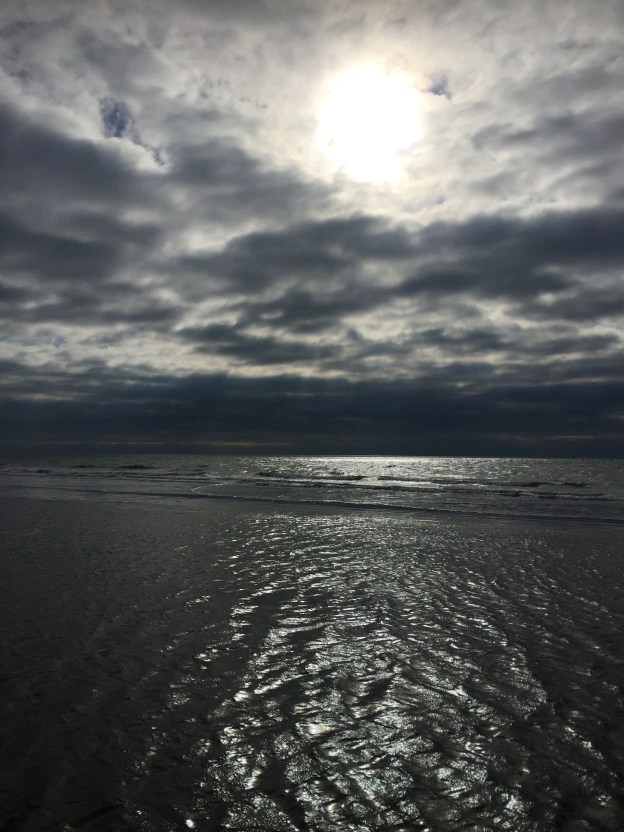
This is the sea

Once upon a time I learned to sail. Time steals the memories of that learning and now that I can navigate the river I can’t remember those days of running aground, of fighting the slow, easy current, or even of the repeated soakings as I was tipped into the water. Nor do I remember those early journeys, all way back upstream now, through the hurried rapids, down the narrow streams of my childhood. Perhaps at the time it all seemed bigger but looking back, up and across to the mountains we made our way down, I can barely make out the path of the water; like tracing my face for the lines left by tears that dried up long ago. As the river widened and relaxed into the valley some memories stick. I do remember that initial sense of freedom, striking out from the bank alone for the first time but secure in knowing that the river was slow, shallow, and not so broad that I couldn’t swim back to something solid. The river guides. That was the teaching: trust in its easy, forgiving flow and use it to learn for the sea. The unspoken truth though was that the river is poor learning for the sea but it is all we have.

The sea looked like hope from the river as I glimpsed it occasionally back then, wide eyed, staring downstream into the future. Just as looking back changed perspective, shrinking things that had seemed vast, looking forwards played the same trick but in reverse. The sea looked contained, bound by shore and horizon; it looked manageable. Navigable. The distance flattened the ceaseless rise and fall of the tides and ironed out the distant surges and storms. It looked like a gently creased, blue grey sheet stretched out between the land and sky and I miss that idea of it. I miss the time when I headed for uncharted waters with excitement and confidence, when apprehension felt like the precursor to discovery – something new and wonderful – instead of the prelude to fear. Even when the discovery was just someone else’s map of those uncharted waters, the discovery that they weren’t uncharted at all, that someone had sailed this course before and left you their notes.

And for a while, as I stuck to the charted waters or uncovered the notes from those that had sailed before me, the sea delivered on the promises whispered in its waves. Close to the mouth of the river it was as easy to sail as the river itself had been. The boat I’d built and sailed as a child rode the benign tides close to shore just as it had coped with the nudging currents that had eventually pushed it out into open water. The coastal squalls were exhilarating rather than frightening, the rush of adrenaline feeding the strength to trim the sails or tack back into the wind. And when they abated the sea was calm for long enough, and I was strong enough, open enough, to improve the boat, to make modifications and adjustments. To face each successive squall stronger than I’d faced the last. Perhaps the sea guides too. That’s what I thought in those days skimming the surface spray hugging the shoreline. I don’t think that anymore.

I don’t remember losing track of the shore. It must have happened slowly, over years, a progressive pull from the ebb of the tides winning out over the flow. Out here the sea doesn’t look contained or manageable and the notes left by fellow sailors are fewer and further between. Is it even navigable ? Out here there’s just the sea. Vast and endless and unforgiving: it can swallow you up and leave you cold, lost and adrift. When the storms hit my boat splintered and sank. I fought them until my bones ached and my fingers blistered from straining against salt lashed ropes in the desperate struggle to stay afloat. If I’d had a solid place to stand then perhaps I’d have saved the boat but the drenched deck gave no purchase for my feet. If I’d battled a single, violent tempest then perhaps I’d have saved the boat but the bad weather resolved itself into a change in the climate, storms piled on storms. If I’d learned to rest, to trust the sails to others, to admit to the weariness of near defeat, then perhaps I’d have saved the boat but even back in the days on the river I’d always sailed alone. There was no solid place to stand, there were many storms, and there was nobody to relieve me as captain: my boat splintered and sank.

The sea’s depths seemed to offer solace, they were untouched by whatever raged above. At first there was a relief in the isolation as I dropped beneath the roiling, rolling waves, pieces of my former vessel, fractured and sinking beside me. As I lingered there longer though it became colder and a kind of numbness set in; it became harder to strike out again for the surface. There was nothing up there but storms and the relentless toss and twist of the swelling waters. Nothing there but more sorrow. There was nothing here either but it was a constant nothing. It was predictable. Navigable. I was lost but if I stayed where I was I’d never be more lost and I’d never risk the hope of clutching at a way back to shore. I’d never feel the touch of the sun on skin but I’d never have to feel the rain either.

The sea doesn’t guide, it just is. The sea doesn’t guide but perhaps those that sail it still can and still do. The notes from fellow sailors are fewer and further between out here – down here – in the sea. But some remain. Even here some remain.  I found one of those stray, rare notes and it said this: even out here it’s not truly uncharted. There’s a universal map written in the stars for those able to raise their eyes and read it. Perhaps it leads back to your shore but you can’t read that map ensconced and ensnared under water. You might see the lights, foggy and distorted, but the water refracts and changes the true positions of the fixed reference points you must follow. You must brave the surface to see the way. The only way back to the shore is to risk the storms. How do you learn to be still on the waves ? Or how do you learn to lean in to the teeth of the gale and laugh ? When does knowing you’re not in control of the boat stop being terrifying and fill your heart with exhilaration ? How do you leave notes as you chart your waters that others might find and learn from in future ? These are the questions I asked and still ask as I seek the playful exploration of the shores close to the river that I learned to navigate when I was young. I read the note and draw strength to seek the surface.

This is the sea. Terrible and terrifying and relentless. Open and hopeful and limitless. Build the best boat you can and learn to make it dance on the river but accept that when you reach the sea it can crush the strongest vessel or the skilled sailor without thought or malice. All you can do is learn to sail again. Seek out the constants in the sky, learn to sail and as you chart your course leave notes that others might follow and might know that they are not alone, adrift in their storms. The river need not be our only learning. We are each other’s guides.

Once upon a time I learned to sail. Happily ever after remains my destination, out there on the horizon, across the sea.


……

This is story 42 in a series of 42 to raise money and awareness for the mental health charity Mind. My fundraising page is here and all donations, however small, are really welcome: http://www.justgiving.com/42shorts

So that’s it. Took longer than anticipated but all 42 are done and, to date, I’ve raised £700 for Mind. This one’s about everything the other 41 were about but also, in spirit, was about the value in sharing stories.

It owes a huge debt to Mike Scott and The Waterboys who said in six glorious minutes and two chords what I’ve struggled to say here.

Prime

Your days are numbered. When they’d told me that, professional, detached, but empathetic, I’d run with it literally. This was day fifteen thousand, seven hundred and six. I liked the length of it, the time it took to roll around my mouth as I said it; it seemed to have more heft about it than counting off my years. Forty three.

They hadn’t actually used the phrase your days are numbered of course. For all their clinical detachment my team of surgeons hadn’t acquired the bedside manner of a bad James Bond villain. Ah, no, Mr Adams, I expect you to die… Having your own team, when it comes to surgeons, is not really something to celebrate – it’s not like Roman Abramovich having his own team. Other than really, really wanting them to win obviously. To be honest I don’t really remember the exact words now, I’m not sure I even registered them as it had been so apparent what the prognosis was before anyone even spoke that I’d just sat there in numb terror; my ears ringing and a rising wave of nausea threatening to envelop me. So I’d filled in the blanks later and settled on your days are numbered.

Fifteen thousand, seven hundred and six days. I’d toyed with restarting the count at one, from the day of diagnosis and seeing how far I could get, see whether I could get past the notional deadline they’d given me. At one point, again with the literal, I’d made it an actual dead line: counted forwards to the date marked by their best estimates and drawn a blunt, thick line down the calendar. Before: alive. After: not so much.

Running the count in days just has more substance to it than years. It’s easier to mentally trace back through individual moments framed by days than the aggregate annual view. Years are just too broad. 1972 born. 1977 start school. 1979 Forest win the League Championship. 1982 cultivate extensive crush on Anna Jackson and understand the cruelty of the human condition via Abba’s “The Winner Takes It All”. You get the picture.

There’s nothing special about 43. At 40 you can take satisfaction in hitting one of the big ones: life begins and all that. At 42, if you were so minded, you can riff on that number being an expression of the answer to life, the universe, and everything. Raise a silent toast to Douglas Adams and collapse into your own mid life crisis. Okay, you may not be so minded. That one might just be me. But 43 ? Nothing. At a stretch it is a prime number so maybe there’s some power in that. The 40s are ripe with them: 41, 43 and 47. A time to be in your prime, perhaps. Primes: indivisible except by themselves or one. There’s got to be a metaphor in that.

It seems easier to imagine a myriad of ways in which you could make a day, rather than a year, special. We could get crazy and break this down into three hundred and seventy six thousand, nine hundred and forty four hours. Or twenty two million – yep, million – six hundred and sixteen thousand and six hundred and forty minutes. Or compressed right down to one billion, three hundred and fifty six million, nine hundred and ninety eight thousand, four hundred and forty seconds. Enough time, put like that, to listen to Springsteen’s “Thunder Road” more than five million times. Or “The Winner Takes It All” of course but there’s only so much heartbreak one person can stand. And the prognosis was heartbreaking enough on its own.

Some of those days have been pretty shitty to be honest. The “your days are numbered” day was obviously a particular lowlight. That said, even on the shittiest day, I couldn’t hand-on-heart claim that every single minute, every single second, of that day was shitty. There must be a tipping point. Does more than seven hundred of the fourteen hundred and forty minutes in a day being crap render the whole day a bad one ? Or is it enough if just one minute – or even just a few seconds – is so horrendous that it sours the entire day ? What about a year ? What about a life ? Is the prospect of spending each and every one of your remaining days with a doctor’s grim proclamation of impending doom ringing in your ears enough to tip the whole thing out of balance: away from something worthwhile, facing down the apparent futility of it all ?

But, you know, some of those days have been pretty goddamn amazing. I have no idea why that sentence felt obliged to pop out all American like that but let’s go with it. Some of them have been real “get in the hole”, “you the man”, “who’s living better than us ?” kind of days. Maybe Americans have just got a better handle on expressing the whole notion of awesome than us Brits. Some of those days have been really rather good old chap. Cup of tea ?

It’s not even that the awesome bits are always obviously awesome. It’s certainly not the case that awesome sentences are in any danger of turning up in this monologue anytime soon. Sifting through the fragments of awesome in memory turns up anything from the biggies: falling in love with the perhaps-now-never-to-be Mrs Adams (maybe I should still ask her ?) right through to something as mundane as walking across Market Square late at night, wrapped up against the cold and watching Saturday’s stragglers and strays shamble out of pubs and bars. No idea why it’s lodged there but it’s filed away under happy. It’s possible I was drunk. Or stoned. Nottingham wasn’t characterized by sobriety for me at the time. There’s friends and family and music and laughter and wine. Strangely there’s also throwing a lemon around in a field in Reading. Another less than sober time. Losing my virginity nestled right up in there with riding the train through Dawlish station (the one with the beach) every week when I was about sixteen (a mere five thousand odd days old). Clearly one of those was a bigger deal than the other: Dawlish is pretty special. An assortment of moments that have stuck fast, constituent remnants of happiness.

So perhaps moments are the thing. Not years, or months, or weeks, or days. Individual moments of no fixed length, not counted in quantity but experienced and remembered for quality.

They hadn’t said my days were numbered. They’d said I had, maybe, three years to live. After the shock had worn off (who am I kidding, it still hasn’t worn off) I decided it sounded too small: three. Another prime number and maybe the one that was going to stop me finding my way from 43 to the next one, 47. So I started counting days, backwards and forwards. The numbers are bigger and stretch my conception of what’s left and what I’ve been fortunate enough to already have.

And they remind me that moments are the thing.

……

This is the thirteenth (another prime) story in my series of 42 shorts that I’m writing to raise money and awareness for Mind, the mental health charity. It is fictional for avoidance of doubt: apart from the bit about Anna Jackson and The Winner Takes It All. And the lemon. That was true too. Please share it if you liked it (or even if you didn’t…). If you’re interested in donating to a great cause then please visit my fundraising page. https://www.justgiving.com/42shorts/

Go on and make a joyful sound

40. For A Dancer – Linda Ronstadt & Emmylou Harris

As I’m closing in on the end (of writing about 42 records of personal significance, not “the end”) then I thought I should lighten up proceedings by sticking together a few words about death. You know, just to take the edge off all those pieces about depression and anxiety and all that laugh out loud fare. If there are a set of recurring themes in my writing then uncertainty is certainly one of them – this, however, is one point of certainty: we’re all going to die.

The irony, of course, in thinking about death is that it quickly becomes thinking about life. It’s reasonable when confronted with mortality to give some urgent thought to how you’ve lived, how best to spend the time left, and to wonder what it’s all about. That hoary old chestnut. Nothing like a midlife crisis to bring on a sudden search for meaning.

In some respects my chosen position on a couple of things, namely a belief that this is all there is, no second chances, no afterlife, and that there isn’t a higher, guiding force in the universe, can lead to some on-the-face-of-it bleak conclusions. The point-of-it-all may well be that there is no point. Particles reacting and colliding predictably, governed by the immutable laws of physics, but the major events in your life governed arbitrarily; order and chaos, humans with free will running amok amid those immutable rules. I think the tension between the two is important – there has to be a belief that you’re the master of your own destiny else you either give up or write everything off to fate or surrender yourself to something ineffable. At the same time there’s too much evidence of chaos to ignore: planes crash, people blow themselves up on trains, maniacs run into schools with automatic weapons. Tell the innocents in each of those scenarios that they were masters of their own destiny.

So, in my version, perhaps meaning is found in those moments of balance between the chaos and order; in control whilst things are out of control. Perhaps it’s more an acceptance that things are out of control and the prospect of that is so terrifying that it’s at the heart of that loose conglomeration of neuroses and mental health issues that I like to wrap up as “my problems”. Wiser people than me have grappled with it. The broad consensus, secular position seems to be that fully experiencing the individual moments of life, being very present in those moments, is probably as good as it gets, probably as much as there is. Teenage Fanclub’s “Ain’t That Enough” (number 26 previously in this series of posts) and Po Girl’s “Take The Long Way” (number 31) cover this territory far more eloquently than I have here.

Jackson Browne’s “For A Dancer” fits within that family of songs albeit it’s the only one of the three that ponders life through the lens of death. The version of the song that I know is the one on Linda Ronstadt and Emmylou Harris’ “Western Wall: The Tucson Sessions” album which, in turn, I’d come to via their brilliant collaborations with Dolly Parton. In truth this is more or less a solo Ronstadt record with Harris adding harmonies (is there any less selfish singer than Emmylou Harris ?) and given the news that she won’t sing again having being diagnosed with Parkinson’s it has acquired further poignancy for me. Chaos up to its arbitrary tricks again.

The song is sung from the perspective of someone saying goodbye at a funeral and reflecting on what it all means: I can’t help feeling stupid standing ‘round, crying as they ease you down. My direct experience of such events is, fortunately, very limited but in all cases Browne / Ronstadt’s next line rings true in spirit to me: ‘cause I know that you’d rather we were dancing, dancing our sorrow away, no matter what fate chooses to play.

The solemnity and sorrow of each occasion was no real reflection of the life that had passed and that we were mourning. That’s not to say that there isn’t and wasn’t value in soberly giving respect to the loss of loved ones but there seems to me to be a difference between that ceremony and the one that the dead might choose for themselves. Do we mourn for ourselves, for the space in ourselves left by the one that is gone ? Speaking on behalf of my future dead self then I’d far rather everyone was dancing. Not some sombre shuffle either: give it your best Jagger strut and, aging limbs allowing, pull a star jump and remember me.

The dancing in “For A Dancer”, of course, doesn’t have to be literal, it’s just a metaphor for living. Browne extends it to wonderful effect in laying down advice from the dead to those left behind:

Just do the steps that you’ve been shown
By everyone you’ve ever known
Until the dance becomes your very own
No matter how close to yours another’s steps have grown
In the end there is one dance you’ll do alone

There’s no belief here in certainty (pay attention to the open sky, you never know what will be coming down) but you’d best meet the chaos as well as you can (keep a fire burning in your eye). There’s also something stirring and deeply moving in the unflinching lack of sentimentality in the song’s overall message:

Perhaps a better world is drawing near
And just as easily it could all disappear
Along with whatever meaning you might have found
Don’t let the uncertainty turn you around
(The world keeps turning around and around)
Go on and make a joyful sound

Essentially we’re in the same place, with the same conclusion, as “Ain’t That Enough” and “Take The Long Way”. This is it. Experience it, savour it, try to enjoy it and maybe, just maybe, there doesn’t have to be a point to it all. Embrace the chaos.

So you can play this song at my funeral during the sad bit before everyone gets drunk and strikes some poses on the dance floor. It’s about as close to anything in a four minute pop song that gets at the big one: what’s it all about ?

Into a dancer you have grown
From a seed somebody else has thrown
Go ahead and throw some seeds of your own
And somewhere between the time you arrive and the time you go
May lie a reason you were alive but you’ll never know.