Tag Archives: depression

Made my mind up to be a black winged bird

41. Black Winged Bird – Nina Persson

This is me.

I love music. Mostly listening but I can muddle my way through a few chords on the guitar. I am tone deaf when it comes to singing – something which I really wish wasn’t true. I briefly had trumpet lessons as a child but the trumpet and I were never going to be close. I used to be able to play the intro to Kate Bush’s “Wuthering Heights” on the piano but it now eludes me. I could probably have a crack at singing it. You might not want me to.

I’m just as likely to laugh at something involved and clever as the crassest, stupidest gag. My all time favourite movie joke is in Steve Martin’s “The Man With Two Brains”: what are those assholes doing on our porch ? Those aren’t assholes… It’s pronounced azaleas. I guess that’s kind of clever and stupid at the same time. That’s the sort of thing I’m most likely to laugh at. I have a good sense of humour (everyone thinks they do though, don’t they ?). I laugh at myself a lot and, given a fair wind and a decent run up, I’d probably make you laugh too.

I sometimes buy books that claim they’ll change my life. Invariably they don’t. I often buy books that don’t claim they’ll change my life. Sometimes they do. Lord Of The Rings changed my life when I was 12 years old (though Star Wars had already done the damage when I was 5). Ken Kesey and Hunter S Thompson and Tom Wolfe blew my mind. Clive James writes in the way that I most aspire to.

I love words. And I mean all words – sometimes if you mean fuck you should say fuck. There’s no offense in words on their own. Context is everything. About a year ago I remembered that I liked to think of myself as a bit of a writer so I started writing again.

I don’t love numbers in the way that I love words but, despite this, I seem to have some aptitude for them. I see patterns in data and build frameworks to understand things. It’s how my mind works. Somewhat accidently I built my career on it. I’m pretty rational and like to see order and causality. I sometimes wonder if my growing realization that life holds far less order and causality than I’d imagined has made me increasingly ill at ease.

I play video games. I was supposed to grow out of it after we got rid of the Commodore Vic 20 when I was about 10. Again after the Spectrum. After the Playstation. Playstation 2. X-box 360. Playstation 3. Still haven’t grown out of it and doesn’t look like I will. Nor do I want to. I mostly play role playing games. So not only do I play video games but I play the nerdiest video games you can play. I usually max out my intelligence stat and make in game choices that are for the common good.

I love sport. Back in the day I was a half decent footballer, what I lacked in finesse I made up for in pace, size, and a low centre of gravity. Or at least I did until I ruptured my anterior cruciate ligament. Bust up my knee. If I’d done it now I’d be in and out of hospital in a day and back to full strength in nine months. I didn’t do it now, I did it then. I’ve had ten operations on that knee: it will never be right and I never kicked a ball again.

I’m an introvert. An introvert in the true sense of the word – my resources and energy are internally focused, not external. People tire me out. Too much external stimulus tires me out. I’m not shy, I don’t entirely lack social skills – it’s just that sometimes I need my own space to recharge. You extroverts might not understand but that’s how we’re built, don’t take it personally. I do sometimes wonder if I correctly balance my need to be alone against feeling lonely.

I’m stubborn and bloody minded about some things, practically horizontal as I’m so laid back about others. If I’m in your corner I’ll fight your corner. I stand my own round. I’m polite, I try to be kind, and I hold doors for people. I think the Oxford comma is a good thing. I serially abuse punctuation though – I am trying to wean myself off dashes and brackets and ellipses (with mixed success…). I get scared and am vulnerable sometimes but don’t much show it. I may have an underlying sense of being weak but a desire to project strength. I over think things.

There are only a handful of people that I love but I love them very deeply. My daughter is the single most important and enriching thing in my life. My wife is the best person I know. They have not always had the best version of me these past couple of years and I sincerely regret that. I have found myself difficult to be around at times so am damn sure other people have too. I’m sorry.

Why ? Well, all of that above is me but then this is sometimes me too:

Churchill had his “black dog”. I have my “black winged bird”. It seems to be a feature of depression that people that live with it characterise it as something separate from them: it isn’t me, it’s this other thing that comes and takes up residence from time to time. The black winged bird that picks me up and takes me away from myself. I can see everything from up there but I’m a long way removed and can’t be reached.

This song isn’t really about depression. It’s hard to read but it’s probably about a failed relationship. That is the sense in which I’ve appropriated it I guess: hard to read and about my failed relationship with myself, or, at least, all parts of myself. It reminds me of aching sadness and absolute loneliness and depression. Perversely I also find it extraordinarily beautiful. The Nina Persson cover is the one I came to first (released as part of loose Irish collective “The Cake Sale”) but the Emm Gryner original is also fantastic.

I guess the point of this post is that I’m not sure what the best way of dealing with depression is. I know… 41 records in with only one to go and I still haven’t worked it out. Slacker. Until very recently I had held it apart from myself, given it some kind of external name – in this case let the talons of some black winged bird rip me out of myself. It might not need such grandiose metaphor and analogy, it might just be a chemical imbalance. The pharmacological solution so readily offered up my local GP might be the right solution. Even if it is then it’s not something to be externalized: it’s part of me. Accepting that it’s part of me and treating it – treating myself – with some compassion might be more helpful than wishing it would go away.

This is sometimes me but I will not let it be all of me. I am all of the things in this post and I don’t want to define myself by my depression or anxiety. It might be part of me but then, so is an occasional compulsion to listen to Meatloaf’s “It’s All Coming Back To Me” and I don’t define myself by that either. Don’t judge (mainly for the Meatloaf thing but, you know, all that mental health stuff too…).

I like to skewer my own self importance with bad jokes. My other favourite joke, apart from the Steve Martin one, is that one about a man taking his wife on holiday to the Caribbean. Jamaica ? No, she wanted to go.

This is me.
It’s not going to stop ’til you wise up

38. Wise Up – Aimee Mann

If there was ever a movie version of this blog – just suspend belief for a moment – then it’s becoming apparent that the director would need to change the ending. There are five records left to cover, including this one, and in the movie you might reasonably expect those final musical musings to build to some sort of rousing conclusion. A happy ending.

However – *spoilers* – we are probably not headed for a neat and tidy finale in which our hero (again, suspend some of that belief for me) unravels the question to the life, the universe, and everything, unpicks whether the answer really is Deep Thought’s 42, and achieves a deep and abiding sense of contentment. It’s going to be more like the end of Empire Strikes Back than Return Of The Jedi, put it that way.

All of which is a slightly convoluted way of ‘fessing up that the road back from anxiety and depression – assuming optimistically that there is a “back” – seems to be a difficult one. In the neat and tidy version of this blog I returned to work after my sabbatical with a renewed and refreshed perspective on how I wanted to live and floated through productive days in a state of Zen like calm. In the real version I’m still artificially moderating my adrenaline levels with pills, still struck with irrational panic in seemingly innocuous scenarios, and still sometimes hating myself for what has happened to me. Or what I seem to be doing to myself, albeit subconsciously. I’m not even really sure which it is. I guess it’s what I’m doing to myself.

I’ve never really been very good at expressing how I feel. Turns out I may not even be very good at feeling how I feel. I seem to have something of an aversion to fully experiencing how I’m feeling and being okay with it, in all its glorious, uncontrollable, maddening cadences. Just for clarity, I’m not a psychopath, I haven’t lost the capacity to feel, it’s just that I seem to have stopped allowing myself full range of expression without even realizing it. It’s almost as if I have become distrustful of giving free reign to experiencing emotion and have tried to lock it away, either to project some notion of strength or to protect against something painful. It is a very difficult thing for me to admit to vulnerability. I realise that sentence looks somewhat incongruous written on a publically viewable blog, somewhat contradictory, but there’s a distance here – between me writing and someone reading, even if it’s someone that knows me – that feels okay in a way that telling someone the same wouldn’t. Put another way, possibly more simply, it is not too difficult to write here that I cried on my way home from work this week because I felt so defeated by my illness (if that’s what it is – I guess that’s what it is) but I would almost certainly never let you see those tears.

For a long time I have tried to keep a lid on it. Keep it under control. Inevitably it’s all still there, bubbling away under the surface – constant maintenance of which requires no little effort (the Manic’s “No Surface, All Feeling” was on my long list of songs for this blog). That’s not to say that I think that everything would be okay if I magically transformed into a creature driven entirely by its emotional impulses, that would seem to me to just be a different kind of hysterical mess. There’s a balance somewhere and I haven’t found it, don’t seem to know quite how to find it, and the consequence of that is that stuff (eat your heart out Jung) builds up inside me, isn’t given expression, and ends up popping out in other ways: lately in anxiety, previously in depression. In that context anxiety really is a fucker (eat your heart out Freud) as it becomes like a loop – repressed emotion feeding an anxiety response which in turn provokes a repression of emotion for fear of an anxiety response. Rinse and repeat.

Even this post is telling about my essential modus operandi. It’s a pretty rational, balanced assessment of something that is happening to me – or something that currently is me – rather than a splurge of feeling. It’s fairly dispassionate and detached. And that might well be part of my issue. The point of it, I guess, is a recognition and acknowledgement of that fact. The process of actually giving up the barriers I duck behind emotionally may take rather longer.

All of which 6th form psychology brings us to Aimee Mann. I’ve alluded to the fact before that there were a number of artists whose place on the list of my 42 records was never in question and she was absolutely one of them. I first heard her properly via the film “Magnolia” (and this song is part of the soundtrack) and the album she released around the same time, “Bachelor No. 2”. She is consistently smart, sharp, wise, funny, melancholic, warm, and melodic. There are very few wry observers of the human condition via the medium of three minute pop songs that I admire more.

“Wise Up” is a pretty simple song – a beautiful song but pretty simple. In the context of “Magnolia” it works to tie together the stories of the various lost characters in the film, asking each of them to recognise that things won’t improve for them unless they acknowledge some things about themselves and change. It’s about as straightforward as it gets in terms of wrapping a record in to my own personal narrative. The last line of the song might be heard as ambiguous – it’s not going to stop so just… give up – but I have always heard that line as “giving up” modes of behaviour or habits that are damaging rather than the more blunt sense of just giving up entirely. It’s a hopeful giving up rather than a fatal one.

So I suspect, in four record’s time, that not all of this will be resolved; there will be room for a sequel (although I’m not committing to writing about another 42 records). It may even turn into a saga – perhaps I could franchise it and sell tee shirts or something (“keep calm and take propranolol hydrochloride” or something equally snappy). I will try at the very least to ensure it remains a story of wising up and giving up.

Lightly tapping a high pitched drum

33. Less Than You Think – Wilco

About three years ago, over the course of a weekend, I started experiencing the sensation of fullness in my ears, as if I was sat on a plane endlessly circling whilst it waited for clearance to land at exactly the altitude where pressure builds in the ear drum but you can’t release it. When that sensation abated I was left with a faint fuzzy white noise in my left ear, mostly noticeable at night when everything was still and quiet. It was the start of tinnitus and it has never gone away since. I’ve kind of given up thinking now that it ever will.

My tinnitus almost certainly arose as a symptom of dysfunction in my jaw joint (if you find the place that the two parts of your jaw join you may be surprised just how close to the ear it is). To cut a long story short I was a serial teeth grinder and clencher which, over a sustained period, had effectively forced my jaw to try and compensate for a loss of height in my teeth by sliding into a new position. Finding this out was a mixed blessing I guess – my ears themselves are fine, this wasn’t tinnitus induced by loud noise (as per the infamous Pete Townshend example here) – but the underlying problem turned out to involve quite a lot of pain.

Or maybe I should put that another way. Quite a lot of low level but continuous pain. Nagging discomfort in my face, down my neck, sometimes into my shoulder, sometimes up to my eye socket. Nothing that stops me in my tracks but enough to distract, to act almost as a permanent stop on properly relaxing, or properly being present in any given moment. It kind of takes over, or at least it did for a while. Even writing it now I feel kind of whiney, there’s a part of me that keeps saying “ah just get on with it, there’s plenty worse off than you” and whilst there’s a deal of truth in that it’s undeniable that living with constant pain profoundly affected me.

It’s not coincidence that shortly after this all started that I suffered my worst period of depression. Not the twitchy, slightly hyper anxiety of recent months but just a numb withdrawal from the world, a dislocation from everything because it had become too overwhelming. Neither are much fun to be honest but if you made me choose I’d probably settle for the anxiety over the depression; an over stimulated fight or flight response at least means you still have some fight. I went through a period with no fight whatsoever: I think I’d just had enough.

Around the time that the tinnitus started I listened to a lot of Wilco’s album “A Ghost Is Born”. I particularly remember listening to it on the way to and from my frequent visits to a specialist dentist near Marylebone who helped (for now at least) realign my jaw (the problem being temporomandibular joint disorder, or TMJ for short). I’m a long time fan of Wilco, not quite from the “A.M.” days but I had second album “Being There” shortly after it came out, but had struggled a bit to find a way in to the somewhat more oblique “Ghost Is Born”. There’s melody and songs but there’s dissonance and noise too. It’s not the Wilco record you’d take home to meet your parents unless your parents were Thurston Moore and Kim Gordon.

At the time I don’t think I knew a huge amount about Jeff Tweedy, Wilco frontman and song writer, and certainly didn’t know the circumstances surrounding the recording of “Ghost…”. However, listening to it repeatedly it seemed fairly obvious to me then – and definitely now – that the record had pain as a theme running pretty centrally through it. Not even, funnily enough, necessarily in its lyrical preoccupations but it’s just sonically jarring: there’s almost a constant thread of background distortion and regular slashes of noise. In particular, towards the end of the record, is “Less Than You Think” which starts out as a sombre, quiet thing, Tweedy mumbling about “your mind’s a machine, deadly and dull” before shortly collapsing into a twelve minute drone; a background hum punctuated with pulses and whistles and clicks.

It’s not a comfortable listen but it is a stunning attempt, I think, to capture the essence of constant pain through music or sound. It resonates very strongly for me as a straight articulation of tinnitus, of my TMJ problems, and of depression. To be honest I don’t listen to it that often anymore, I find the early part of the drone quite raw now – in fact I’m sat listening to it now and it’s physically uncomfortable. Takes me back to a time and place that I don’t really want to revisit albeit I think that sometimes, in seeking understanding, that I should.

More recently I’ve dug a little into Tweedy’s history and it transpires that, as suspected, “Ghost” had a difficult birth. He has suffered most of his life with migraines as well as anxiety and depression; he believes the former was probably a manifestation of the latter. Whether some of my physical issues – teeth clenching and grinding – have been manifestations of something psychological over the years I don’t know but there’s definitely a temptation to conflate the two. Tweedy ended up addicted to pain killers before getting clean, this record was written and recorded just before that happened, so pretty much at his lowest point. There’s a long piece that he wrote himself for the New York Times (link here) on his health issues which is well worth a read, from that here’s what he says specifically about “Less Than You Think”:

In particular there’s a piece of music — “Less Than You Think” — that ends with a 12-minute drone that was an attempt to express the slow painful rise and dissipation of migraine in music. I don’t know why anyone would need to have that expressed to them musically. But it was all I had.

He also says this on the role music has played for him as a buffer against pain and depression which largely captures, I suppose, what writing the 42 has been about for me:

On a creative level being able to play music and disappear into something as meditative as music can be has been a real blessing in my life.

So, in some respects this is an odd choice. A song that’s mostly not really a song, it’s an extended collage of sounds that try to represent pain that, by my own admission, I can’t listen to very often. It’s telling that I can’t find a video clip of the full track anywhere – the link at the top of the post snips off the drone entirely. If you want to hear it then you’ll have to go and buy (or stream) “A Ghost Is Born”. There’s a ton of other Wilco songs that I love and listen to all the time. You want straight forward Americana tinged rock and roll ? Look no further (Outtasite). You want a sweet poppy love song ? Here you go (You And I). West Coast sunshine harmonies ? Yep (Nothingsevergonnastandinmyway). And that’s before you even get to the masterpiece that is “Yankee Hotel Foxtrot” or the rootsy, stripped back “Sky Blue Sky” or the back to basics fun of “Wilco”. They are a brilliant, brilliant band. But this is my choice because it so specifically articulates a part of my life and it’s almost miraculous to me that it came from a set of circumstances that had such strong echoes of my own. I’m also slightly in awe of how Tweedy, in that state of mind, could express himself so cogently.

Is there a point to this post ? You know, a point beyond my odd need to strip away the façade I seem to have built for myself of being a “strong” person, whatever the hell that means. Stoical. Stiff upper lip. Bollocks to that. I guess the point is just to try and tread lightly, treat people with some kindness: they might be carrying burdens they’ll never let you see.

Hard times come and hard times go

30. Wrecking Ball – Bruce Springsteen

“You’ll probably look back and think this was the best thing that ever happened to you”. If you ever find yourself talking to someone that has just lost their job, just been made redundant (what an appalling turn of phrase that is), then take it from me, don’t fall back on telling them that it might turn out to be a great thing. However well intentioned. Give them some time. Give them some empathy, some sympathy even, but don’t dismiss the awfulness of it in that sentence. Let them work through just how shit it is before you start up with the platitudes. And believe me it’s shit.

Just over three years ago I was about to leave the office late on a Friday afternoon. I knew my company was struggling – it would have been difficult not to know as I was responsible for understanding UK consumers, the market, and how we performed in that context. UK consumers were on the floor, the market had finally run out of technology innovation that had propped us up and kept customers spending, and even the weather had turned against us – the preceding Christmas wiped out in a flurry of snow. I also knew that something was going on. It was nearly the end of the financial year, which is often when these things happen, and I just had a sense that my time might be up. I’d been in the organisation for 13 years, part of the furniture, and was pretty well plugged in to all of the usual rumour, conjecture, and gossip that flies around a business. I wasn’t the only one that had suspicions.

I was due to be in Leeds the following Monday evening, invited to speak at a market research event, and so I stopped by my boss’ office to float the idea that I might just go directly up North rather than come in to the office. On reflection I think by this point that I already knew. I was just trying to fish for some kind of confirmation. He clearly didn’t want to give anything away. Presumably there had been some kind of agreement internally to “not spoil everyone’s weekend” and he was cagey. Eventually I somewhat bluntly asked him if I needed to be in the office on Monday morning. Yes, was the response. He knew what he’d just told me. I knew too.

Knowing is one thing but being directly confronted with it is another. It seems vaguely laughable now but there was a ridiculous mistake made over the weekend – the one that presumably was not to be spoiled. Meeting invites went out to various members of the Marketing team, ordered in a particular way (if you were near the end it was good, near the start was bad), on the Sunday, evidently with the intention that they’d be seen as everyone came in on Monday morning. Under normal circumstances we weren’t the type of employees that left our Blackberries alone all weekend, let alone in a time of heightened tension about our future prospects. So various of us saw the invites on the Sunday, saw the run of people summoned to the same room on the first floor, and drew our own conclusions.

I held it together until the Monday morning. I was in early as usual and one of the first people I saw was the new HR head, a woman that seemed to have expressly been brought in to do unpleasant work. She was well suited to it. There are lots of things, looking back, that I’d do differently if it all happened again. One of those things is that I wouldn’t have pleaded with her quite so desperately to tell me what was going on, only to be stone walled. I get why. I understand the professional obligation, the need to treat everyone the same, the requirement to protect the company’s interests and not say anything that might compromise the process. I get it but it’s utterly dehumanising. I wish I’d not said a single word to her. That stone walling, along with many other parts of what became “the process”, reduces you to the status of a line on a spreadsheet somewhere. You don’t really exist as a person anymore in the eyes of the organisation. You finally get to understand that age old Finance gag that directly rebuts HR’s “people are our greatest asset” line: people, on any balance sheet, will always be listed as a liability.

I didn’t have to wait very long for my meeting. It transpired that I wasn’t the only casualty in my team and so they needed to remove me first. To this day I deeply regret that the fate of the rest of my team was taken out of my hands, particularly as one of them was away on maternity leave at the time – but redundancy is no respecter of that. The ones that survived this cull all left within three months anyway; the writing was on the wall and I’m glad at least that I recruited and worked with people (great people) that had enough nous to bail out when they could. I don’t remember all of the details of the meeting; I just remember being very, very angry. In a bizarre way it almost helped that I didn’t particularly get on with my boss, it gave me a focal point for my rage and scorn. He didn’t necessarily deserve it, we were just different people, but that was where I directed all of my negative feelings.

The official line was that I was in a period of consultation – a month – as my role had been deemed redundant. That’s always the distinction: it’s the role, not you personally, that is redundant. The business doesn’t need that role anymore. It’s not a reflection on you. It’s not personal. Except, of course, it couldn’t be more fucking personal. The role doesn’t pay your mortgage. The role doesn’t give up its time and energy and emotionally invest in a place, in the people that work there, in the work that it does. The role doesn’t have to go out and find a new role: it’s redundant. You, of course, do. And you, of course, are inseparable from the role and are the one that is really now deemed redundant. Don’t ever let them tell you it’s not personal.

“Don’t go to Leeds”. I remember he said that. Told me – not unreasonably I guess – that I probably wasn’t in the right frame of mind to drive for three hours and deliver a presentation on engaging businesses with customer insight. At my very best I’m not good at being told to not do something. Sheer bloody minded stubbornness is not necessarily my most appealing character trait but there it is. I wasn’t anywhere near my best. “Don’t go to Leeds” was like a red rag being stuffed in my face and, in that moment, I would have crawled on my hands and knees through broken glass to sodding Leeds and delivered that presentation just to spite him, spite the company I’d given 13 years to, and to try and retain some sense of myself as a professional, employed, person.

I went to Leeds. Delivered a great presentation to the good folks of the Northern branch of the Market Research Society. Didn’t breathe a word of what had happened until afterwards when I couldn’t keep a lid on it anymore. I think they were a little surprised. I was exhausted. It had been a pretty draining day.

I was one of the lucky ones. That’s what I tend to tell myself now. The business I left folded a couple of years later, collapsing after a private equity buy out that, whilst difficult to prove, looks a lot like it was designed to close the business and walk away with a profit. Some people made money on a business that failed: none of those people were the ones that worked there. So I was lucky because I got paid off. I more or less walked straight into another job too. But I don’t remember feeling particularly lucky sobbing in the toilets at the office when it all got too much during that month of “consultation” or when I pretended to be working from home because I couldn’t tell our child carer what was going on or when colleagues I’d known for years – had worked directly for in some cases – couldn’t bring themselves to have any words for me. You find out who your friends are I guess. For every person that suddenly seemed unable to even look at me there was another who would take me out for lunch. For every process and policy demon in HR there was others who, in simple terms, put the human back into human resources (they know who they are). I was particularly touched by the generous spirit of my research agency network who, without exception, were wonderful at a time when there was genuinely nothing in it for them beyond being decent people – I couldn’t commission any work for them anymore.

About a year after I went through the redundancy Springsteen released “Wrecking Ball”, an angry riposte to the banking crisis induced recession and consequent human cost. Inevitably it’s the record I have co-opted as articulating my powerless anger about what happened to me and about the subsequent collapse of the business I worked so long for. It’s a big fuck-you of a record, especially the title track (the video at the start of this post); a giant musical middle finger extended to an abstract set of bankers who dealt in abstract trades that had anything but abstract repercussions. For me it’s more straightforward: you got rid of me, I’m not going to let it beat me.

I walked away – or more accurately was made to walk away – from my job with a decent chunk of money and didn’t need it to tide me over until I found another one. But there was a cost. My redundancy wasn’t the only thing that tipped me into depression 18 months later but it was undoubtedly one of the things. It was almost like a bereavement and I don’t think I’d worked it all through until I took my 6 month sabbatical some 30 odd months after the event. Some of it is still probably working its way through now. And, as I say, I was one of the lucky ones; I didn’t have to bear the financial cost as well as the emotional one. I have nothing but empathy and respect for all my former colleagues who had to deal with both.

So, no, even in retrospect I wouldn’t say that it turned out to be “the best thing that ever happened” although in a roundabout way it was one of the triggers that made me write again so perhaps, eventually, I’ll look back on it differently. For now it’s still a big old wrecking ball that clattered through my life and the dust from the damage that it caused is still settling.

Just Write: Week 8, 17th March – part 2

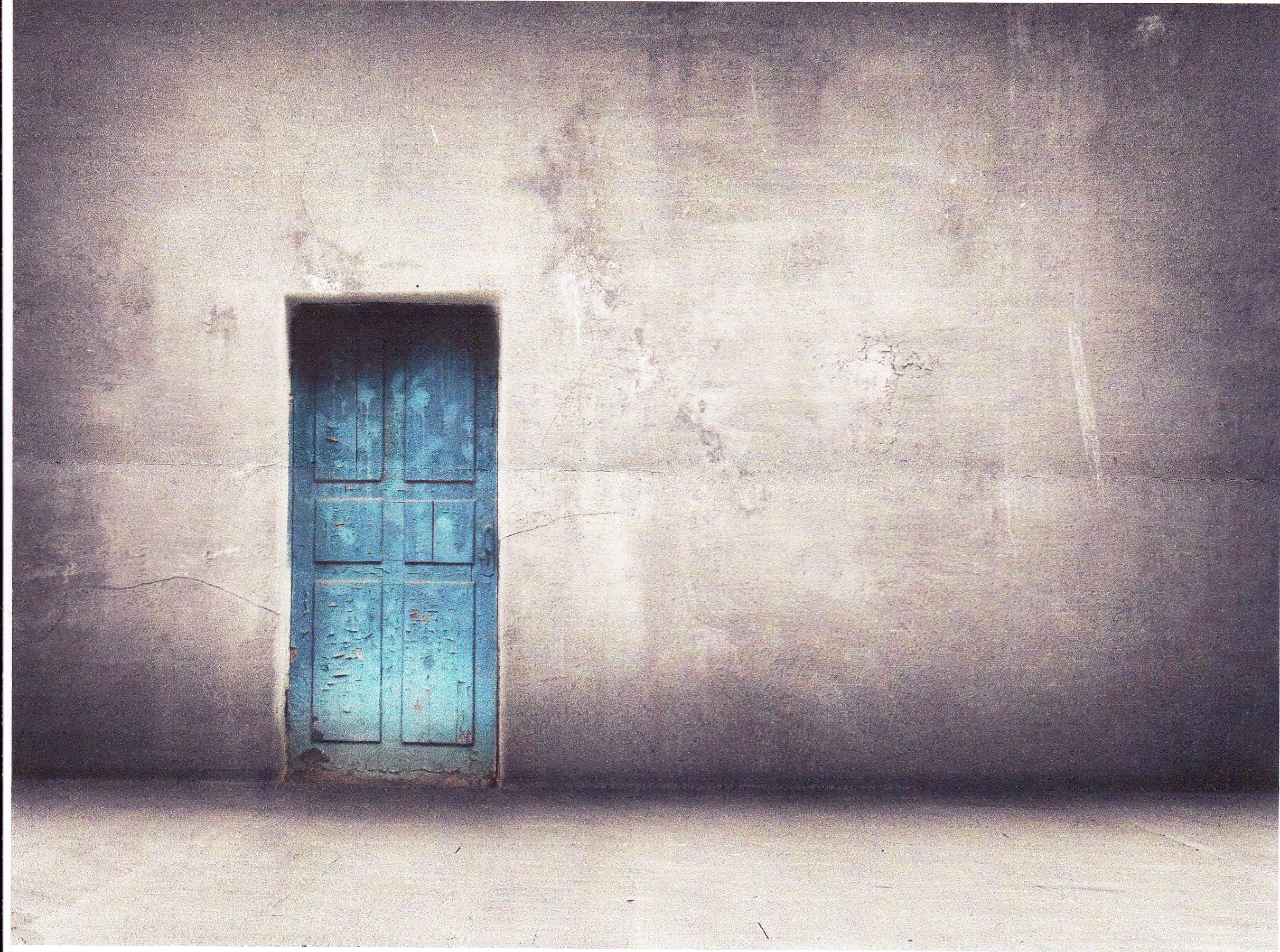
door

I opened the door and stepped inside. Shut it tight behind me. Shut all of it out.

The room was empty. Four grey, stone walls, with matching floor and ceiling. A single blue door facing me in the opposing wall, identical to the one I’d just shut behind me. I crossed the floor towards it.

I opened the door and stepped inside. Shut it tight behind me. Shut all of it out. Went further inside.

This room was also empty. Four grey, stone walls, with matching floor and ceiling. It was a little darker than the previous one, the only light pervading from the cracks around the door behind me, less light leaking through to this room than the one before. Otherwise it was a replica. A single blue door facing me in the opposing wall, identical to the one I’d just shut behind me. I crossed the floor towards it.

I opened the door and stepped inside. Shut it tight behind me. Shut all of it out. Went further inside. Further beyond reach.

The third room was empty. Four grey, stone walls, with matching floor and ceiling. The light was faint now, a pale glow describing a rectangle behind me, thin tendrils reaching into the room ahead. Enough to see that there was nothing to see except the familiar single blue door facing me in the opposing wall, identical to the one I’d just shut behind me. I crossed the floor towards it.

I opened the door and stepped inside. Shut it tight behind me. Shut all of it out. Went further inside. Further beyond reach and reason.

The fourth room – was it the fourth room – was empty. Four grey, stone walls, with matching floor and ceiling. It was quite dark now, the brief illumination as the door opened quickly fading. It didn’t matter as there was nothing to see, nothing here. Reflexively I crossed the floor towards where I know will be a single blue door in the opposing wall, identical to the one I’d just shut behind me.

I opened the door and stepped inside. Shut it tight behind me. Shut all of it out. Went further inside. Further beyond reach and reason. Was this far enough to be safe ? Or was this too far to come back ?

The next room, number five or six or seven, was also empty. Pitch dark and silent and empty. I had no reason to believe there was anything other than four grey, stone walls, with matching floor and ceiling. A single blue door in the opposing wall, identical to the one I’d just shut behind me, would be there if I was compelled to go further. This far in it was easy to lose orientation: was this further in or the way out ? If I wanted to get out could I find the way ? It is easy to find a way in here, there’s enough light to find a way in to the darkness, but so much harder to come out when the darkness has stolen the light. I hadn’t intended to come this far. A blue door in the opposing wall or is it the blue door in the original wall ?

I opened the door and stepped inside.

……

I have cheated a little here. This isn’t the piece that I wrote in Monday’s writing class but it is the piece that I wanted to write. I’ve posted it without rereading or editing so I may well look back at it and hate it but this was broadly what I wanted to write. The class revolved (pun possibly intended) around a set of pictures of doors – we had to pick one, make some initial notes of ideas it suggested to us, and then write a short piece.

I had a number of ideas but zeroed in on this door pretty much immediately and also knew pretty much immediately that what it suggested to me was a series of rooms that were all identical, repeating, with someone (me) disappearing further and further into them. It was a fairly straightforward metaphor for depression.

However, I wasn’t entirely sure I wanted to commit to that in the general bonhomie of the last-lesson-of-term and we only had about ten minutes… So instead I wrote a cheery piece on the idea of being tortured in some far flung prison, loosely inspired by Abu Ghraib. It’s not the sort of thing I’d usually write and I don’t think it’s that good to be honest but, I guess, that’s in part because my heart wasn’t really in it. Anyway, for posterity here it is (I would definitely lose the last line looking at it again):

Just before they shoved me inside the blindfold was ripped from my face. Harsh sunlight pierced my skull and I reflexively shut my eyes, the light playing across the inside of my lids even after they were closed.

A foot in the back of my knee forced me to kneel before I was urged back to my feet. I reached out my arm for purchase and grabbed at the door; a cool blue in a blank stone wall of grey. The door opened and I staggered in, managing two steps before sinking to my knees again. Adjusting to the relative gloom I blinked and glanced around, tried to take in where I was. It was a dark, square space, illuminated from behind me by the light streaming in through the door and ahead by a solitary bulb suspended from the ceiling. It hung above a simple metal chair in the middle of the stone floor. There was no other furniture save a large, deep sink on one wall, the tap dripping and with water pooling beneath from some rusted, leaking pipe. My eyes followed the shape of the pool as it edged into the room, finally reaching a carelessly tossed towel. The towel was stained red with something.

I was dragged back to my feet, weakly protesting, struggling in vain as they pulled me to the chair. Through the terror I realised the towel was stained with blood.

Mirror in the mirror

19. Spiegel im Spiegel – Arvo Part                                                                                          2011

More than any other record in this list I would urge you, before you read any further, to take ten minutes out and just listen to this one. Quite aside what it means to me and the associations it has it is a sublimely beautiful piece. If you’ve never heard it then it’s worth hearing “clean” before  anything I might have to say about it becomes part of your association to it.

Back ? Good. It’s quite something isn’t it ?

My usual start point in approaching any of these posts is to try to learn a little more about the record in question, mostly by listening to it but also by reading about it. Sometimes the latter exercise throws some new light on the music for me but often it’s just checking things I’d always assumed as fact: Abba getting divorced, Al Kooper sitting in on “Like A Rolling Stone” by accident, the difficult gestation of The Wall. I’m not sure what those facts add. I’m not sure that they particularly tell me, or you, anything about my relationship with the record. Not really. They tell you I can find my way around Wikipedia, probably know a little bit of this stuff anyway after *cough* roughly thirty years of listening to music, but beyond that ?

There have been pieces that have gotten closer to the spirit of what I’ve been trying to do I guess. The posts that reflect my love for my wife and family, that’s closer. The poetry. The thinly disguised fiction. All closer. All harder for me to do and all somewhat clumsily executed. But closer I think. I’m always simultaneously most satisfied and most disappointed with those ones  – satisfied that I tried and that it rings emotionally true, disappointed that it’s not better written. The other stuff is enjoyable (to me) but I’m less sure what it’s for – the Dylan piece, for example, is okay but the bulk of it, despite its early protestations to the contrary, is trying to do a Greil Marcus-esque job and there’s really no need; he’s pretty good at doing that job already. The more personal bit, the section about “having no secrets to conceal” flirts with something emotionally true to me and then gets cold feet, backs away.

The reality is that there is no “big” secret to conceal. The truth is that I suffer from – or suffer with might be more accurate – depression. Some days it’s bad. Some days, most days fortunately, I don’t really feel it at all. I’ve had long stretches of years in my life without a murmur. Then, in the last couple of years, I’ve had stretches when it’s gotten on top of me, been in danger of being swallowed by the rising tide.

Not every song in this list is about depression (“thank god” – entire rest of reading world*) but this one, for me, is. It’s the one that let me admit to myself what the problem was and start to get some help.

So, back to my usual approach, if we research “Spiegel im Spiegel” then we get something like this (it’s from Wikipedia – as I know absolutely nothing about classical music then I’m prepared to trust it as a reliable guide…):

Spiegel im Spiegel is a piece of music written by Arvo Part in 1978 just prior to his departure from Estonia. The piece is in the tintinnabular style of composition, wherein a melodic voice, operating over diatonic scales, and tintinnabular voice, operating within a triad on the tonic, accompany each other. It is about ten minutes long.

Okay. I got the bit about Estonia. 1978. Ten minutes long. That stuff in the middle might as well have been in Estonian for all I was able to understand it and, do you know what, even if I possessed the technical knowledge to decipher the sentence it still would have told me precisely nothing about my involvement with that piece of music. But that’s what I do, I try to understand stuff – try to take the songs apart to see what makes them work – rather than just sometimes experience it. In microcosm it’s what I do in life, I’m not happy unless I can rationalise something – solve it by understanding it – and sometimes there isn’t a rationale. Sometimes you just have to experience it, let yourself feel it, and wait for it to pass.

I don’t even remember how I found this piece of music. Poking around the web now there seems to be some concern that it’s almost become too ubiquitous, if something can be too ubiquitous. Is it one of those absolutes like unique ? Whatever, it was a surprise to me that it’s well known enough to even provoke a debate. It’s an odd thing to just find though, almost ten minutes of minimalist classical music – it’s not even as if any of the various algorithm sites I sometimes use would have thrown it up as a “people who liked… also liked…” recommendation. Let’s accept it as a gift and call it fate.

My memory of hearing it, whilst not a happy one, is crystal clear. I was lying on the sofa at home. I was spending a lot of time doing that, dimly aware that all was not entirely well. There had been an unprecedented run of what you might call bad luck or you might just figure was how life plays out sometimes; losing a job, struggling a bit with loss of status in a new one, reconstructing my knee (again), some unexpected and particularly unpleasant surgery, and discovering that I’d managed to displace my jaw joint. Away from my house you would never have known. Maybe that was part of the problem, trying to tackle it all myself for fear of letting anyone know that I was struggling. My wife knew of course and I will be forever sorry for the burden that it placed on her.

The circumstantial stuff wasn’t the real issue though. Each element on its own wasn’t ideal but was manageable. Even all of them together might have been okay if I’d not been pre-disposed to mental health problems. Am I pre-disposed ? Is anyone ? Maybe that’s the wrong phrasing. I’ve certainly suffered at various times in my life with mental health problems and this set of challenges pushed me further and further back into myself until I thought I couldn’t get out.

And then I heard this. Whilst that sounds a bit like it’s come straight from the “and with a single bound he was free” school of deus ex machina it genuinely was like that. I lay on the sofa listening to this and it was like someone had thrown me down a torch into the dark pit that I’d taken up residence in – the torch lasted long enough for me to see where I was and realise I was in trouble and probably wasn’t going to get out on my own. It enabled me to see myself very clearly. I don’t know if it’s the repetition or the tempo or just the still tranquility in this piece of music but whatever it is it just allowed me enough space and distance to understand.

Part moved from Estonia and spent much of his life in Berlin. I never studied German and know next to nothing of the language. Until I started this post in my usual researching fashion it didn’t even occur to me to translate the title: it means “mirror in the mirror”. Imagining two mirrors, endlessly reflecting themselves, disappearing into infinity in their planes, is absolutely the essence of how “Spiegel im Spiegel” works for me. For me it’s profoundly moving and desperately sad but also meditative and extraordinarily beautiful.

So it might seem a little strange to be so forthcoming now but there is method in my madness. After a while it’s just tiring carrying around the lie that everything’s always okay. Not allowing the bad stuff expression becomes part of the problem. It’s not about sympathy but I guess it is about empathy. It’s also an acknowledgement that lots of people either have or will experience something like this in their life and I guess this is my small attempt to let them know that I can empathise with that and that things can get better. Don’t try to do it on your own though. People will surprise you (in a good way). Find a doctor, find a therapist, find your family and friends, and they will help you find yourself.

——–

* based on current stats “entire rest of reading world” actually means about 4 or 5 people a day. Surely one will go viral one day ? What’s that you say ? Less depression, more videos about cats. Ah, now I see where this is going wrong…

Look ! A cat:

DSC00127

As long as we keep our stride, I believe we’ll be fine…

13. Walking To Do – Ted Leo & The Pharmacists                                         2013 and the future

I had a wobble today. A sense of wondering what the point in carrying on with this was. Maybe I’d gotten a little too obsessed with the WordPress stats page (there’s nothing more dispiriting than a day of no visitors and no views) and a little removed from the original point in writing again.

So what was the original point ? I guess it was a combination of things. In part a recognition that, in some shape or form, putting thoughts down on paper (in actuality or virtually) has been a part of my life since I was 12 or 13 and not doing it cuts off an important outlet for me. Also, in part, a desire to prove to myself that I could commit to and complete a writing project of a certain size and scale – this was a way in, a route to getting past a novel length number of words within a defined timescale. The 42 was plucked somewhat arbitrarily based on my age at upcoming birthday next February and, slightly more esoterically, as a reference to the answer to life, the universe and everything from “The Hitch-Hiker’s Guide To The Galaxy”. There have been a number of occasions in the last few weeks when I wished I’d picked a nice, round, small number like 20. Finally, the point was that this was intended to be about me as much as it was about a bunch of records – a means for me to work some stuff out after a difficult couple of years. My choosing to do that in a public space stemmed from a genuine desire to connect with people, both people I already know, and maybe people that just found this stuff. Being honest about certain things – not always being okay, depression, a love of country music – has generally been a positive experience and prompted a richer connection with people. Not everyone obviously, I appreciate the country music thing is hard for some people to accept.

There’s a place I go sometimes and I don’t know how I get there. Why would I ? It’s not somewhere I want to go, just somewhere I end up. It’s a place where I’m locked away inside myself. Stuck. There’s a bunch of metaphors that I’ve thought to myself when I’m there – it’s like being deep under water, not able to surface; it’s like being overrun with weeds, nothing else can grow; it’s like being in a cave, it’s dark and you can’t find the way out. None of them are really adequate and I don’t have the breadth of expression in my writing to explain it. Put in clinical terms it’s depression and it’s fucking horrible.

I wasn’t there today but there was a wobble. I was a bit flat. Could hear that, at first, small, insistent voice that wanted to just give in, sink into it, and stop bothering with anything. Because: what’s the point ? I was trying to write. Trying to force some words out about Springsteen’s “The Wild, The Innocent & The E-Street Shuffle” and feeling mildly intimidated by it. The record is so good and he’s so important to me – in a way far beyond anyone else covered on the 42 so far – that I’ve been running a bit scared of trying to tackle it. My gung ho attitude to it first thing this morning (the product of a couple of weeks of pure, unambiguous happiness and contentment) quickly evaporated as I got stuck in clichés about melting pots of musical styles and hyperbole about New Jersey’s favourite son. Or at least that’s how it felt to me. Reading it back some of it’s not so terrible.

So I stopped doing that. I stopped doing that and, perhaps with half an eye on the weeds analogy above, I raked leaves up in the garden. If you know me at all you’ll know that this is somewhat out of character. In fact, I believe it may be the first time in my life that I’ve raked leaves in my garden. After all, what’s the point ? They’ll only fall down again next Autumn.

But there was something in it that got me to thinking about tending. Obviously, in a literal sense, about tending to the garden but – and here’s that forced metaphor again – also about tending to myself. It was the first time in a long time that I’d been aware of that nagging, disruptive, unhealthy voice in my head telling me that I was worthless and had chosen to quiet it. Not in a dramatic way, just in the simple act of finding something else to do. In not continuing to bang my head against its own internal brick wall. That image doesn’t work does it ? How can you bang your head internally ? You get the general idea. There’s a wonderful bit in the Steve Coogan / Rob Brydon series “The Trip” (which I’ve already referenced in “The Winner Takes It All” piece) where Coogan trys to cross a river across a series of stepping stones but gets stuck, and subsequently falls in. Brydon baits him by shouting “you’ve got stuck halfway to your destination, you’re stuck in a metaphor”. Well, clearing the lawn of leaves I was stuck in my own.

When I came back into the house the record that I put on was this one. It was deliberately chosen because it has become my go-to record for hope, for determination, and for helping me believe that everything will be okay. It’s not a record that’s specifically about depression but it acknowledges that life sometimes throws up the “cruel and hard” but that you’ll be fine if you stay on your feet and keep walking. It’s enough in the ballpark of how I feel for me to force my own interpretation onto it – to adopt its positivity and spirit as rallying cries. If we were doing a quick round of “what’s your theme song” (really ? you’ve never done that ? must just be me) then, lately, I’ve tried to make this mine.

It’s fairly straightforward lyrically, adopting an extended metaphor about life being a journey to be walked through and how two people can draw strength from each other by walking alongside each other. There’s a neat rejection, early on, of the idea that meaning in life comes from some external, higher power:

Would you take me where my feet feel happy in their own time

And the cathedral of reason let’s the bells chime

And the lighting is fine ?

I’m old enough to know that people waiting for some big sign

Should quit their waiting on the Divine

Divine is what’s in your mind

From then on it’s a message of companionship and support – a sharing of the journey, a sharing of perspectives – and a clarion call that there’s more to do, more to see:

I see the road is long so get on my side – there’s a whole lot of walking to do

And if we stay on our feet, we’ll make it in our own time

And though the road has got some steep climbs, I believe we’ll be fine

Towards the close there’s a quieter section (you musician types might refer to this as “the break down”) which, literally, recounts the places that the singer and companion have journeyed together: my house to your house, Bethnal Green to the tube, Aoyama to Shobuya, Rock Park Creek to the Avenue, and on past the zoo… There’s a whole lot of walking to do. It’s brilliantly done, rooting the song back in reality after the abstracts of the original analogy: this is where we’ve already come from, where we’ve already been… Still lots of places, literally and figuratively, to go in future.

Right at the close the song unwinds with a jubilant call and response, pitched full of joy, life and defiance:

Well I’m here – and you’re here – and it’s true: there’s a whole lot of walking to do

And I’m cool – and you’re cool – and it’s true: there’s a whole lot of walking to do

There’s no fuss and I trust – I trust you: there’s a whole lot of walking to do

And you’re strong and I can be too: there’s a whole lot of walking to do

And you do – and I do – there’s a whole lot of walking to do

There’s a clue too in the “you do, and I do” that the companion in this song is Leo’s wife, which clearly makes sense in the context of the rest of the song. I always take that as my read anyway and this is another song that reminds me of the continued strength and support of my own wife. I always think of her in that final section of the song.

It finally ends with the sound of glasses chinking as if everyone’s sat in a bar, surrounded by friends, and enjoying life. I adore the end of this song. I adore the whole song and am indebted to a very old friend for introducing me to Ted Leo. I love that it doesn’t gloss over that life can be hard but that it’s okay, if we stick together we can get through it. I love that, musically, it kicks righteous ass: if you want to ignore the words and just jump around inanely to it, go right ahead, this song will serve you well. I love that it’s smart; richly observed without disappearing up its own arse (which may or may not be where I’m currently headed). But whatever, love makes you crazy and I love this song.

So, now we’re a long way from the wobble. A long way from the deep sea depths or the choking weeds or the cave. We’re out in the open, drinking in the air, grateful for being alive, for sharing it with some incredible people, and with some belief that there’s more to come. And that it will be good.

There’s a whole lot of walking to do.

Our Lady, Star Of The Sea

5. Stella Maris – Moby                                                               When: 2011

“Stella Maris” (Latin: star of the sea) is often used in reference to the Virgin Mary – known in English as Our Lady, Star Of The Sea – and also as a name for Polaris, the North Star. Either way it’s a point of guidance – for lost sailors and lost souls.

The extraordinary Moby track of the same name takes some familiar Moby tropes – appropriated vocal, huge synth chords, a slavering of strings – and blends them into a moving, redemptive piece of music. It’s built from a 12th century plainsong recorded by Trio Mediaeval; a simple but stunning, haunting vocal over a dirge (the original is here and is amazing). Moby distorts and buries the voice beneath those patented, enormous synths, producing an effect that’s akin to half hearing them through ears clogged with water. They’re there but dislocated, distorted, displaced – the purity of the voice struggling to be heard.

There are some records which bypass parts of my conscious, rational mind and cut straight to an emotional truth. This track, by turns breathtakingly beautiful and achingly sad, has the capacity to unlock me with ease. I’ve long believed I’m principally driven by a rational approach to life but, the older (and madder) I’ve got the more I’ve come to appreciate, if not fully understand, that as fallacy. If internalisation was an Olympic sport then, frankly, don’t even show up – I’m taking home that gold medal – and it’s only through external agents that some of the forces at play inside of me find a way out. This is one such agent.

It’s interesting that, effectively, the song has no words – the original piece is in Latin and is rendered largely incoherent in the production anyway. The response engendered – that’s beautiful, that’s colossally sad­, that’s like, to nick another Moby song title, the face of god moving over the water – is a gut response to the music. And I can’t deconstruct that. I neither know enough, technically, about how it’s achieved nor have the understanding of why a particularly assembled set of notes and instruments can make the hair on the nape of your neck stand up, or make you cry, or make you dance. “Stella Maris” is not much of a dancer.

As I can’t deconstruct, and in the spirit of National Poetry Day (October 3rd), I thought I’d attempt to construct. This isn’t an attempt at lyrics that the song doesn’t need, rather it’s my closest approximation for how it makes me feel or how it allows me to reference a state of feeling that I am familiar with.

Star Of The Sea

Submerged, sinking, lost, and

Drifting within the murk

Beneath the waves.

Ebbing, flowing.

Immune to the swell; the rise and fall, the salt’s lash.

But trapped; wrecked.

……

Drowning, silent, alone, and

Accepting the deep embrace

Of the implacable sea.

Falling, fading.

Untouched by the storm; the gusting gale, the stinging hail.

But dislocated; numb.

……

An echoing tone through the depths, penetrates.

A light in the gloom,

Distant but fixed, guiding me home.

Surging, rising.

It speaks of water becalmed, of skies quiet and clear.

Breaking surface; released.

……

They sing: don’t look back, don’t be scared, don’t be scared.

4. Engine To Turn – Tift Merritt                                                             When: Summer 2013

“A musician must make music, an artist must paint, a poet must write, if he is to be at peace with himself. What a man can be, he must be.” Abraham Maslow

Songs can save lives. They can enrich, nourish, bring hope, ease pain, and give expression and outlet to feelings that might otherwise overwhelm.

Three months ago I stood below deck on a moored boat in Bristol, beer in hand, and waited for Tift Merritt to perform. I was all over the place. Two years, perhaps more, of surgery, ill health, redundancy, change, lack of control, listlessness, and uncertainty had coalesced into a series of panic attacks. Constriction of the chest, shortness of breath, a chorus of competing voices yelling for attention in my head; no idea which of them to listen to first. Or whether to listen to any of them. Emotionally and mentally I had run out of road – exhausted – and my body just shut me down.

It’s a terrifying experience to wake up in the middle of the night unable to breathe, heart accelerating in your chest like it’s trying to hit enough speed to break out. I thought I was having a cardiac arrest. Doctor checked everything out and all was fine. Except, obviously, it wasn’t. I was mainlining adrenaline and cortisol, a primitive physiological response to stimulus, to stress.

Societally stress is a loaded word. Sometimes used blithely, mundanely (“stop doing that, you’re stressing me out”) but in its clinical manifestation it’s anything but mundane. And it’s hard to empathise with, to understand. Tolerances are so different, symptoms vary, and causes are wide ranging: one person’s bad couple of years is another’s exciting set of opportunities. I can tell you about the ruptured ligament in my knee and the resulting operations and it’s easy, you’ll “get it”, you can understand the mechanics of it. To tell you about my battles with depression, with an unspecified mental malaise, will be a little harder. I may need to hide behind some records. I may need as many as 42.

So, back on board The Thekla, moored and anchored – ain’t it grand when life throws you a free metaphor ? Tift Merritt is touring her wonderful new album, “Travelling Alone”, and takes to the stage, opening with “Engine To Turn” from her previous record, “See You On The Moon”. It’s one of my favourite songs of hers and, in the space of three minutes, it strips everything away, helps me let go of everything I’ve been holding on to – some of which is profoundly damaging to me – and all that’s left is me, a beer in one hand, my wife’s hand in the other, and the opportunity to listen to a great singer perform. Tears roll down my face and I lose myself in the next 75 minutes of the gig.

“Engine To Turn” is, like much of Merritt’s later work, a deceptively simple song. Four chords; verse, chorus, verse, chorus, bridge, chorus. Lyrically direct, honest, straight, unadorned. Within familiar forms she addresses universal themes – there’s no mistaking what the song is broadly about but it leaves enough space for you to layer in your own experience, for the words to attach themselves to your own meaning.

From the outset the song sets out its challenge, opening up a theme – uncertainty – which has already cropped up in the 42 and, no doubt, will again:

I don’t know how to fix the world.

I don’t know how to fix myself.

Clearly for me personally this strongly resonates, speaking directly to a sense of being unwell, of being broken, and not being entirely clear what to do about it. This is further explored in the metaphor that gives the song its title – “I’m just trying to get the engine to turn”. The machinery is all there but it won’t come to life and typically, to extend the motif, an engine either needs fuel or a spark to get going. As I wrote earlier, I was running on empty, had run out of road. Any more car imagery and this is in danger of turning into a Springsteen song…

However, this isn’t a song that wallows in its own uncertainty, it’s not a pessimistic lament to a life without meaning. There are solutions here, simple articulations of what might work:

…seems like some tenderness could turn the whole thing around…

…seems like I ought to slow down…

…maybe the pieces are here if I just took a good look around…

And finally there’s an almost defiant statement of intent that closes each chorus and, ultimately, the song:

I’m just trying to smile through my tears
And I still got so much to learn

But the best I can is what I have to give

Gonna give it while I’m here 

Not beaten. Unbowed. Determined. An eloquent expression of, perhaps, all that life is about.

The final chorus is prefaced by the wonderful bridge, an internal rallying cry that’s the exact opposite of my previously referenced competing voices yelling for attention:

Sometimes there’s a choir in my head

Singing at the top of its voice

Singing at the top of its voice

They sing: don’t look back

Don’t be scared

Don’t be scared

If, at risk of sounding like an X-factor contestant, my “journey” towards dealing with my own demons (and its expression through these words) is about anything then it’s about finding a way for these shouting, squabbling, picky, destructive, competing voices in my head to cohere into a choir that sings up in defiance, support and reassurance.

There’s a Bukowski quote that feels apposite with respect to Merritt’s work over her last couple of records, and particularly so with respect to “Engine To Turn”:  “An intellectual says a simple thing in a hard way. An artist says a hard thing in a simple way.

There’s presumably a story to be told about Merritt’s career, from feted Americana star (debut “Bramble Rose”) to Grammy nomination (second album “Tambourine”), being dropped by Lost Highway, her label, moving to Paris, then to New York, and ultimately recording another three fine singer-songwriter records in the best traditions of Carole King, Lucinda Williams, or Emmylou Harris. But, interesting story that it is, my connection to her, my interest in her, is through her work – through what seems to be her ongoing assertion of personal and artistic integrity and growth. There’s a great recent interview with Backseat Mafia here which explores some of this territory.

Since that relative commercial failure of second album “Tambourine” and the subsequent fall out, Merritt has mined a progressively simpler, sparser seam of songs. In paring back the production and some of the instrumentation in the songs all that’s left is the craft of her songwriting. It says much about her skill that her work sounds just as vital now, if not more so, when delivered with just a voice and acoustic guitar as it did backed by a full band, Memphis style horns, and George Drakoulias production.

In many respects it’s a travesty that her audience in the UK is so limited, there must have been 80 of us at The Thekla on a Friday night. However, I suspect that’s no longer her overriding motivation. There are times in the performance that I saw – and also when I saw her play solo at The Radcliffe Centre in Buckingham (a converted church with a grand piano and great acoustics) a couple of years ago – when she and the band are transported in the performance, caught in a moment in which everything else falls away. The Maslow quote that opens this piece about sums it up; the impulse to create, the impulse to connect, irrespective of the size of the crowd, seems to be the motivating force at work. I can’t speak for the rest of the audience but she created a moment that allowed me to, if only briefly, let go of my troubles and regain some perspective. Music can do that.

Songs can save lives. Don’t be scared. Bukowski again: “We are here to laugh at the odds and live our lives so well that Death will tremble to take us”. Now to work on getting my choir to believe it and sing it loudly and often.