My 10 rules for writing

It was the last class of my local writing group on Monday, a long break for the summer until we reconvene in September. I’ll mop up a couple of loose ends later in the week but, for now, here’s my homework from the previous week. The brief was “10 excuses for not doing your homework” which I altered a bit, inspired by the memory of a corporate, motivational, change-your-life style speaker I saw last year at a work event (guy called Jim Lawless who has a book out called “10 rules for Taming Tigers”). That day is a story for another time…

So here, not entirely seriously, are 10 rules for doing your writing homework. The only other things you might need to know are that Sally is the name of the person that keeps our motley crew in good order and leggy blondes are a standing, group in-joke.

  1. Write it. Just write it. Scribbled on a napkin, scrawled in a book, typed neatly on a page – it doesn’t matter. Just put words down on some kind of page in some kind of order. Grammar is optional. Spelling is for spell checkers. Write.
  2. Ignore the instructions. Sally won’t mind. If no inspiration comes based on the instructions then ignore them in deference to rule 1.
  3. Don’t count words. Make words count.
  4. Take inspiration from wherever you can. Sometimes this may involve stealing stuff and making it your own. I must have stolen number 3.
  5. Don’t measure the worth of your work against other people’s. You’re probably not going to write “Hamlet” but then Shakespeare might not have done either. Marlowe always seemed quite plausible to me.
  6. If you get stuck just write something else. Edit later. Research later (or possibly earlier). They’re different things.
  7. A leggy blonde will always help any story. And so will the marvelous people at your local writing group.
  8. No one can really tell you exactly how to do it. Whilst this may seem disheartening it also means no one can really tell you that you’re doing it wrong.
  9. You’ll probably be your own harshest critic. Let someone else read what you write and you might be pleasantly surprised. If you’re not pleasantly surprised then defer to rule 8 and ignore them.
  10. Ten rules seems overly complicated for what is essentially a process of making stuff up and writing it down. So ignore all of this. Except the first one. Write.

I must be losing my mind

37. Lazarus – The Boo Radleys (with guest appearances from “Indian” – The Cult and “Finest Worksong” – REM)

A cautionary tale from a more guilty time…

Where are they ? Where the fuck are they ? It’s been too long. Something must be wrong, properly wrong. Must be wrong to have been this long. Too long. Too, too long. Wrong. Wrooong. Fuck. Get a grip. Concentrate. Think. Mind enhancing, isn’t that what this is supposed to be ? An upgrade. A stepping up and out of normal consciousness. So thinking shouldn’t be too hard. It should be easier and better in fact. Shouldn’t get stuck on an echoing rhyme of long and wrong bouncing around endlessly in my head. Long. Wrong. Long. How long could this go on ? And not be wrong ? Or be wrong ? How long ?

I seem to have lost something here. It might be my mind. If I sit very, very still perhaps nobody will notice. Not that anyone is here anymore, only me and Andy. He won’t have lost his mind, I think he’s used to the artificial enhancement. I better not let on that mine may have been misplaced, it won’t look good, will make it look like I don’t know what I’m doing. I should let you in on a secret though – I don’t actually know what I’m doing. But if I sit here very, very still and just listen to these songs then nobody need know and in a few hours I expect – at least I’ve been told – that I will find my mind again. The mind I will find. A mind find.

Focus. Don’t start all that again. He will suspect if you start all that again, the rhyming of a madman. Although I don’t think I said it out loud so how would he know ? It feels like he would know. He seems calm, just sitting there listening to the songs, so that’s what I need to be. He seemed pretty calm when we rang the ambulance, the only one thinking we should get out of the house and find a phone box. Best not let them know where we are. Smart thinking. We were just panicking. He seemed calm when the ambulance picked them up. I’m glad he didn’t go with them. He’s the only one who knows what’s going on so I’m glad he stayed. He can’t have been completely calm though because as we were walking back across that petrol station forecourt he didn’t seem to see the fuel lorry siphoning its load into the ground. He can’t have seen it otherwise he wouldn’t have lit that fag as we walked by. We both saw the guy come running out of the booth shouting and waving his hands. We ran.

There could have been an explosion. A spark was all it needed. Like the ones he’s making now, running his thumb around the wheel of that lighter, holding it upside down and watching the flame invert itself. Why does it do that ? I should know this. Heat rises, maybe that’s it. Maybe the flame rises too. Maybe I’ve been looking at that flame for a long time now. It feels like a long time. Best look away before he gets suspicious. Just listen to the songs.

He’s rewinding the tape again. How many times is that ? The same three songs over and over again. “Lazarus” and that one by The Cult and then REM, “Finest Worksong”. Bliss. Despair. Hope. Again and again and again. Did he only tape three songs ‘cos they’re all so long ? So long and not wrong. Steady, hang in there, focus. I know these songs and they’re not that long. Time stretching out and out and out must be one of the enhancements. Only that Cult song – what’s it called, Indian Woman or something – sounds so bleak and I don’t want it to go on and on and on. Standing at the edge of the world. Me too Ian, me too. What happened to you and Billy Duffy after Love anyway ? He suddenly learned the guitar as if he’d had a time machine like at the end of Bill & Ted’s Excellent Adventure and you uncovered some long lost Native American heritage and started prancing around with feathers in your hair. Maybe you had some of what we’ve had. Come to think of it you probably had quite a lot. Where do you get the Native American stuff ? Peyote. That’s it. Rhymes with coyote. Shit – where is my mind ?

Standing at the edge of the world… Wonder where they are ? They must have gotten to the hospital by now. Ages ago in fact. We’ve listened to these three songs – the longest, longest songs in the world, the longest songs ever recorded – at least four times so hours must have been and passed. I can’t listen to this one again. I need to tell Andy to turn it off. That refrain, it’s killing me. What if they are standing at the edge of the world ? Not literally. I haven’t lost that much of my mind. Just misplaced some of it. Not literally. What if they lost theirs and they can’t find it again ? He seemed pretty out of it. We’re all pretty out of it. Keeping clear of heavy machinery might be a good idea. What’s Andy doing skinning up again ? Surely that’s not a good idea ? In for a penny I guess.

It started well. That’s what we’ll probably say later when we’re laughing about it. It started well. Like these songs. Wait for Lazarus to come back on ‘cos that’s kind of how it started. A slow vibrating, swelling noise – dislocated shapes echoing out of the silence. Shapes ? Shapes don’t echo. Ignore me, I’m wasted. Settling into that dub bass with the fragments of feedback sounding queasily in the background, everything shifting and sliding slowly out of the old focus and into something different. Shaking your head as if descending into a dream and then that build into the trumpet, rising, rising, swelling and rising, peaking and climbing, a wave crashing over the sea wall you’ve put up around your consciousness. Jesus I am wasted. But that’s how it started. The song ? Not just the song.

I must be losing my mind…. It’s right there in the first verse. It’s not like they’re hiding these clues. It’s not particularly oblique. I must be losing my mind. Lost it and bought the tee shirt. Lost it and we’re a man down, carted off for an adventure in A&E whilst we sit here in silence and listen because we don’t know what else to do and don’t have control of our brains anymore. But it started well.

And now it’s The Cult again and standing at the edge of the world and, presumably, slipping off the edge of the world and tumbling into some terrible abyss, never to return. Except… except hang in there for a few minutes – it will feel like a few hours but believe that it’s a few minutes – and REM will roll around again. “Finest Worksong” is the most aptly titled song in the world. Listen to it blazing out of that cheap little tape player, all defiance and pride and get-up-and-go. I want to roll up my sleeves. Andy wants to roll up a joint. He is rolling one up. No wonder we’re not finding our minds, he must have done this every time that song has come on. Worksong, roll one up. Rewind tape. Smoke joint. Listen to Lazarus and believe we are touching the outer limits of a higher state of being. Finish smoking. Listen to The Cult and believe we are about to be pitched into the deepest reaches of hell itself, taunted by Ian Astbury, possibly brandishing a tomahawk. Worksong. Repeat. Must break the cycle but unable to speak. This way madness lies…

What was that ? What the hell was that ? Shit, it’s the phone. It’s… Andy’s answering. How can he still function ? What ? They’re okay ? They’re sitting behind a curtain in A&E on a bed laughing their heads off whilst we’ve been here in despair with Ian Astbury and REM and The Boo Radleys ? If I had any pieces of my mind left I’d be giving them one now. But they’re alright. And that means we’ll be alright.

Sanvean

36. Sanvean (I Am Your Shadow) – Lisa Gerrard

There’s a moment in The Rolling Stones’ “Gimme Shelter”, about three minutes in, when Merry Clayton, in duet with Jagger, gives herself over to her performance so completely that Jagger is spontaneously moved to acknowledge what he’s hearing. Her voice threatens to break open, cracks on the line “murder yeah”, and he lets out a gleeful, slightly awed “woo” in response; completely natural, unforced and without artifice. Clayton had been called up in the middle of the night to see if she would come down to the studio to record a vocal. She hadn’t heard of the Stones but, encouraged by her husband, she duly turned up, hair still in curlers, and talked through the lyrics before delivering her peerless performance in two or three takes. She was pregnant at the time and sang sitting on a stool. Tragically she miscarried later that night, possibly a result of the stress and strain in the performance.

Even stripped of the surrounding context it’s an astonishing recorded moment, you don’t need Clayton’s back story to recognise the brilliance and intensity of her performance. Knowing it makes the song even more chilling. It’s telling that trying to replicate Jagger’s response comes across as a little flat on the page: “woo”. That is broadly, phonetically, the sound he makes but it’s nigh on impossible to impart the complex range of feeling, from encouragement to admiration to delight to astonishment, that he lets slip in one sound without actually hearing it. Similarly noting that Clayton’s delivery “cracked” in the verse scarcely does justice to the ragged, impassioned, desperate pleading in her voice unless you hear the tones and textures as well as listen to or read the words. You can hear the song here (link) introduced by Clayton’s vocal separated out as an individual track: it is magnificent, terrifying, and simultaneously one of the most inspirational and heart breaking things I’ve ever heard.

Music can tap emotion directly. I think, when you strip away everything else I’ve written in the 42 so far, that’s what it fundamentally does for me. In hearing the direct expression of feelings in a performance I can experience more fully my own. It might be too simplistic to say, to paraphrase Nick Hornby, that I particularly listen to sad songs because I feel sad but there’s some truth in that. I do genuinely think there’s solace there too, I think that in experiencing that sadness it makes me feel better – this isn’t just a form of emotional masochism. Or at least I don’t think it is.

There’s a host of singers who express aspects of the human condition through sound – rather than just through their lyrics – for me. It’s why I’m generally not particularly fussed by overly technical singers; someone hitting a note beyond the seventh octave leaves me cold if it’s done just for the sake of showboating and doesn’t serve the song. There has to be, as Bruce Lee might put it, emotional content: don’t miss all that heavenly glory and all that. So I hear it as plainly in Jeff Buckley’s pitch perfect cry at the end of “Grace” just as I hear it in Kurt Cobain’s somewhat more ragged screams throughout Nirvana’s songs. It’s there in Future Island’s Sam Herring’s last-chance-saloon performance on Letterman – grunts and growls and vocal tics – and it’s there in Sinead O’Connor’s take on Prince’s “Nothing Compares 2 U” (it’s there with or without the tear rolling down her cheek in the video). Dusty Springfield had it in spades (listen to the majestic Goffin / King song “Goin’ Back”) and so did Amy Winehouse – away from all the attendant bullshit that surrounded her life just listen to “Back To Black” and it is an extraordinary record.

At the extreme end of that spectrum of singers that really connect with their song is Lisa Gerrard. Former singer with Dead Can Dance, and latterly probably most famous as the vocalist on much of Hans Zimmer’s Gladiator soundtrack, Gerrard often sings in her own fabricated language. There is no room for words to either help or hinder the delivery of her message: if they mean anything at all then only she knows. As a listener you’re free to purely experience the sound of her voice and allow it to provoke or evoke.

I have very little idea as to what “Sanvean (I Am Your Shadow)” is officially about. By officially I mean what the artist may have said it’s about. There’s relatively little about it to be found online beyond some odd speculation (“is it sung in Algerian ?” – no it isn’t) and Gerrard only gives away that it was written at a time when she was missing her children who were in a different country. For me there’s certainly a deep sense of melancholy in the song, a bottomless, beautiful sadness conjured in her haunting vocal. On some level I had always taken death as one of the themes of the song, it always feels like there’s a sense of mourning in her voice here – a keening quality that conveys both the release and sorrow in that final parting. On that read I guess the “shadow” could be referenced almost directly as some sort of spectral, ghostly presence watching over those left behind – whereas if it’s a more straightforward lament to missing her children then the shadow is just a reminder that she’s always with them even when far away. It’s possible that my read has been influenced by the song’s appearance in West Wing episode “7A WF 83429” – although explicitly used to reference the mobilisation of troops to recover President Bartlet’s daughter the prospect of death hangs pretty heavily over the entire scene.

Almost irrespective of the specifics the song is quite simply utterly mesmerising, almost transcendentally beautiful. I tinker with writing and I can find my way around a guitar so, often, I can at the very least begin to understand the mechanics of a song. Whilst I couldn’t create any of the songs in this series of posts in most cases I have some comprehension for how they work, how they’re built. “Sanvean” exists way beyond my comprehension and I can understand why some people have been moved to write (in various places on the web) that they detect something spiritual here, the presence of God. That’s not to say that I entirely agree – the song hasn’t caused an epiphanous turnaround in my atheism – but it gives me pause. There is something spiritual here and something deeply, profoundly moving.

When my daughter is older and wants to talk about what I believe constitutes a human soul I think I will play her this by way of a start.

The moon and shadow

Just Write (belated catchup): June 9th

I have been somewhat slack in typing up any and all output from recent writing group classes so back to the meeting from the 9th. We spun together a story based on a three stage trigger – a set of three top-of-mind nouns, an imagined landscape, and a character we’d never really thought about before. So, here’s what came of that:

……

Lana jumped on the the back of the mech-bus as it began to move, her umbrella pulling itself shut automatically behind her. She didn’t much notice as the mirco evaporators briefly flared, harvesting and stray water molecules from the umbrella’s surface. Damn pilots she thought. Since they put through that AI upgrade you might as well forget the timetables. Behaving like those real drivers she’d read about from the past, coming and going as they pleased.

She sat. It was only five minutes to the University but she’d been out in that downpour for a while and the seats had the same tech as her umbrella. Weather was getting worse. More extreme even here. God knows how people coped near the equator now, those that were left anyway.

The windows facing her were all running ads. She realised that she’d forgotten to turn her pers-com to private and her presence had been registered. A sequence of commercials tailored to her began to run, isolated on the window in front of her. A set of texts for her study to be sent direct to her personal logs. A bag that matched her umbrella. So far, so predictable she thought, remembering why she ordinarily held her settings as private. Then the window filled with a desolate, grey expanse of rock. A voice: “ever think of starting again ?”. You’re not selling this, she thought. The shot panned to a solitary footprint in the dust, then up and away from the print to an American flag, firmly planted in the ground. With a start she realised this place to start again wasn’t here. It was the moon. They were trailing the colony program again. But why her ? She knew, or thought she knew, enough about the algorithms in the ads that tailored content and messages to individuals. Why did they think she would want to go there ?

……

In case you’re wondering my three nouns were umbrella, bus and University. I had intended to write about the moon but it somehow turned into a pre colonisation story (or the start of one at least). I enjoyed putting it together in the class and could have quite happily spent much longer in 2100 or thereabouts although I’m not sure there’s much new in the final result. Anyway, homework was a stripped back version of the exercise in the class in that each of us gave the person to our left a single word as the trigger for a story. Mine was “shadow” which resulted in this:

……

“Your father lives in shadow.”

“But he lives ?”

The question echoed around the chamber, bouncing back from unfurnished stone. The tomb was cool and still, the question remaining unanswered by the dead. Varane asked it again of the living.

“He lives ?”

“Aye, he lives boy. If dwelling in the shadow can be called living.”

Varane turned. Only Zamar would dare address him as boy, especially in this place amongst generations of his line. Zamar met the boy’s questioning look, narrowed his eyes as if silently appraising him, before speaking again more softly.

“When a man crosses to the shadow Varane he is lost to us. None has ever been reached, none returned. He may dwell there a day, a week, a year – your father is a strong man – but eventually we will lay him here.”

As Zamar spoke Varane paced the tomb, every couple of strides taking him past another generation, names from the past, names and deeds he’d been learning since he could read. He paused at the far end of the room and brushed dust from a name etched into the largest and oldest stone coffin: Ombrager. He lowered his head and whispered:

“How many ?”

“My liege ?” asked Zamar.

Varane lifted his head but did not turn. “How many Zamar ? How many of them…” he raised his arm gesturing at the row of coffins. “How many of them were lost to shadow ?”

“Varane…” began Zamar advancing towards the boy. “It is not yet time to know. You are still so young my liege.” There was a note of kindness in his voice.

“Not time ?” Now Varane did turn. “Not time ? My father lives in shadow and it is not time ?” He strode towards the older man jabbing a finger accusingly. “It is past time Zamar. For all you call me boy it is well past time. Ten generations lie here. How many Zamar ? How many were lost to it ?”

Zamar didn’t move and the two stood face to face in the middle of the chamber, neither breaking the other’s gaze.

“Ten my liege” he said flatly.

Momentarily Varane’s eyes betrayed his shock; a flicker that spoke of incomprehension and a touch of fear. Just as quickly it was gone and Zamar could discern nothing in his grey eyes beyond implacable resolve.

“All of them. Every Ombrager Varane. Some young, some old but all lost to shadow.”

“And none ever reached ?” asked Varane.

“None” replied Zamar gently. “No man passing to shadow has returned.”

Abruptly both men looked back up the tomb, the door had been shoved open and a slight figure stood silhouetted in its frame, light streaming around it. The figure stepped forwards into the tomb, planted hands on hips and grinned.

“Zamar has you right brother” she said. “No man has lived in shadow and returned. But I have.”

“Aurore ? Is that really you ? How… how can this be ?” Varane stepped tentatively towards his sister.

“It’s me little brother” she said. “I lived in shadow and I have returned.”

……

I may return to this (although that would entail working out actually what the hell the shadow is beyond some vague allegorical ideas) as I quite like it. I would change the names as the first couple were nicked from the French football team as I was watching them play in the World Cup at the same time as writing… the latter ones (Ombrager, Aurore) had more of a point relevant to events when translated. Sacre bleu. 

Send that stuff on down to me

35. There She Goes, My Beautiful World – Nick Cave & The Bad Seeds

There are days when nothing comes. Days that stretch into weeks that unwind into months and before you realise it, years have passed. It always starts with a blank page, or a page almost blank save for a half formed jotting of an idea: something that felt alive in your mind but that you manage to kill as soon as you set it down in words. That’s how it has been for me these past twenty odd years, my twenty years of pretending to be a writer.

Before I did my degree I was a different kind of writer, one who actually wrote stuff. You may be thinking that’s an altogether better kind of writer for a writer to be. You’d be right. Write ? Right. I’m not going to pretend that the various false endings for one of Joyce’s Dubliners’ stories that I submitted just-for-the-hell-of-it on top of my English A level homework were necessarily particularly good but the point was that I wrote them. Neither will the self deprecating poems that I used to write holed up in a house in Cornwall, sharing my temporary bedroom with a washing machine, during my O levels (GCSEs for strict historical accuracy) be troubling any anthologies anytime soon but, again, the point was they actually made it on to the page. As did thousands and thousands of words, scribbled away like a West Country Adrian Mole, in various editions of my epic teenage diaries. Epic in the sense of there being a lot of it rather than the Homerian sense. Helen of Troy did not feature. Caroline of the number 20 bus did. You probably wouldn’t go to war for her. To be fair she wouldn’t even go to see “Top Gun” with me.

Then something changed. I started talking about writing a lot but didn’t actually write anything. All through University, three years, sitting around talking about the idea of publishing a novel. Picking up my first few jobs in and around Nottingham and thinking how temporary they would all be because I was going to be a writer. And then twenty years went by and I hadn’t written a word.

Which brings us to “There She Goes, My Beautiful World”, Nick Cave’s helter skelter, chaotic rallying cry for inspiration; a plea for help to a lost muse, his personal puzzling out of the creative process.The temptation in writing about a Nick Cave record is, frankly, to just reproduce his lyrics and let them speak for themselves: he is, for my money, the finest lyricist working today. Working seems to be the right word too: Cave famously sets about his craft as if it were a job, taking himself off to his office every day and grinding out the hours. Therein may lie a clue as to why I went twenty years without writing a word…

Cave captures perfectly the vagaries of artists’ approaches to creativity and the fact that various ailments and disadvantages were no impediment to their work:

John Willmot penned his poetry riddled with the pox

Nabokov wrote on index cards, at a lectern, in his socks

St John Of The Cross did his best stuff imprisoned in a box

And Johnny Thunders was half alive when he wrote Chinese Rocks

We even get a little creative license wrapped up this section of the song. Johnny Thunders didn’t actually write “Chinese Rocks” (it was mostly Dee Dee Ramone) and it would be slightly surprising if Cave didn’t know this but you trying scanning Dee Dee Ramone instead of Johnny Thunders in that line. The next verse runs with the same idea:

Karl Marx squeezed his carbunlces whilst writing Das Kapital

And Gauguin, he buggered off man, and went all tropical

While Philip Larkin stuck it out in a library in Hull

And Dylan Thomas died drunk in St Vincent’s Hospital

I’m not sure there’s anyone else working in what you might loosely term “rock” music today – or indeed in the past – that takes you from Karl Marx and his carbuncles (true) to Paul Gauguin’s adventures in Tahiti. There isn’t anyone else quite as smart, funny, and razor sharp (in words as well as tailoring) as Cave.

Other sections of the song are concerned with trying to recapture the muse, our narrator lying here with nothing in my ears, just lying here with nothing in my head. His pleading for inspiration becomes ever more desperate, ever more imploring, starting out with – I will kneel at your feet, I will lie at your door – and ending up with – I will be your slave, I will peel you grapes, up on your pedestal.

In truth I don’t really know where it comes from. Of late my subconscious has been playing havoc, merrily provoking anxious physical responses to threats that only it sees, but occasionally it also spits out something positive. I was struck by it again at my writing group last night (which I will write up separately) as an exercise that started with a random set of nouns, an imagined landscape, and a character you’ve never met span out into a set of stories in the room that, twenty minutes earlier, hadn’t existed. The people in the room, I suspect, wouldn’t even have known how to reach for those stories and yet, with a bizarre set of prompts, there they were.

I wonder how Cave really works. He can’t, I imagine, sit in his office for eight hours and solidly produce line after line after line. There must be time gazing in agony at a blank page ? A quick browse round the internet ? Doesn’t strike me as the kind of guy that checks his Facebook page very often. Or ever. Maybe it isn’t like that. Maybe he genuinely produces vast reams of stuff and then judiciously mines it down to the gold.

I still struggle with the process. It’s still hard work committing the words to page and not hating every single one of them. But sometimes, out of the work, comes a sense of extraordinary satisfaction that I just don’t get with anything else. It happened last night in the writing group – not even necessarily because my output was that great but I just got lost in it at a time when I needed to get lost in something – and it happens in fits and starts when I write this blog. Courage and persistence and work: I think if the last seven or eight months have taught me anything they’ve taught me that those are the key. The difference between being a writer who doesn’t write, and consequently who can always hide behind a sense of might have been, and one who does, even if it means producing a whole lot of rubbish for the sake of the odd moment of inspiration.

Cave should have the final words. He is a master of them:

So if you got a trumpet, get up on your feet, brother, and blow it

And if you got a field, that don’t yield, get up now and hoe it

I look at you, you look at me, and deep in our hearts babe we know it

That you weren’t much of a muse but I weren’t much of a poet

Dear diary…

Just Write 19th May: Diary

It’s impossible for me to write the words “dear diary” without it calling to mind “Heathers” which remains one of my all time favourite movies. So many brilliant lines (the clip above has at least two belters in 90 seconds – “are we going to prom or to hell ?”, “my teen angst bullshit has a body count”) and wickedly funny. However, this post has nothing to do with “Heathers” other than the fact that my writing class this week was concerned with diary entries as a potential route in to creative writing.

Starting with the homework from the previous class… We were tasked with keeping a diary for the week but I didn’t do that, or didn’t do that quite as briefed. Inspired by the session on first lines from a fortnight ago I decided to just do an opening line for each day. This in no way reflected the fact that I had left the whole thing until an hour before the class began. No way. Don’t dare insinuate as such… Here ’tis:

Tue 13

I’ve kept a diary since I was 13 and know days that aren’t worth recording: today is one of them.

Wed 14

My new boss fixed me with another stare and leaned in close: “I was a combat soldier for 10 years so I’ve seen people struggle with similar things”.

Thurs 15

“The bomb disposal team are now investigating the car” intoned the voice over the tannoy as we descended another flight of stairs, walking past a sign that ominously declared: “no refuge beyond this point”.

Fri 16

A lovely surprise as one of the bands I had blogged about shares my post on their Facebook page and my blog stats go berserk. (By berserk I mean I get about 200 views in the week which qualifies as berserk relative to my usual stats.)

Sat 17

It doesn’t matter how long I’ve lived here, riding up The Mall in the back of a black cab, watching Buckingham Palace recede through the rear window, still feels magical: like the opening credits to your own movie, the script as yet unwritten.

Sun 18

Nikki is claiming she will never drink again; I am silently congratulating myself on ducking the cocktails in favour of a humble beer.

Mon 19

Decide to start my homework two hours before it’s due which, if a diary is supposed to be an insight into character, is a pretty telling insight. Spend some time debating with myself whether it’s technically cheating to just write first lines for each day in a cunning attempt to splice together the task with something we were doing in the last session. Spend so much time debating it that a first line becomes as much as is realistic in the remaining hour.

I actually thought this worked out pretty well although it helped that some genuinely interesting things happened to me in the week – notably being evacuated to the sub vault of the Bank of England during a bomb scare. Perhaps I should try a one line diary over a longer period of time.

The class itself was a really enjoyable one with a nice mix of character profiling and some subsequent writing based, in part, on the diary idea. The character profiling involved writing up some basic details that we associated with a couple of random selected photographs: name, age, significant others, enemies, current problem etc. In so doing myself and my partner for the exercise came up with a slightly convoluted story about two Americans – Dr Chuck Brody and Charlie Wright and Chuck’s struggle to be honest about his sexuality. It wasn’t entirely serious and wound up a bit like an episode from “Days Of Our Lives”, the soap that Joey from Friends stars in as Dr Drake Ramoray. Anyway, part one of the exercise was a diary entry from, in this case, Dr Brody, about one of three scenarios we were given – in our case, fortunately, one of them was “having an affair” as we’d already made that part of the story up in developing the characters ! Part two was supposed to be more of a show-don’t-tell piece of prose just after the moment at which the affair had become known to both parties. Make of it what you will:

Trouble again today, I can’t keep this from Charlie for much longer. Met up with Milton as planned, the usual pretext for Charlie – we’re just catching a game of tennis after work. Went to that new place down town, La Scala. Figured she wouldn’t know, besides I think she was trying to sort things out with Grace tonight. But Leyton was there. Man what are the chances ? He saw us. We spoke for chrissakes, I made something up about double booking the court but did he see how close we were ? It’s not so strange, two guys catching a bite to eat and Leyton’s met Milton before so why am I freaking out ? It’ll break her, this on top of the custody battle. What was that joke she keeps making ? You’re number two Chuck, this has gotta work out – I can’t be a divorce lawyer with two divorces on my watch.

……

Leyton called the waiter over to get the cheque and then froze, fingers raised in the air. It was Chuck and Charlie. He was about to turn his raised fingers into a wave to attract their attention but hesitated. Charlie had quickly taken her seat leaving Chuck standing, a puzzled look on his face. She had already picked up a menu, raised in front of her face like a shield. Chuck sat down opposite her and studied the table in silence. Hadn’t he seen Chuck in here last week ? With that guy ? Milton. That was him. They’d been sat together, maybe poring over some documents he guessed, shuffled up close so they could both see. He’d said hello but they’d seemed offhand and Chuck had dashed off. Strange he was back so soon, he must have rated this place. Charlie was still buried in her menu but, briefly, it lowered as she let it slip from her fingers. It was hard to tell across the room but Leyton could’ve sworn she was crying.

As mentioned it all came out far soapier than planned. I think we’d set up a comedy (even with daft name gags – Milton Keynes and Leyton Buzzard) which I then didn’t really commit to in what I ended up writing so it sort of fell somewhere between a not very funny farce and a not very convincing drama. Ho hum. Lessons learned… and I guess that’s the point.

It was the best of times, it was the worst of times

Just Write, Monday 5th May: First lines.

I have been a little remiss in posting updates following the last couple of writing class sessions so I’ll try to redress over this post and next to cover the 5th and 19th (we didn’t meet on the 12th). As my first line suggests we spent some time a fortnight ago covering, ahem, first lines. From a relatively straightforward prompt – man and woman meeting for the first time – I had:

She only realised she was still alive as he pulled her dead husband off her.

“I can’t believe it meant that little to you. It’s me, Sophie !”

“Hi, are you Michaela ? Thanks for filling in – I usually throw the knives from here but just relax, I’ll let you know where to stand”

Notably none of them will be troubling this post’s title as killer openings (typing this up I note that I’d scribbled “it is a truth universally acknowledged…” in the margin of my notebook, possibly as inspiration, possibly as an ironic nod to the limits of my efforts). However, I don’t entirely hate the slightly gloomy first one and the last one works alright in a light, knockabout way.

The main exercise expanded from a prescribed first line and, as usual, involved a quick five minutes of free writing. Opener was “why did you do that ?”

“Why did you do that ?”

“I don’t know.” I was pleading now, an urgent catch in my voice. My head was swimming and I tried to slow everything down, tried to make sense of it all.

“Come on !” he barked. He’d been growing ever more impatient, striding around the small holding cell, and now he leaned in close. “You must know Mr Reynolds. You do know.”

Silence hung between us. He didn’t move away and I held his gaze for fear that to look away might hint at guilt, might give him further cause to doubt me. Eventually he strode back across the room, his back to me.

“You withdrew £200 Mr Reynolds, on each of your three cards. Yesterday we have a witness statement that says you bought a new mobile phone but you were still in contract on your old one. You erased the contents of your hard drive.”

“I just don’t know…” I trailed off.

“And today, Mr Reynolds, we pulled your wife out of the Manchester canal. So I ask again: why did you do that ?”

I am tending to find that I’m producing work outside of the class – either as part of the homework or unrelated – that I’m more satisfied with and this wasn’t an exception. I like the discipline of being thrown a start point and having to produce something but it’s rare that it produces anything I’d necessarily keep. In this instance I was reasonably happy with the mood of the scene and the premise was okay (man genuinely not aware of what he may or may not have done despite large body of evidence against him) if not especially original. I suspect, however, that a terse, tight thriller is not going to be my calling…

I love you, would you marry me ?

34. Slaveship – Josh Rouse

Ten years ago today (as featured at this link here in the 42) I was fortunate enough to marry my wonderful wife. We had been a couple for close on five years prior to getting married but I had known that we’d spend our lives together within a few short weeks of us getting together. When people had enigmatically responded “you’ll just know” to the how-can-I-tell-if-this-is-the-one question I’d never really understood it until, a little like magic, you do “just know”.

And the process of being married, of sharing your life, of being as much in love now as you were at the beginning, is all about uncovering new truth. New to you at least, it’s a path well trodden by those lucky enough to have experienced it. I was struck, in that spirit, by one of the readings that we had at our wedding. Sonnet 116 by William Shakespeare, who knew a thing or two about love and writing, if not much about naming sonnets, is not an uncommon wedding reading. It kicks off by directly and playfully referencing the marriage service itself – the call to anyone knowing of any lawful impediment – before reflecting on the constant nature of love:

SONNET 116

Let me not to the marriage of true minds
Admit impediments. Love is not love
Which alters when it alteration finds,
Or bends with the remover to remove:
O no; it is an ever-fixed mark, 
That looks on tempests, and is never shaken;
It is the star to every wandering bark,
Whose worth’s unknown, although his height be taken.
Love’s not Time’s fool, though rosy lips and cheeks 
Within his bending sickle’s compass come; 
Love alters not with his brief hours and weeks, 
But bears it out even to the edge of doom.
   If this be error and upon me proved,
   I never writ, nor no man ever loved. 

What struck me was how little I think I understood that sonnet ten years ago in comparison to now, how much richer and how much more valuable love is when it has been tested. Not tested in the sense of feelings becoming uncertain or wavering, quite the contrary – tested in the sense of life’s adversities being faced down by two people utterly unwavering in their commitment to each other.

My wife and I (to borrow a line guaranteed a cheer in any Groom’s wedding speech) have enjoyed a wonderful ten years together. We have laughed a lot, retained a shared love of many things (big American DVD box set dramas, Buffy The Vampire Slayer, country & western, wine), and respectfully disagreed on others (asparagus, football, the merits of video games, eating meat). We’ve raised – or started to raise at least – a smart, funny daughter who makes us proud every day. Even on her worst days. We’ve made a home in a house that, had you asked her ten years ago, my wife would have point blank refused to live in. We still haven’t plastered the artex ceilings. We have built and share a life.

We’ve also, inevitably, dealt with our fair share of stuff that you wouldn’t parcel up and label as fun. Surgery, job loss, more surgery, baby with bronchiolitis, buying the wrong house, madness, further surgery, the cancellation of Firefly, and a bunch of other surgery. Don’t get me wrong, this is just life and, by many, many yardsticks we’re very lucky. It’s just life – it’s just that sometimes there’s been so much of it all at the same time.

That’s when you understand “an ever-fixed mark, that looks on tempests, and is never shaken”. You don’t understand that stood atop the aisle surrounded by family and friends. Sure, you listen to the words and nod and smile but you don’t really get it. You get it when you’ve stood firm through a few tempests – if not quite to “the edge of doom”.

There’s a brilliant piece of literary criticism on Sonnet 116 dating back to 1936 from Tucker Brooke:

[In Sonnet 116] the chief pause in sense is after the twelfth line. Seventy-five per cent of the words are monosyllables; only three contain more syllables than two; none belong in any degree to the vocabulary of ‘poetic’ diction. There is nothing recondite, exotic, or metaphysical in the thought. There are three run-on lines, one pair of double-endings. There is nothing to remark about the rhyming except the happy blending of open and closed vowels, and of liquids, nasals, and stops; nothing to say about the harmony except to point out how the fluttering accents in the quatrains give place in the couplet to the emphatic march of the almost unrelieved iambic feet. In short, the poet has employed one hundred and ten of the simplest words in the language and the two simplest rhyme-schemes to produce a poem which has about it no strangeness whatever except the strangeness of perfection. (Brooke, p. 234)

I love this piece because it recognises entirely that the heart of the poem, its power and meaning, can not be pulled apart through an unpicking of the mechanics of the verse. Has about it no strangeness whatever except the strangeness of perfection. What a wonderful line. In exactly the same way I can not fully articulate the power and the meaning in my marriage through a straight articulation of the facts: we met, we got married, we bought a house, we had a child. There is a common thread running through those dry facts, a simple but strong stitch that binds them: love. The star to every wandering bark; the fixed point in the sky that guides our vessel home.

There isn’t an easy way to wrap ten years married, fifteen years together, in a single record. Shakespeare gets closer than a song – did I mention he knew a thing or two about love and writing – but this isn’t 42 poems, 42 years. The nearest thing through our time together to “our song”, I guess, is this mildly daft, quirky, fun, light-as-a-feather piece of pop that Josh Rouse put out on his fantastic “1972” album. I don’t think we necessarily both love it because we’re also mildly daft, quirky, fun and light-as-feathers, though at our best we are all of those things, but it does seem to carry some of the essence of what makes us tick as partners. We love some terribly serious and intellectual stuff too but, if I’m honest, putting on this record is far more likely to put a smile on our faces than breaking open “The Complete Works…” and having a quick read through of the Bard.

It remains a privilege each and every day to be married to the best person I know. This post is for her with all my love, always.
……

Citation:
Shakespeare, William. Sonnet 116. Ed. Amanda Mabillard. Shakespeare Online. 8 Dec. 2012. < http://www.shakespeare-online.com/sonnets/116detail.html >.

References:
Shakespeare, William. Shakespeare’s Sonnets. Ed. Tucker Brooke. London: Oxford UP: 1936.

Blue Sky Falls

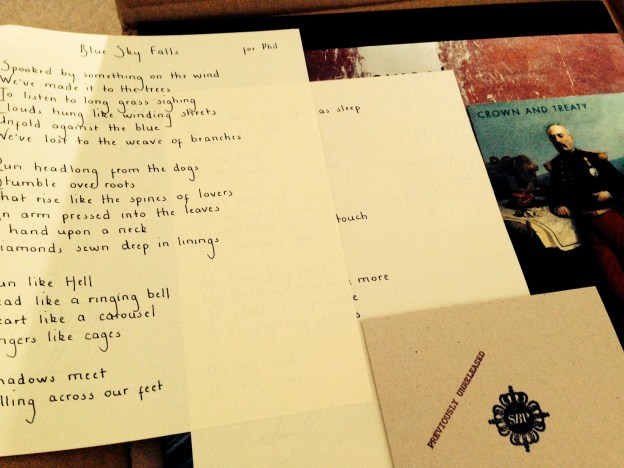
A quick post to show off some rather fine musical swag that arrived over the weekend. I recently signed up to become a “patron” for the new Sweet Billy Pilgrim record which is all pretty exciting as I’ve never patronised anything before; you may insert your own gag about how patronising I am here.

So the deal is that, for the princely sum of £85, you get a signed vinyl copy of their last album (the Mercury nominated, bloody marvellous “Crown & Treaty”), a CD of unreleased music, a hand written set of lyrics to a song of your choice, a pair of tickets to an upcoming gig, and a copy of the new album when it’s finished. There’s a £500 version where you get a private gig in your house which I would love to have stumped up for but the subsequent divorce would have cost even more. More details on all of that here at their website.

SBP loosely hail from Aylesbury (what is with Aylesbury bands and crowd sourcing – has Mark Kelly been running workshops ?) which, in a bizarre way, has always made me feel a certain affinity with them beyond the fact that I love their music. So my £85 was for anyone trying to create something in the Chilterns; be it them, Marillion, or Bill Drummond plotting his latest art experiment. Of the three I figure SBP will probably use the money in the wisest way – Marillion don’t need it so much and Bill might burn it.

I guess the cost, pitched some way above the usual price of a new album, might raise a few of your eyebrows. But what’s a song worth ? If you asked me to put a price on Jeff Buckley’s “Lover, You Should Have Come Over” or Merry Clayton’s vocal on “Gimme Shelter” or John Squire’s solo at the end of “I Am The Resurrection” or the drums at the start of The National’s “Bloodbuzz Ohio” then I would struggle. I have paid money for all of those records so I can tell you the cost to me in buying them but the £10.99 (or whatever it was) doesn’t come close to expressing their value to me.

It’s a question that I asked myself again last year when SBP offered up “Crown and Treaty”, for free. It seemed – still seems – mildly ridiculous to me that something so lovingly crafted and brilliantly executed could be mine for nothing. In particular the closing track, “Blue Sky Falls”, a gorgeous, fragile slow burner, is worth more than that surely ? For each and every time it has lifted my spirits as I picked my way across the countryside separating Amersham from Milton Keynes, driving to work, for each and every moment it has spoken to me of escape, every time that layered, building, intertwining “oh my god” harmony at the song’s climax has raised the hair on my neck and pulled a smile to my face, for all of those times it’s worth rather a lot more than nothing.

Here it is in all its glory:

So £85 seems like fair redress to me. Besides: behold the glorious swag !

Lightly tapping a high pitched drum

33. Less Than You Think – Wilco

About three years ago, over the course of a weekend, I started experiencing the sensation of fullness in my ears, as if I was sat on a plane endlessly circling whilst it waited for clearance to land at exactly the altitude where pressure builds in the ear drum but you can’t release it. When that sensation abated I was left with a faint fuzzy white noise in my left ear, mostly noticeable at night when everything was still and quiet. It was the start of tinnitus and it has never gone away since. I’ve kind of given up thinking now that it ever will.

My tinnitus almost certainly arose as a symptom of dysfunction in my jaw joint (if you find the place that the two parts of your jaw join you may be surprised just how close to the ear it is). To cut a long story short I was a serial teeth grinder and clencher which, over a sustained period, had effectively forced my jaw to try and compensate for a loss of height in my teeth by sliding into a new position. Finding this out was a mixed blessing I guess – my ears themselves are fine, this wasn’t tinnitus induced by loud noise (as per the infamous Pete Townshend example here) – but the underlying problem turned out to involve quite a lot of pain.

Or maybe I should put that another way. Quite a lot of low level but continuous pain. Nagging discomfort in my face, down my neck, sometimes into my shoulder, sometimes up to my eye socket. Nothing that stops me in my tracks but enough to distract, to act almost as a permanent stop on properly relaxing, or properly being present in any given moment. It kind of takes over, or at least it did for a while. Even writing it now I feel kind of whiney, there’s a part of me that keeps saying “ah just get on with it, there’s plenty worse off than you” and whilst there’s a deal of truth in that it’s undeniable that living with constant pain profoundly affected me.

It’s not coincidence that shortly after this all started that I suffered my worst period of depression. Not the twitchy, slightly hyper anxiety of recent months but just a numb withdrawal from the world, a dislocation from everything because it had become too overwhelming. Neither are much fun to be honest but if you made me choose I’d probably settle for the anxiety over the depression; an over stimulated fight or flight response at least means you still have some fight. I went through a period with no fight whatsoever: I think I’d just had enough.

Around the time that the tinnitus started I listened to a lot of Wilco’s album “A Ghost Is Born”. I particularly remember listening to it on the way to and from my frequent visits to a specialist dentist near Marylebone who helped (for now at least) realign my jaw (the problem being temporomandibular joint disorder, or TMJ for short). I’m a long time fan of Wilco, not quite from the “A.M.” days but I had second album “Being There” shortly after it came out, but had struggled a bit to find a way in to the somewhat more oblique “Ghost Is Born”. There’s melody and songs but there’s dissonance and noise too. It’s not the Wilco record you’d take home to meet your parents unless your parents were Thurston Moore and Kim Gordon.

At the time I don’t think I knew a huge amount about Jeff Tweedy, Wilco frontman and song writer, and certainly didn’t know the circumstances surrounding the recording of “Ghost…”. However, listening to it repeatedly it seemed fairly obvious to me then – and definitely now – that the record had pain as a theme running pretty centrally through it. Not even, funnily enough, necessarily in its lyrical preoccupations but it’s just sonically jarring: there’s almost a constant thread of background distortion and regular slashes of noise. In particular, towards the end of the record, is “Less Than You Think” which starts out as a sombre, quiet thing, Tweedy mumbling about “your mind’s a machine, deadly and dull” before shortly collapsing into a twelve minute drone; a background hum punctuated with pulses and whistles and clicks.

It’s not a comfortable listen but it is a stunning attempt, I think, to capture the essence of constant pain through music or sound. It resonates very strongly for me as a straight articulation of tinnitus, of my TMJ problems, and of depression. To be honest I don’t listen to it that often anymore, I find the early part of the drone quite raw now – in fact I’m sat listening to it now and it’s physically uncomfortable. Takes me back to a time and place that I don’t really want to revisit albeit I think that sometimes, in seeking understanding, that I should.

More recently I’ve dug a little into Tweedy’s history and it transpires that, as suspected, “Ghost” had a difficult birth. He has suffered most of his life with migraines as well as anxiety and depression; he believes the former was probably a manifestation of the latter. Whether some of my physical issues – teeth clenching and grinding – have been manifestations of something psychological over the years I don’t know but there’s definitely a temptation to conflate the two. Tweedy ended up addicted to pain killers before getting clean, this record was written and recorded just before that happened, so pretty much at his lowest point. There’s a long piece that he wrote himself for the New York Times (link here) on his health issues which is well worth a read, from that here’s what he says specifically about “Less Than You Think”:

In particular there’s a piece of music — “Less Than You Think” — that ends with a 12-minute drone that was an attempt to express the slow painful rise and dissipation of migraine in music. I don’t know why anyone would need to have that expressed to them musically. But it was all I had.

He also says this on the role music has played for him as a buffer against pain and depression which largely captures, I suppose, what writing the 42 has been about for me:

On a creative level being able to play music and disappear into something as meditative as music can be has been a real blessing in my life.

So, in some respects this is an odd choice. A song that’s mostly not really a song, it’s an extended collage of sounds that try to represent pain that, by my own admission, I can’t listen to very often. It’s telling that I can’t find a video clip of the full track anywhere – the link at the top of the post snips off the drone entirely. If you want to hear it then you’ll have to go and buy (or stream) “A Ghost Is Born”. There’s a ton of other Wilco songs that I love and listen to all the time. You want straight forward Americana tinged rock and roll ? Look no further (Outtasite). You want a sweet poppy love song ? Here you go (You And I). West Coast sunshine harmonies ? Yep (Nothingsevergonnastandinmyway). And that’s before you even get to the masterpiece that is “Yankee Hotel Foxtrot” or the rootsy, stripped back “Sky Blue Sky” or the back to basics fun of “Wilco”. They are a brilliant, brilliant band. But this is my choice because it so specifically articulates a part of my life and it’s almost miraculous to me that it came from a set of circumstances that had such strong echoes of my own. I’m also slightly in awe of how Tweedy, in that state of mind, could express himself so cogently.

Is there a point to this post ? You know, a point beyond my odd need to strip away the façade I seem to have built for myself of being a “strong” person, whatever the hell that means. Stoical. Stiff upper lip. Bollocks to that. I guess the point is just to try and tread lightly, treat people with some kindness: they might be carrying burdens they’ll never let you see.