Category Archives: Flotsam Jetsam

Day After Tomorrow

It’s end of year round up time which has tempted me out of writing-about-music-semi-retirement. In no particular order my three favourite records of 2014 (without checking whether they actually came out in 2014) are: The Delines “Colfax”, The War On Drugs “Lost In The Dream”, and Emily Barker & The Red Clay Halo with “Dear River”. I am obviously getting older as they all have more of a late night sit at home with a glass of wine vibe about them than throwing frantic shapes on the dance floor feel.  The spirit remains willing but the flesh is a little weak and all that.

The Delines record is a Willy Vlautin (of Richmond Fontaine fame) project with Amy Boone singing and it’s a brilliant set of bruised, weary sketches. Vlautin’s usual sharp words and eye for character detail richly conveyed through Boone’s aching, resigned vocals. It’s a pretty determinedly melancholy album but beautiful at the same time. I’ve been scratching around for the right word that sums up its mood and the closest I can get is a Portuguese term with no direct equivalent in English: saudade. A deep, nostalgic melancholic longing. It’s not quite that but that’s pretty close (and a fine word). Wonderful record anyway.

The War On Drugs record has featured a lot in end of year lists and is another heartbreaker – let’s be honest, this is me, Meghan Trainor’s “All About That Bass” was never likely to feature. I was obsessed with this in the early part of the year; a strange mashing together of 80s rock (bit of Springsteen, bit of Rod Stewart, bit of Dire Straits even) and 90s indie. “Burning”, in particular, owes more than a passing debt to “Dancing In The Dark” and “Young Turks” but manages to more than stand on its own merits: if anyone makes their way backwards from it to those records then that feels like a good thing to me.

Last, and by no means least, there’s the Emily Barker album. “Dear River” is a fantastic set of lovingly crafted folk/americana songs spinning out stories of place, identity and travel. Sadly it (for now) appears to be the last album that they will make together and so I feel a little like I arrived at this particular party just as everyone was leaving. I’m really not sure how they slipped under my radar for so long as I’ve been back through the earlier albums from “Dear River” and it’s all brilliant. Barker must be the best kept secret in the UK (and, country of origin, Australia). Possibly it was just me that not having my finger anywhere near the pulse again.

The video at the top of this post is a song that’s not actually on “Dear River”. I was fortunate enough to see the band play in London a few weeks ago, in St James’s church in Piccadilly, and this was my fondest musical memory of the year. On the night itself I was feeling a bit under the weather, was pretty tired, and it was one of those evenings when crawling into bed with a lemsip was looking like an attractive option. We met some friends for dinner before the gig and that pepped me up but, consequently, we were a bit late to the venue and ended up, initially, with a fairly limited view of the stage from behind a pillar. Glorious building, don’t get me wrong. Luckily we were allowed to move up on to a balcony for the main set and sight lines improved hugely but given how glorious the music was I’m not sure it would have entirely mattered.

I’ve tried to write before about the real magic of music to create moments: to bring you precisely into the present, for everything else to fall away. There were lots of those moments in the performance that night but, specifically, when the group played “Day After Tomorrow” (a Tom Waits cover) I was utterly transfixed. It is one of my absolute favourite things to hear something for the first time live that I’ve never heard before and instantly fall in love with it. I sat through this in a church in London, barely breathed for four or five minutes, let tears fall down my face, and marvelled afresh at the bewildering spell craft of music to strip back life to its essentials. Its capacity to really make you feel, to surface and experience emotion. In Emily Barker & The Red Clay Halo’s take on the song there’s an a cappella section in the middle where all the instruments drop out save four voices in harmony. It was the most exquisite, breath taking thing I heard all year. Any sense of being tired, or off colour, or griping about pillars just disappeared.

I don’t think I’ll ever really understand it and perhaps that’s the point. It’s magic I tell you.
10 favourite books

There’s a meme doing the rounds on Facebook at the moment to list out your 10 favourite books. At risk of turning this into Buzzfeed I thought I’d note my choices here, mainly in the spirit of trying to reflect on what, if anything, I could glean about my own writing from my selection of reading. Other than oh-my-god-I-could-never-write-as-well-as-that, of course…

Subject to change on a whim, with a break in the weather, or depending on what I’ve just had for breakfast here are the 10:

One Flew Over The Cuckoo’s Nest – Ken Kesey. This is my all time favourite and the book that fired my entire interest in 60s counter culture in the States. From here I went back to Kerouac and forwards to Tom Wolfe and Hunter S. Thompson. Sadly I never drove across America in a brightly painted bus with flowers in my hair but perhaps there is still time. If you know the film then you’ll know that it is a brilliant thing but the book is far richer and more nuanced. It works as a straightforward story but also allegorically to describe the entire movement Kesey was associated with: a freeing of the mind from tradition and authority. It’s very funny, deeply sad, and, by the end, redemptive and hopeful.

The Lord Of The Rings – JRR Tolkien. Yes it’s somewhat predictable. And yes I have read many fantasy genre books since that I consider “better”. However, this is the one that opened an 11/12 year old me up to an entire genre that has given me significant pleasure and escape over the past 30 years. If there’s a fantasy closet then I’m coming out of it. Two books in and another that’s possibly now more famous for the film version which may say something about either my taste or the steady decline of Western Civilisation. Or both. Either way the films nail the scale and scope but the key to why I love this, which the books inevitably had long before Peter Jackson could speak, let alone speak Elvish, is imagination. All of that stuff. Out of one person’s head. Imagination was Tolkien’s great gift to me.

Unreliable Memoirs – Clive James. I’m not sure if the rules for this list specified works of fiction. I’m not particularly sure that Clive James took much notice of the fiction / non fiction distinction in his collection of memoirs anyway so it probably evens out. This is here simply because the man writes so beautifully; few craft a phrase as eloquently as James and few could guide you through their formative years with such humour, candour, and grace. His command of voice leaves me mildly awestruck – each page is perfectly and consistently him. This is the book that made me look at fifteen odd years’ worth of diary entries and want to chuck them all in the bin.

The Hitchhiker’s Guide To The Galaxy – Douglas Adams. Eminently quotable, much cleverer than it’s given credit for, and extremely funny. I think, reflecting on it, that what I really like about Hitchhikers is the sheer number of ideas in it. Whilst it’s difficult to know how much ended up on the cutting room floor I like to imagine that Adams chucked everything in that was running through his head, inventing ever more complex problems for his narrative to solve. The slight cheat, of course, was that he was writing both SF and comedy so when things got too tough he could always fall back (with a knowing wink) on deus ex machina.

Generation X – Douglas Coupland. I’m instinctively wary of something that had the whole “defines a generation” tag foisted on it but this book caught me at exactly the right time. Reading it in my mid 20s it felt authentic to me at a time when I was wondering what else was. I haven’t read it since and suspect that it may not speak as loudly now as it did then albeit it’s interesting that the central premise of the book – that three disempowered friends tell each other stories as a means of expression – is one that I seem to have unconsciously processed and am vaguely channeling in this year’s writing project.

The Lions Of Al-Rassan – Guy Gavriel Kay. There are a number of fantasy books (other than LOTR) that I could have picked but Kay has steadily worked his way to the top of my pile in recent years. His early work was very Tolkien-esque (relatively unsurprising given that he worked on editing some of Tolkien’s unpublished writing) but he has subsequently mined a richer seam that weaves fantasy with historical fiction. Al-Rassan is set in a parallel mediaeval Spain and chronicles a regional power struggle between various political and religious factions. The central characters are brilliant, it’s tightly plotted, lyrically written, and a fabulous exercise in world building (or, I guess, world borrowing).

The Unbearable Lightness of Being – Milan Kundera. Another book I read in my mid to late 20s and which, I think, stuck with me precisely because it was so overtly philosophical. It was probably the first time I’d encountered a style that very consciously called out the themes that the book was seeking to explore in its narrative, often directly framed to the reader almost as non fiction. I like that authorial voice speaking from the page alongside the narrative voices and I like that this is a book that is unashamedly about the big stuff: existence, love, being, life.

Stoner – John Williams. The newest book on my list in terms of when it was read. This popped up last year to a fair degree of fanfare as a “lost classic” and I picked it up whilst taking a 6 month sabbatical from work. In that sense it’s probably another case of right book at the right time given that it deals almost exclusively in reflecting on the course of a relatively ordinary life and its significance. It’s quite slow, nothing much happens, but it’s breathtakingly beautiful and heartbreakingly sad.

The Great Gatsby – F Scott Fitzgerald. I read it for English Literature A level. I didn’t get it. See also Pride And Prejudice. I had one teacher, a man, who taught me Arthur Miller, dystopian visions of the future, and Shakespeare. I got all that. I had another, a woman, who taught me Gatsby, Austen, and the Romantic poets. For a long time I didn’t get it all. She persevered with my immaturity and wall of rationality until, between us, we knocked it down (or, at least, took a couple of bricks out). Gatsby is magical, poetic, heady, dizzying, and, in a common theme for me, also, at its core, very sad. I love it now, just as I also learned to love Austen, and Keats, and anyone else that understood how to make your heart beat a little faster through words.

Fantastic Mr Fox – Roald Dahl. This is the one I read and read and read as a child. Reading Dahl again now, to my daughter, is a great pleasure but this was the one that I loved as a kid and probably most obviously started me off into all of the other books listed above. I also loved those Enid Blyton books about all girls’ boarding schools as a kid: not really sure what that was all about and perhaps best we let that one lie…

Tomorrow I will remember with a groan something really obvious that I’ve missed out. Let me know in the comments what your favourites are and what I’m missing out on.

O Captain ! My Captain !

In 1865 Walt Whitman wrote a poem mourning the loss of Abraham Lincoln. “O Captain ! My Captain !” sets out an extended metaphor, using its titular captain, dead on the deck of his ship, returning in victory from some battle, as an elegy for Lincoln, killed but victorious, at the close of the American Civil War. 

O Captain! My Captain! our fearful trip is done;
The ship has weather’d every rack, the prize we sought is won;
The port is near, the bells I hear, the people all exulting,
While follow eyes the steady keel, the vessel grim and daring:

But O heart! heart! heart!

O the bleeding drops of red,

Where on the deck my Captain lies,

Fallen cold and dead.

The poem – or at the very least its title – has become closely associated with the film “Dead Poet’s Society”; it is a moniker the inspirational teacher in the film dares his students to bestow upon him, in part a throwing off of the cloying conformity of their regimented school lives as he teaches them to seek new perspectives, find expression, and think for themselves. At the climax of the film the teacher has been dismissed but has to return to the class to fetch some personal effects. A number of students, in trying to say goodbye, climb atop their desks – a perspective shifting trick he’d previously encouraged in them – and call out “O Captain ! My Captain !” in tribute. It’s a scene that always moves me but I accept that, for some, may seem overly schmaltzy.

The teacher – or the actor playing the teacher – was Robin Williams. He died this week, taking his own life at the age of 63. In the shocked aftermath there’s been something of a conflation of the roles he played and the person he was, which I guess is inevitable when there is so much of him in the public domain, and the inspirational teacher figure seems to have struck a chord. That and the irrepressible funny man: the kinetic, slightly manic, lightening fast mind that seemed to spin relentlessly with ideas. 

I’m not going to lay claim to being a huge Williams fan. I like some of his work, in particular his stand up and some of his movies – “Dead Poet’s Society”, “Good Will Hunting”, “Good Morning Vietnam”. I watched “Mork And Mindy” as a kid. Large parts of his work though passed me by – I didn’t find “Mrs Doubtfire” particularly funny and have never been in a hurry to seek out “Patch Adams”. I thought he was one of the good guys but I’d become pretty ambivalent about his films.

So, in some respects, it has surprised me that I’ve dwelt on his death, that I’ve given it much thought beyond noting it with sadness. Except, of course, that Williams suffered from depression and took his own life and if you’ve ever suffered something similar then news like this is like a flare going up from a stranded boat – some vessel grim and daring perhaps – and you feel your eyes drawn to it. I should stress at this point that I am not currently in a bout of depression nor do I have suicidal thoughts: if you’re reading this and you do then please take some time to reach out to people that can help, The Samaritans, Mind, your doctor, a friend or your family. It may not feel like it but things will get better. There’s no shame in letting people help you.

The heavy media coverage has made it difficult to tear my eyes away from that flare even if I wanted to. Some of it sensationalist, salacious, downright irresponsible but some of it at least prepared to try and open up some new dialogue about mental health. Williams doesn’t look like our imagined personification of depression. When Philip Seymour Hoffman overdosed earlier this year – also a long term mental health sufferer – there was a little commentary on the end of another life by a terrible illness. But no substantive change in the narrative: it was seemingly easy to understand his self destruction as another in a long line of tortured, genius artists. Williams, from a media and public perspective, is different. He was a clown, the life and soul of the party, the guy that starred in tender hearted kids’ films. The tragedy, of course, is that in reality they were all too similar: both torn apart by being unwell.

So with Williams’ death we’ve had plenty of the “but how can someone who brought so much joy…”, “but how can someone who had so much…”, “how can someone who was that funny…” questions. Maddening as they are it’s useful, I think, that they’re asked: perhaps this is what it takes to move perceptions. Someone could have everything in the world, could bring endless happiness to everyone, always be the funniest guy in the room, and still be depressed. It does not discriminate. It’s an illness. Sure, we call it “depression” and it’s not as straightforward as that, case to case it doesn’t neatly fit a catch-all, one size fits all categorisation but it’s as arbitrary as cancer, as arbitrary as life. Understanding and empathising with that moves us a long way.

My Captain does not answer, his lips are pale and still;
My father does not feel my arm, he has no pulse nor will;
The ship is anchor’d safe and sound, its voyage closed and done;
From fearful trip, the victor ship, comes in with object won;

Exult, O shores, and ring, O bells!

But I, with mournful tread,

Walk the deck my captain lies,

Fallen cold and dead.

There’s a long way to go: the fearful trip is not done but we have lost another captain. A more open discussion of mental health illnesses might be something positive that comes from this loss. It feels finely balanced at the moment – a mixture of some frank, illuminating stories and reporting that set out the challenges in treating mental health issues, against some lurid, tabloid rummaging through the garbage (“he was sober / wasn’t sober”, “he was bankrupt”, “his marriage was breaking up”, “he was in early stage Parkinson’s”). Some of the good has come from surprising sources – Alistair Campbell wrote an eloquent piece in The Guardian that  strongly echoes my own views – which is encouraging. The more we hear stories from people that we don’t think depression looks like the more we can appreciate that it can look like any of us.

It looks like Buzz Aldrin. Winston Churchill. Someone you know at work. Possibly as many as one in five or one in six people in the UK at some point in their life. The person you love. A lot of people you’ve never met. It sometimes looks like me. It also looked like Robin Williams and we need to keep talking about that until the ship is anchor’d safe and sound, its voyage closed and done. 

Are you alright there ?

“Are you alright there ?” asks the girl with the green hair behind the till.

I set down the books I’m buying on the counter: “Overcoming Anxiety”, “Mindfulness: Finding Peace In A Frantic World”, and “Man’s Search For Meaning”. Oh, and Robin Hobb’s “Ship Of Magic”. Three parts self help, one part pure escapism.

Her question isn’t literal. I know that. It is a very British way of wrapping up “hello” and “can I take some form of payment for those books you’re holding ?”. It doesn’t need a response. Certainly not an honest response; that would be a clear violation of social etiquette. You don’t really tell someone whether you’re alright. Particularly someone  you’ve never met.

But the books… It’s so obvious. It seems too absurd to be asked that question, lay down those books, and not say anything. And she has green hair. I had already decided, in a distracted moment in the queue, that nobody who had green hair could be a bad person.

“Evidently not…” I offer apologetically. “As you can see by my choice of books”.

It hangs there uncomfortably between us. As soon as I say it I feel awful. She clearly now feels desperately awkward. There had been nothing in the Waterstone’s customer service training that covered this terrain. Nothing, frankly, in much of our usual social intercourse amongst strangers that covered it. I was in clear violation of all of the unspoken rules and I knew it and regretted it.

“Well I hope the books help…” she starts. A pause. “I suffer a little with anxiety too so I know what it’s like…”

She leaves it hanging there. What had started as a straightforward transaction – small pieces of paper handed over for larger, bound ones – had turned into a mental health confessional. A tiny, strange connection.

“Books help most things, don’t they ?” I offer back.

“Yeah” she agrees. “And it’s good you’ve got the Robin Hobb. Bit of self help and then a big story to get lost in”. We are silent for a moment as she scans the books and I pay. “Hope they help” she says again, putting the books into a bag, folding my receipt, and handing them both back to me.

“Thanks” I say. Not just for the books but for forgiving my intrusion, for acknowledging my admission, for showing some empathy, some vulnerability, and for liking Robin Hobbs. I didn’t say those bits. My ingrained social etiquette is back in control.

I hope she knew that was what I meant anyway. At the very least I hope I didn’t mess up her day. Our briefest moment of recognition was pretty much the highlight of mine.

Blue Sky Falls

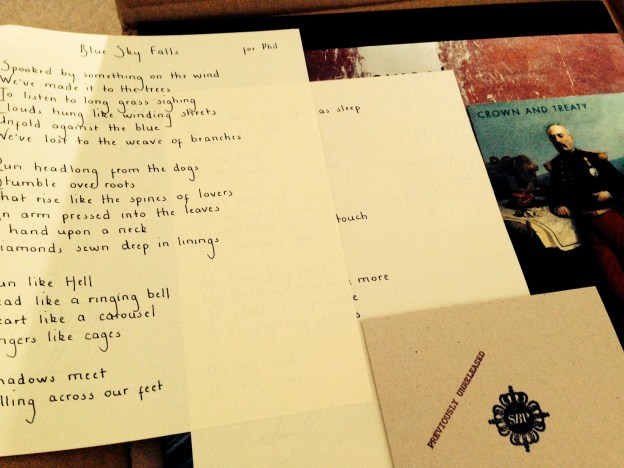
A quick post to show off some rather fine musical swag that arrived over the weekend. I recently signed up to become a “patron” for the new Sweet Billy Pilgrim record which is all pretty exciting as I’ve never patronised anything before; you may insert your own gag about how patronising I am here.

So the deal is that, for the princely sum of £85, you get a signed vinyl copy of their last album (the Mercury nominated, bloody marvellous “Crown & Treaty”), a CD of unreleased music, a hand written set of lyrics to a song of your choice, a pair of tickets to an upcoming gig, and a copy of the new album when it’s finished. There’s a £500 version where you get a private gig in your house which I would love to have stumped up for but the subsequent divorce would have cost even more. More details on all of that here at their website.

SBP loosely hail from Aylesbury (what is with Aylesbury bands and crowd sourcing – has Mark Kelly been running workshops ?) which, in a bizarre way, has always made me feel a certain affinity with them beyond the fact that I love their music. So my £85 was for anyone trying to create something in the Chilterns; be it them, Marillion, or Bill Drummond plotting his latest art experiment. Of the three I figure SBP will probably use the money in the wisest way – Marillion don’t need it so much and Bill might burn it.

I guess the cost, pitched some way above the usual price of a new album, might raise a few of your eyebrows. But what’s a song worth ? If you asked me to put a price on Jeff Buckley’s “Lover, You Should Have Come Over” or Merry Clayton’s vocal on “Gimme Shelter” or John Squire’s solo at the end of “I Am The Resurrection” or the drums at the start of The National’s “Bloodbuzz Ohio” then I would struggle. I have paid money for all of those records so I can tell you the cost to me in buying them but the £10.99 (or whatever it was) doesn’t come close to expressing their value to me.

It’s a question that I asked myself again last year when SBP offered up “Crown and Treaty”, for free. It seemed – still seems – mildly ridiculous to me that something so lovingly crafted and brilliantly executed could be mine for nothing. In particular the closing track, “Blue Sky Falls”, a gorgeous, fragile slow burner, is worth more than that surely ? For each and every time it has lifted my spirits as I picked my way across the countryside separating Amersham from Milton Keynes, driving to work, for each and every moment it has spoken to me of escape, every time that layered, building, intertwining “oh my god” harmony at the song’s climax has raised the hair on my neck and pulled a smile to my face, for all of those times it’s worth rather a lot more than nothing.

Here it is in all its glory:

So £85 seems like fair redress to me. Besides: behold the glorious swag !

One sentence at a time

bookstack

Ever read something that makes you want to put down your pen, close the lid on your laptop, and never dare write another word ?

There’s sometimes a moment, a gut reaction, to something so perfectly crafted that makes me despair of ever getting close, when the gap between here and there yawns to a chasm. I had that reaction on reading John Williams’ “Stoner” last year, specifically during one transcendent scene in which the eponymous lead sits alone in his study, lost in the warmth of the room, gazing at the drifting snow outside. A few paragraphs in which nothing happens but written with such poise, such grace, that you inhabit that room and that character utterly. I had it again watching the opening scene of Aaron Sorkin’s “The Newsroom” last month, a deliberate piece of grandstanding, like the film that blows its entire special effects budget on the first scene or a band that opens their set with their biggest hit. Bold, funny, biting, true, ambitious, fiercely intelligent, and slightly sentimental: typical Sorkin then in many respects. I adore his writing and can only watch in slightly befuddled awe at where it comes from. Does he have that stuff on tap ?

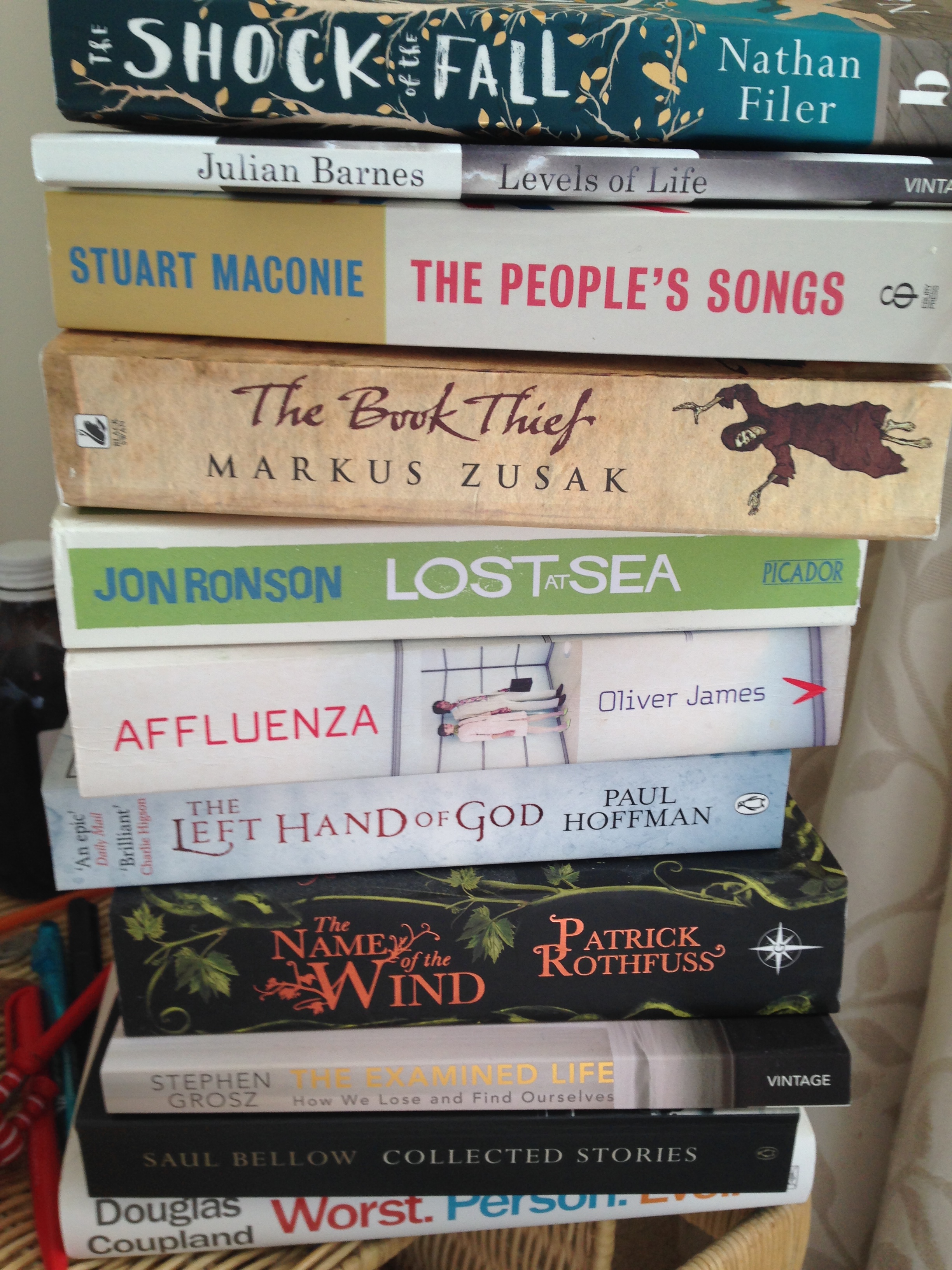
I had it again this morning finishing up Nathan Filer’s “The Shock Of The Fall” which is astonishingly good; blackly funny and deeply sad. There it was, that first thought: I could never do that. He writes the bulk of the novel in a single voice and it is note perfect, a real person come to life across the pages of the book in your hands telling their story of death, and grief, and mental illness. Did I mention that it is also blackly funny ?

I have an idea for a story that deals in death and grief. Right now I feel exactly how I used to feel playing in bands at University, those terrible moments when various guitarists were all together in the same place, casually showing off to each other in their rehearsing: me pretending I was still tuning up so I didn’t have to play anything. I didn’t persist with the guitar, I still play (in so much as knowing a few chords is playing) but I never tried to really improve. I gave up. It didn’t matter to me as much as writing matters to me; it was something I wanted to do but not something that always felt like my best expression of myself. So what if you sometimes feel like the best expression of yourself, stacked up against other work, just isn’t that good ?

As that moment passes – that shit I might as well pack up and go home moment – I allow some different thoughts to take hold. Sometimes, I remember, a sentence comes out that isn’t half bad. That wasn’t one of them by the way. Sometimes I write something that makes me smile, or feels close to capturing what was in my head, or articulates an idea well, or tiptoes its way round being trite or hackneyed or clichéd. Sometimes I don’t serially abuse punctuation. Again, pretty much this whole paragraph doesn’t fall into that category…

Maybe the gap between here and there, between an idea and a book, is in having enough of those fragments – the ones that seem to come unforced, like someone else steals into your mind and places them there – and patching them together coherently, consistently ? You can’t play guitar like that, a single pure note amidst a blizzard of noise (although J Mascis may beg to differ), but perhaps you can write like that. No one ever need hear the noise.

The writing group I joined earlier this year reconvenes next week. I expect I will produce a lot of noise but perhaps, too, some pure notes. Looking forward to it. One sentence at a time.


I’m not like them but I can pretend

You will have your own opinion, no doubt, of Kurt Cobain. I’ve heard most of them before – the range running from “spokesman (or person as he would surely have preferred) for his generation” through to “junkie loser”. Now he seems to just be a face on a tee shirt, like Che Guevara is a face on a tee shirt, an icon or emblem of something (rock and roll ? suicide ? disaffected alienation ?) that’s disconnected from the person.

Twenty years ago today was probably the day he died, his body found three days later on April 8th, 1994. I was in my final year at University and heard the news as I lay in bed listening to the radio. I’m still not entirely sure why but it definitely affected me at the time; it was troubling and shocking and sad. In retrospect my “tribute”, which involved daubing his name on the back of a white football shirt for a 5-a-side tournament I was about to play in, doesn’t seem desperately respectful. But then, it was playful I guess, and perhaps he would have liked that.

I was first aware of Nirvana from my frequent visits to the Kandi Klub in Bristol in the late 80s and early 90s. I don’t remember it exactly but I imagine “Sliver” was probably my introductory point. They made a bigger impression at the Reading Festival in ’91 – about a month before “Teen Spirit” was released – playing a set in the middle of the afternoon that had the site buzzing for the rest of the weekend. Not, mind you, that any of us thought they were about to have a no.1 album in the States – they were just one of “our” bands that had played a great set. Mudhoney played an equally enjoyable set that day and some of the smart money was on them breaking through if anyone was going to.

After success happened Cobain never seemed to satisfactorily reconcile art and commerce for himself; desperate not to “sell out” on the one hand but making choices that left himself open to the charge on the other (major label, the production on “Nevermind”, the video for “Teen Spirit”). It’s frightening how much changed for the band in the space of a year. They were back at Reading in ’92 but this time as headliners amid wild speculation about the state of Cobain’s health (which he lampooned by being pushed out on stage in a wheelchair dressed in a surgical gown). Their performance was good – I don’t have many “I was there” stories but Nirvana at Reading ’91 and ’92 is one of them – but there’s more cynicism. It’s worth listening to and comparing the frenetic run through of “Teen Spirit” from the ’91 set (at about 9 mins in here) to the deliberately mangled take from ’92 (here) when Cobain, at least, was evidently pretty sick of playing that song. The nod to the Boston “More Than A Feeling” steal at the start is still pretty funny though.

It had felt like a victory when “Nevermind” broke, a validation if you felt like you were on the margins of mainstream culture. It’s okay, that victory said, it’s okay to feel a little lost and a little alone and a little like you don’t know what your life is going to be. It’s okay to be vulnerable. He was never a “spokesperson” for me or for anyone I knew but he was someone I could identify with, from the goofing around with his friends to the pain you heard every time he opened out that cracked and ragged voice to sing. And make no mistake, Cobain was a brilliant, brilliant singer if the point of singing is to articulate and express aspects of the human condition. Catharsis is usually the word that gets bandied around when people talk about his vocals; cathartic for us maybe but evidently in the end not for him.

So inevitably it felt like a defeat when he died. Not just died but took his own life (I don’t buy any of the conspiracy theories). He was living in a lot of pain by all accounts and trying to numb it with whatever he could; heroin and, ultimately, a shot gun. Here was one of the guys that had made you feel a little better about being on the outside and he’d not been able to cope. Maybe everything wasn’t going to be okay ?

I don’t, and won’t, glorify his death nor his drug taking but neither will I judge him by those acts alone. I admired his sense of humour, how he took his work seriously but not the stuff around it, his sense of melody married to noise, and the way that he could produce sounds with his voice that spoke to how I felt, even (especially) when I felt pretty dark. I wish he’d been free of pain, free of his mental demons, free to find a way to continue to make music, and free to be with his daughter. I will raise a cup of lemsip (I am currently sick – it seems fitting) in his honour today.

The way I will always remember him is splayed out amongst Dave Grohl’s drums at the end of that ’91 Reading set having launched himself into it as a finale. Kinda cool. Kinda stupid. But happy and alive. Not just a face on a tee shirt. He got up, gave us a grin and a wave, and was gone.

Let me bid you farewell…

11. Brothers In Arms – Dire Straits                                                                When: June 6th, 1944

Before

He’d held a gun before:

Well before June ’44,

Bagging rabbits in the fields near his home.

He gripped it tight as the boat lurched on through the foam.

He’d run before:

Countless miles before the war,

Across grass, through woods; blood pumping, his heart.

Now his legs scrambled on sand as the beach blew apart.

He’d known friends before:

But not like the 48, this Marine Commando corps,

Bunkered under dunes; for respite, to hide.

O’Boyle, the Corporal, lay dead by his side.

I’d been to church before:

Usually head bowed, eyes fixed on the floor;

Not a believer in gods but respectful of men.

Especially one, that after the war, found peace with a Wren.

I’d remembered before:

Silly stuff – an accident, bowling a ball through his patio door

Or watching him wind up Grandma, a sparkle in his eye,

Perfected and practiced as their years had gone by.

I’ll remember again:

A silent two minutes for those lost and those slain.

And the quiet dignity of the man that I knew

Who never asked us for anything but that we live our lives true.

……

For my grandfathers: inspired by the one I was fortunate to know but not forgetting the one that, unfortunately, I barely had time with before he passed away.

It must be the time of year…

9. December – All About Eve                                                             Nottingham, December 1996.

A short story.

This feels true. It isn’t, of course. I know that. She would know that. The details are all wrong and nostalgia and memory aren’t the same thing. But you don’t know that. All you need to know is that once upon a time we tried again. Failed again.

……

I think it must be the time of year; it had started in late Autumn. Back then we were two chronically shy souls tentatively finding each other; the falling leaves marking our own inexorable falling in love. There was an awkwardness between us, somehow in us, at first which held a certain naïve charm. An innocence. I don’t know, maybe we were just foolish kids. It had ensured that those beginnings had run on from October into December, two months of careful courtship – our painfully slow reaching for each other as old fashioned as that word implies.

So this time of year always brought it back, the magical blaze of the beginning sustained over those months that ran from fireworks to fairy lights – the world alive with lights in the darkness.

It had ended a handful of years later in the same span of months; still those clear, crisp skies, and the aging sun hung low, but now with a snap and bite to the wind. Still discernibly Autumn but withering into Winter.

And now here I was, lost and lonely, reaching for her again across the years, looking for what we’d once had. Choosing to be blind to the reasons why it had failed the first time, the second time, all of the times. I reached for the phone, dialled a number. The brief silence before the dial tone sounded was enough to give me pause and I hung up, put the phone down again, picked up a bottle of cheap red wine and poured another glass.

Eventually I reached again for the phone. Dialled a number.

……

She had stayed for the weekend as usual – it had become our habit over the past six months. She’d even stayed on Sunday night which was less common as it meant an early start for her long drive back south to make it to work on Monday morning. Neither of us could have known for certain that it was our last night together, lying there squeezed together on my single bed. If we had would it have been different ? Would we have made love, reconciled to the end and spending those last moments lost in each other ? Perhaps we’d have talked, spent the time making sure we were right that this was the end, that there wasn’t some way we could make it work that we’d missed ?

I don’t think we’d have talked. We’d never spent our time together talking, never found a way to open ourselves up honestly and ask for what either of us needed. We wrote, that was what we did. Even in those beginnings we wrote to each other, exchanging letters in person, the sender waiting nervously as the recipient read. It was the only way we found to express ourselves. The next day would bring a reply – a conversation played out over days, in slow motion, that might have taken minutes if we’d been able to break the silence. Perhaps we imagined ourselves characters in one of the Austen novels we’d been studying. Maybe we were just foolish kids.

Things had briefly flared again in those last months, occasionally a spark catching flame in the dying embers, but ultimately turning to ash. Picking our way back across familiar ground felt good at first, a small reminder of the rush of being sixteen and falling headlong into first love. But we weren’t sixteen this time. Besides, even when we had been the evanescent rush hadn’t sustained us once that initial thrill had passed. Don’t misunderstand, I’m not denying the truth of what we felt that first time: it was something extraordinary. You only fall first once and we fell so hard we were left gasping for air. But this time ? Could it be taking our breath away again ? Were we just clinging on to the feeling of being in love or were we really in love ? That I even wondered seemed to suggest an answer.

She left before dawn as I slept.

……

When I got up I found that she’d left a letter. Carefully placed where it couldn’t be missed. A letter to say all of things that we couldn’t say. Just like in the beginning, just like always. It was a letter of the future, talking of all the things she would do, all the places she would go, all the dreams she still had. She wanted to move on with her life and was asking if I wanted to come along.

I knew that I didn’t.

I knew but it broke my heart all the same.