I’m three years in to this blog now and have sporadically produced an end-of-year round up of my favourite records at year end. Okay, I’ve done it once. This will make it twice. Two out of three ain’t bad as Meatloaf wisely attests.
There’s no getting past the fact that it’s been a dreadful year. The world has gotten uglier, more stupid, and less tolerant. Irrespective of your personal perspective on, say, Brexit or Trump it’s been a year characterised by a dearth of reasoned, fact based, rational discourse. We are all a little poorer and democracy is ill served by a toxic environment where lies stand as truth and dissenting voices are shouted down as traitors.
In “normal” circumstances the dumbing down and drift (lurch) right of our politics would have been enough to tip this year into the debit column. And, sure, we lost some fine people too. Bowie, Cohen, Prince. How’d I get through the 42 records thing without room for any of them ? All of that marked 2016 as rotten. But all of that, personally, ended up being nothing.
I lost my mum this year. I’m old enough at 44 to have known her a long time. In brighter moments I take some comfort in that but it’s only been three and a half months and there haven’t been many brighter moments. I’ve written about loss and grief elsewhere in these pages and it has seemed an easier thing for me to access or articulate in the abstract. I have exhausted metaphors involving the sea or the weather but it’s interesting that they were the props I reached for. There is something vast and overwhelming about the loss of a parent, even as an adult, that means you reach for things equally vast. I’ve written about depression a lot on these pages as well and there’s some equivalence in the feelings but they’re not the same. I guess the symptoms present in the same way but the root cause is different. Mum used to read my words and I suspect they were a route in to her hearing from me, understanding me. I’ve never been a great talker. I don’t regret. I can’t change the way I’m wired but I hope (I think) that she knew me a bit better as an adult by reading my ramblings about records and my sporadic, random stories. I miss her as my best reader but most of all I miss her as my mum. She was the best one anyone could have.
So my three stand out records of the year (the year being when I experienced them and not necessarily when they came out) entirely reflect all of the above. First up, Marillion’s FEAR (Fuck Everyone And Run) deals in an angry, anxious reaction to the banking crisis, to changes in global politics, to a world in which divisions between rich and poor deepen and grow. It’s breathtakingly good. Broad in scope but personal and relatable, musically rich, technical but emotional. It won’t get much credit in the end-of-year lists because Marillion have long been abandoned by the mainstream music press but it’s a remarkable statement and a career high for a band that have already scaled a few anyway.
Second is Nick Cave’s “Skeleton Tree”. It was released after the death of his son (and partially written after that event, though not entirely) and is devastating. I’m not sure in any other year whether I’d have had the appetite to listen to Skeleton Tree very much. It’s too raw and too painful but I found it a conduit for my own feelings. A lot of stuff felt very trite this year in comparison to “real life” and this record was anything but.
And finally there’s Tim Minchin’s “Matilda” soundtrack/score and, in particular, the song “When I Grow Up”. The musical is an utter delight and I think I found its overtly clever lyrics a tonic in this post-truth year of all years. I’m well aware that the musical particularly speaks to me as a father of a smart, sensitive daughter and that I have become overly sentimental in my middle-ish age. However, “When I Grow Up” kinda sums up the year for me. On the face of it it’s a singalong call to be older, to get to “eat sweets every day” and do what you like – the imagined liberation of being an adult from a child’s perspective. Inevitably it’s more complex than that and I can’t listen to the song without feeling an extraordinary sense of sadness and pathos in the lines about being old enough to carry all the things you have to carry as a grown up, about being able to fight off the monsters under the bed when you’re a grown up. There are lots of markers of being a “grown up”. Formal ones like turning 18 or 21. Or informal ones like buying your first home or getting married or having children. Or losing your mum. I wish, I really wish, that you did get to easily fight off the monsters under the bed when you grow up and I really, really wish you learned to carry all of things you have carry but it’s not as straightforward as that. This year they all got a lot heavier. This year I got to be a grown up and I’d give anything to be able to be a child again.
Go listen if you’re so minded. They’re all great records although none will make the playlists at many Christmas parties. But it hasn’t been that kind of year.
A quick post to show off some rather fine musical swag that arrived over the weekend. I recently signed up to become a “patron” for the new Sweet Billy Pilgrim record which is all pretty exciting as I’ve never patronised anything before; you may insert your own gag about how patronising I am here.
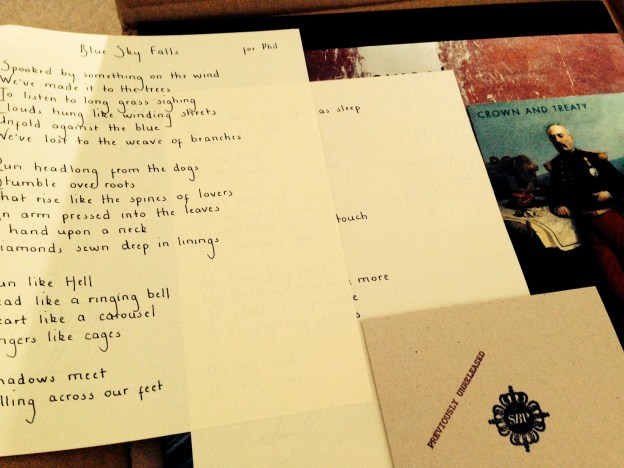
So the deal is that, for the princely sum of £85, you get a signed vinyl copy of their last album (the Mercury nominated, bloody marvellous “Crown & Treaty”), a CD of unreleased music, a hand written set of lyrics to a song of your choice, a pair of tickets to an upcoming gig, and a copy of the new album when it’s finished. There’s a £500 version where you get a private gig in your house which I would love to have stumped up for but the subsequent divorce would have cost even more. More details on all of that here at their website.
SBP loosely hail from Aylesbury (what is with Aylesbury bands and crowd sourcing – has Mark Kelly been running workshops ?) which, in a bizarre way, has always made me feel a certain affinity with them beyond the fact that I love their music. So my £85 was for anyone trying to create something in the Chilterns; be it them, Marillion, or Bill Drummond plotting his latest art experiment. Of the three I figure SBP will probably use the money in the wisest way – Marillion don’t need it so much and Bill might burn it.
I guess the cost, pitched some way above the usual price of a new album, might raise a few of your eyebrows. But what’s a song worth ? If you asked me to put a price on Jeff Buckley’s “Lover, You Should Have Come Over” or Merry Clayton’s vocal on “Gimme Shelter” or John Squire’s solo at the end of “I Am The Resurrection” or the drums at the start of The National’s “Bloodbuzz Ohio” then I would struggle. I have paid money for all of those records so I can tell you the cost to me in buying them but the £10.99 (or whatever it was) doesn’t come close to expressing their value to me.
It’s a question that I asked myself again last year when SBP offered up “Crown and Treaty”, for free. It seemed – still seems – mildly ridiculous to me that something so lovingly crafted and brilliantly executed could be mine for nothing. In particular the closing track, “Blue Sky Falls”, a gorgeous, fragile slow burner, is worth more than that surely ? For each and every time it has lifted my spirits as I picked my way across the countryside separating Amersham from Milton Keynes, driving to work, for each and every moment it has spoken to me of escape, every time that layered, building, intertwining “oh my god” harmony at the song’s climax has raised the hair on my neck and pulled a smile to my face, for all of those times it’s worth rather a lot more than nothing.
Here it is in all its glory:
So £85 seems like fair redress to me. Besides: behold the glorious swag !
The point of the 42 is not to rate things and, as a rule, I fight shy of reckoning one particular record as “better” than another. It usually strikes me as a false comparison, like saying tomatoes are better than cucumbers, or red is better than green.
I will make an exception here.
“Exile On Main Street” is the greatest rock and roll album ever recorded. It is. I’m happy to discuss it but, to paraphrase the late, great Brian Clough, we’ll talk about it for twenty minutes and then agree that I’m right. Or I’ll just play you “Tumbling Dice” and four minutes later we’ll agree that I’m right.
There has been a distinct lack of swagger in my list of records so far. Plenty of late night navel gazing, plenty of bottom-of-the-glass laments to what might have been and plenty of reflective moments of sobriety. You can stack the previous 23 records in all their contemplative angst ridden glory up against this and it redresses the balance on its own.
This is swagger writ large. It’s savouring the taste of draining your glass and not staring mournfully at the bottom of it but sliding it across the bar for another. It’s sexy as hell and, for its duration, will convince you that you’re sexy as hell too. It’s suss and street smarts and it’s never going home at the end of the night alone. Burn your copy of “Feel The Fear And Do It Anyway”. Buy this record, play it often, and let it arm you with its unshakeable confidence.
This is my favourite Friday night song. It’s my job interview song. It was my yes-I’m-going-to-call-her song. It is guaranteed to get me onto any dance floor irrespective of the deteriorating state of my surgery sodden knees. Moves like Jagger ? You better believe it. Doesn’t matter if you don’t ‘cos the magic of this song is that it makes you believe. Honestly I suspect that I look like a constipated, arthritic peacock when I sashay around my house to this, hips shaking, hands clapping, head nodding in a strut. I suspect that’s the reality but I don’t believe the reality. I believe the myth this song creates for me. I am a dancefloor god made flesh when this song plays. This – and follow these links, they will make your life better – is me. And this. Maybe even this.
There’s a whole lot of stuff I could write about “Exile…”. The villa in Nellcote. Tax exile. Marianne Faithful. Gram Parsons. Recording all night in the basement and sleeping all day: the sunshine bores the daylights outta me indeed. It’s a great story – go read about it, Robert Greenfield’s “Exile: A Season In Hell With The Rolling Stones” is as good a place to start as any. But a detailed and sober analysis of this record – of this song in particular – just isn’t in keeping with the spirit of what it does for me. There’s no thinking. It’s all feel. (Now we’re paraphrasing Bruce Lee).
This song works in the gut, in the feet, especially in the hips, and the only thing it asks your head to do is nod appreciably. It’s the exact opposite of everything Marillion are about from the last post. Try having sex to a Marillion record. Those time signatures are all wrong. Try having sex to “Tumbling Dice”. Notice the difference ? Now try “Ventilator Blues”. Oh my god. Charlie Watts sliding in just behind the beat. That’s the best sex you’ve ever had in your life.
You can’t blame the Stones for everything that happened after this record. For Aerosmith. For hair metal. For Dogs D’Amour. I don’t even really blame them for becoming the corporate brand that they are now – would be interesting to know what Keith would have said to you if you’d told him in 1972 that he’d wind up playing a caricature of himself in a kids film about pirates because one of the other pirates was modeled on him. I imagine he would have – as in my all time favourite Keith clip on the internet – chopped the mother down.
You can’t blame them because once they were the best band on the planet. I’ve long since frozen them in time and the Stones exist for me as their ’69-’74 incarnation. The one that makes me move and makes me feel more alive.
Marillion are probably the least “cool” band in the UK. Certainly the least covered in the mainstream music press these days considering the size of their fan base. I suspect they don’t care and more power to them for that. They were a big, big band for me as a teenager, presumably hooked in by “Kayleigh” in ’87 (some fine hair in that video) and then going backwards into the first two albums, “Script For A Jester’s Tear” and “Fugazi”. I don’t actually remember my route in but it must have been via the singles from “Misplaced Childhood” – they were probably the archetypal “handed down from older brother” kind of band but I didn’t have an older brother. I do vaguely recall liking a girl called Hayley at around the same time and I’m trying hard to suppress a memory of changing the chorus to “Kayleigh”* to fit my unreciprocated love. Sadly, a recurring theme of my teenage years. The lack of reciprocation, not the changing of lyrics to the chart hits of the day…
To fully immerse myself in this post I decided to listen to all of their studio albums, in order, up to and including “Marbles”, from which “Fantastic Place” is taken. That’s 13 records. It took me a couple of days and I did cheat a bit on day 2 when I had to listen to something else just to break things up. What struck me was the disconnect in my head between the two versions of Marillion – with Fish, with Steve Hogarth – and the reality. Fish era Marillion was the one that I grew up with and I was still a fan during the transition as Hogarth became the vocalist – in fact, the only line up I’ve seen live was with Hogarth round about “Season’s End” and “Holidays In Eden”. I still think of the band’s output as split roughly equally between the two singers but in actuality Marillion has long ceased to be Fish’s band. Albums with Fish: four. Albums without Fish: thirteen (counting the “Less Is More” acoustic re-workings album).
I lost track of the band just after “Holidays In Eden”, the second post Fish record. Listening back to it now it has its moments but it’s a little polite, particularly for my tastes back in 1991 when I was in thrall to fuzzed guitars and singing wasn’t singing unless it was a cathartic scream for understanding. Ironically the follow up, “Brave” is a fine record – a concept album about a girl found wandering on the Severn Bridge, unaware of who she is or how she got there – and I should have given it more of a chance back in ’94 when it came out.
There’s then a run of five albums between ’95 and ’01 which I’d never heard. This run also marks the point at which the band moved away from a traditional record label model for recording and distributing their music towards an ahead-of-its-time version of fan funding. I don’t know if they did it first but Marillion were certainly doing Kickstarter before anyone had even heard of Kickstarter. There’s an interesting Tedx talk from Mark Kelly (the band’s keyboardist) on crowdfunding on the band site: here.
Hearing these records for the first time, in sequence, was an enjoyable experience. A few songs popped out straight away as warranting further attention and “This Strange Engine”, in particular, as a complete album is one that I will go back to. Marillion don’t tend to write immediate songs though so repeated listens often repay; it’s music to sit and soak in rather than stuff to stick on in the background while you’re doing something else.
Those five take us up to “Marbles”. About three years ago I had noticed that a friend (who had been a fellow Marillion fan at school) had been listening to a couple of their songs that were unfamiliar to me – via last.fm, the marvelous music-meets-stats website (my profile is here). This piqued my curiousity and I found the songs on a streaming site. One of them would have been “Neverland” which I immediately fell in love with and subsequently ordered the album direct from Marillion.com. Who says streaming services don’t work ? Artist royalties is perhaps a debate for another time…
“Marbles” is a wonderful record. Built loosely around recurring themes of madness, escape and the loss of childhood innocence it showcases the band at its best – I think it’s their career highpoint (although “Clutching At Straws” from the Fish era is also a brilliant record). Those recurring themes, eagle eyed regular readers of this blog will have observed, are like cat nip for me but they wouldn’t be enough on their own for the record to resonate. Sometimes, for me, like quite a lot of what you might term prog, Marillion can lose the balance between a song and something that extends for its own sake. Sometimes the sounds don’t seem to be going anywhere. That never happens on “Marbles”. Never happens on the 13 minute opener “The Invisible Man”, never happens on 12 minute closer “Neverland”. And even never happens during the 17 minutes and 57 seconds of “Ocean Cloud”. Everything here, every note on this record, is perfectly judged, immaculately played, and serves each song. There’s nothing extraneous which is no mean feat given the length of the album.
There are four or five tracks on the record that I really love, particularly the stellar closer “Neverland” (well worth your time, linked on the Neverland reference above) but “Fantastic Place” is the one I have taken refuge in more times than I care to remember. Sunk into it and let it spirit me away. A song about escape that I use to escape.
As is becoming a recurring theme in this list my relationship with the song doesn’t rest on a literal read of the lyrics although there are themes here which resonate, notably about opening yourself up to somebody (say you understand me and I will leave myself completely; I’ll tell you all I never told you, the boy I never showed you) and the idea of release from everyday life (take me to the island, show me what might be real life; put your arms around my soul and take it dancing). This song, for me, is all about how it builds. It’s similar in some ways to where we started, way back with Warren Zevon and “Desperados Under The Eaves” – a self contained journey from disillusionment to the potential of something better.
“Fantastic Place” is a slow burner, from the muted, subdued opening – Hogarth almost murmuring the verse – through choruses that progressively grow in scope musically; it swells like a wave building until finally breaking into the bridge. That section as the bridge lyrics run over into the guitar solo (say you understand me and I will leave myself completely, forgive me if I stare but I can see the island behind your tired, troubled eyes) is breathtaking. It’s not rare for a song to make the hair on the back of my neck stand up but it is rare for the same song to do it, in the same place in the song, every single time I hear it.
Then we’re into Rothery’s gorgeous solo (his playing throughout “Marbles” is exquisite) before the song just continues to soar through to its close. Hogarth’s vocals on this track are also worthy of special mention, particularly in the very final section where he pulls off a performance that’s technically spot on (in so far as these ears can tell such things) but that wrenches something genuine out of his guts. I deliberately posted a live version at the top of this as it’s worth watching Hogarth perform it and his reaction to the song as it finishes – he is utterly lost in it and it’s a touching moment seeing him almost return to the room, back from wherever the song has taken him.
There is a magic in this song, a transformative, transportative magic. Strong enough to make up the word transportative and strong enough to carry me away when I need to be carried away.
* Given that Fish allegedly wrote “Kayleigh” about an ex girlfriend called “Kay Leigh” I think I’m in good company. She’ll never guess, Fish.
 42 @ 42